


Religion of the Garden: An Interview with Luis Eduardo Luna
Religion of the Garden: An Interview with Luis Eduardo Luna
Luis Eduardo Luna, Director of Wasiwaska, Research Center for the Study of Psycho-integrator Plants, Visionary Art and Consciousness

Religion of the Garden: An Interview with Luis Eduardo Luna
Transcript drawn from an interview with Luis Eduardo Luna and his Psychedelic Intersections keynote. It has been edited for length and clarity.
Jeffrey Breau: In your “Psychedelic Intersections” conference keynote, you shared that your encounters with the cannabis plant and yagé [an Amazonian plant brew similar to ayahuasca] caused you to abandon your “militant atheism” and to rediscover spirituality. Can you share more about how what happened?
Luis Eduardo Luna: I was born in the Colombian Amazon. Well, it was the Amazon at that time because the forest in the Caquetá region was still almost intact when I was born. This area has now been heavily deforested, mostly due to cattle ranching. In my early childhood, my town, Florencia, had no running water and no electricity. At 13, my parents had the idea to send me to a seminary in Bogotá, and when I was 18, I was sent to Spain to study philosophy and theology. I lived for two and a half years in two monasteries in northern Spain. Then, I left the seminary and went to Madrid to study at the Universidad Complutense de Madrid.
In 1971, something important happened to me. I went back to Florencia for holidays after seven years of absence. There, I met Terence McKenna at a bar. He was trying to order something to eat in bad Spanish. I approached him and said the magic sentence, “May I help you?” That changed my life.
We stayed two months together. My parents had a little house some 12 kilometers from Florencia, which is where Terence introduced me to Santa Marta Gold, a particularly strong strain of cannabis. At the time, I had been drunk only once in my life, when I was 13. I didn't know anything about this kind of thing. So, when he said, “Try this grass; this cannabis,” I said, “OK, fine.” If he had called it “marijuana,” I would have said, “Oh, no, no, no.” Later, I learned that cannabis was the same as marijuana. I had no idea!
Before meeting Terence, I had gradually abandoned all thoughts about being a priest; it was already out of my system. When I smoked that grass, it was suddenly like a rediscovery in a way of my inner self and the mystery of existence. It was theoretically always there; it was the reason why I was interested in philosophy. But it's different when you have an experience that you cannot explain in terms of the normal, everyday way of looking at reality. So that was like an opening for me. I said, ‘OK, there is something else.’ And I recovered a sort of spirituality.
Later, Terence and I took yagé as well. Since childhood, I knew an Ingano shaman whose name was Apolinar Jacanamijoy, or Don Apolinar. He was originally from Mocoa but had moved to the Caquetá region. Terence and I took some yagé that Don Apolinar had prepared, though he was not there. I had visions of a place similar to the Garden of Delights of Hieronymus Bosch. I became very interested in the experience and said, “OK, I want to know what is yagé.” And so, I went to see Don Apolinar. He told me, “If you want to learn about yagé, you have to come with me, keep a certain diet, take yagé for 40 nights, and then he [yagé] will come.” I asked, “How does he look like?”
“He's a little man. He's simpático,” Don Apolinar said.
JB: You’ve said your spirituality is best described as animism. Was this the type of spirituality you recovered after those experiences?
LEL: My thinking about animism has been gradually evolving. Even the term ‘animism’ I started to use it only some years after doing fieldwork in Peru.
In 1979, I went back to Florencia after yet another seven years away from the country. I went with a brother all the way to Yurayaco, where Don Apolinar lived. I drank yagé for the second time, and that experience marked me forever. I thought I became a serpent. I was moving like a serpent, feeling like a serpent. I listened to the frogs out there, and I thought, ‘I will chase those frogs.’ At the same time, my, let’s say, “other self” was saying, “What are you doing? What is happening? What is your mother going to think about this?” Having two minds at the same time made me think that, somehow, your mind can travel into something else to see and perceive the world through another way of looking.
I wanted to make a film about Don Apolinar and his family, but he died some months after I was there. Advised by Terence, I went to Iquitos, where I met Don Emilio Andrade Gómez and took ayahuasca, which is the vine Banisteriopsis caapi but with a different plant, the leaves of Psychotria viridis. In yagé, the admixture plant is Diplopterys cabrerana. While there, Don Emilio1 told me, “Ayahuasca is a doctor, and other plants are doctors. Tobacco is a doctor. Bobinzana (Caliandra pentandra) is a doctor, Ojé (Ficus insipida) is a doctor. These are all doctors.” In Iquitos, I again came to the idea that these plants are intelligent beings capable of teaching us.
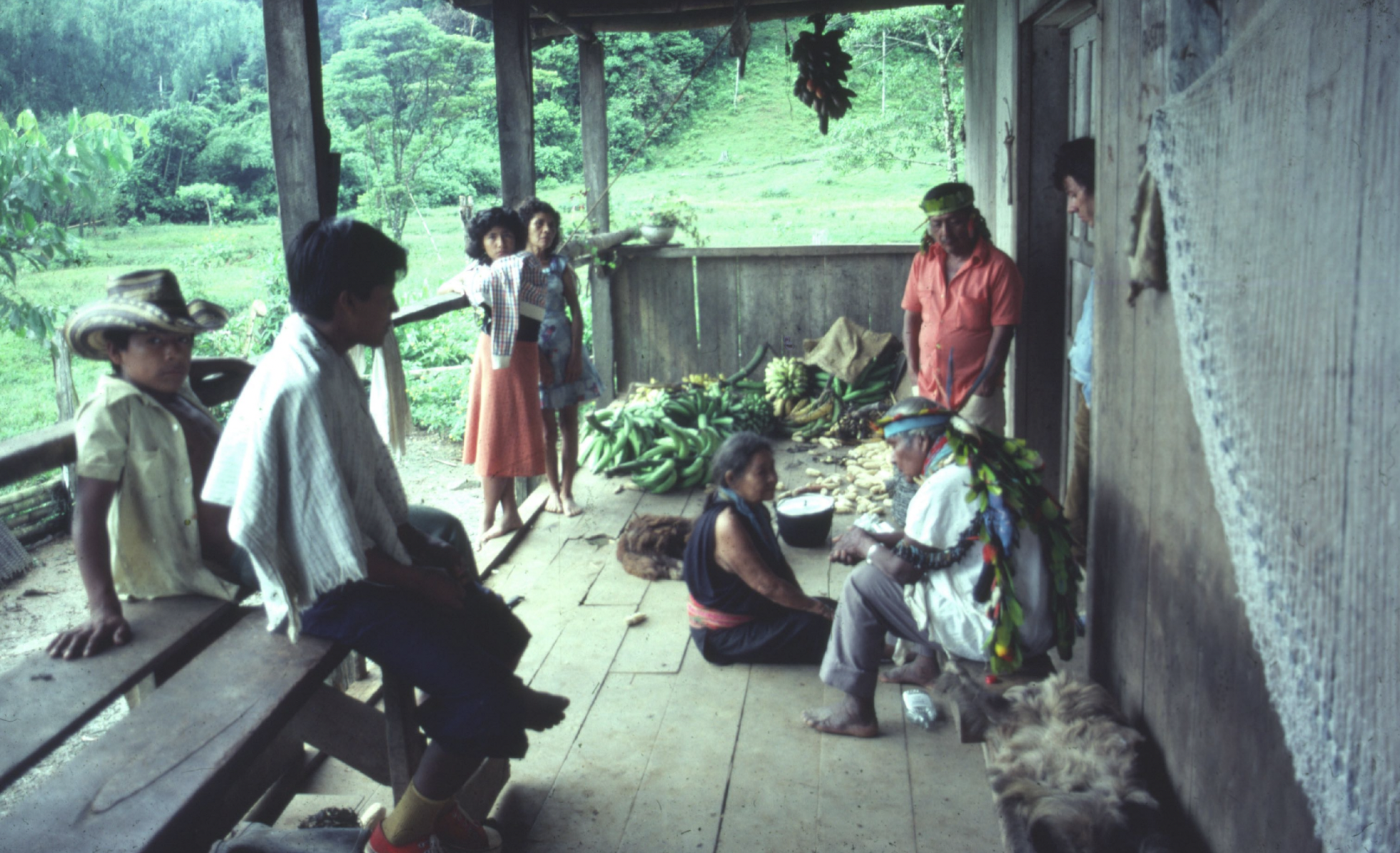
Don Apolinar Yacanamijoy and his family. Yurayaku 1979.
JB: Does seeing the world through another being's mind change your relationship with the natural world?
LEL: We look around us, and we conclude that the world is just like we see it. But of course, for every animal, for every organism, the world is completely different. We know that we have our limitations as human beings. We are jealous that birds can fly and we cannot. The world of the ant, of the bird, of the amoeba is completely different. Shamanism, perhaps, is a way to extend our abilities, to become something else, and get information from the point of view of another organism.
Nowadays, I prefer animism to any religion. And I think that animism is like a common ground; you can be Buddhist, Hindu, any religion. Animism is not an ideology; it's not a religion. It is based on observation. It is just a relationship. I prefer that kind of approach nowadays.
My religion now is the garden. The garden and all the beings that are coming to the garden: the birds, the insects, and the reptiles. They are all coming to the garden. That, for me, is more important than words and dogmas and this kind of thing.
JB: You spoke in your keynote about your garden and the diversity of life represented there. You gave the example of the complexity of ayahuasca brews, which contains many different admixture plants and reflects the diversity of the Amazon. Can you share more about this?
LEL: Ayahuasca is used as a way of learning about the effects of other plants. It's enough to put a little bit of the bark, the root, the leaves into the brew. From the point of view of the Indigenous people, you are getting in touch with the spirits of those plants. Everything is alive; everything has mind. The same way that ayahuasca is used for the diagnosis of illness, it is also used to learn about these other spirits. In a way, the possible admixtures are infinite because you can add anything. It's a way to learn about other plants.
JB: What is being learned?
LEL: From the Indigenous point of view, you get in touch with the spirit of the plant. And the plants will tell you what they can be used for.
I spent some time doing the diet and taking ayahuasca. I was interested in the plants. I used to collect plants and send them for identification. When I was with Don Basilio, a Shipibo shaman, he said, “If you know the song of a plant, you don't need the plant.” They learn certain songs, and those songs are like the quintessence of the plant. The song itself will do the healing, which is extraordinary to think. From the point of view of Western science, how can molecules become melodies? And how can melodies do the same thing as molecules?
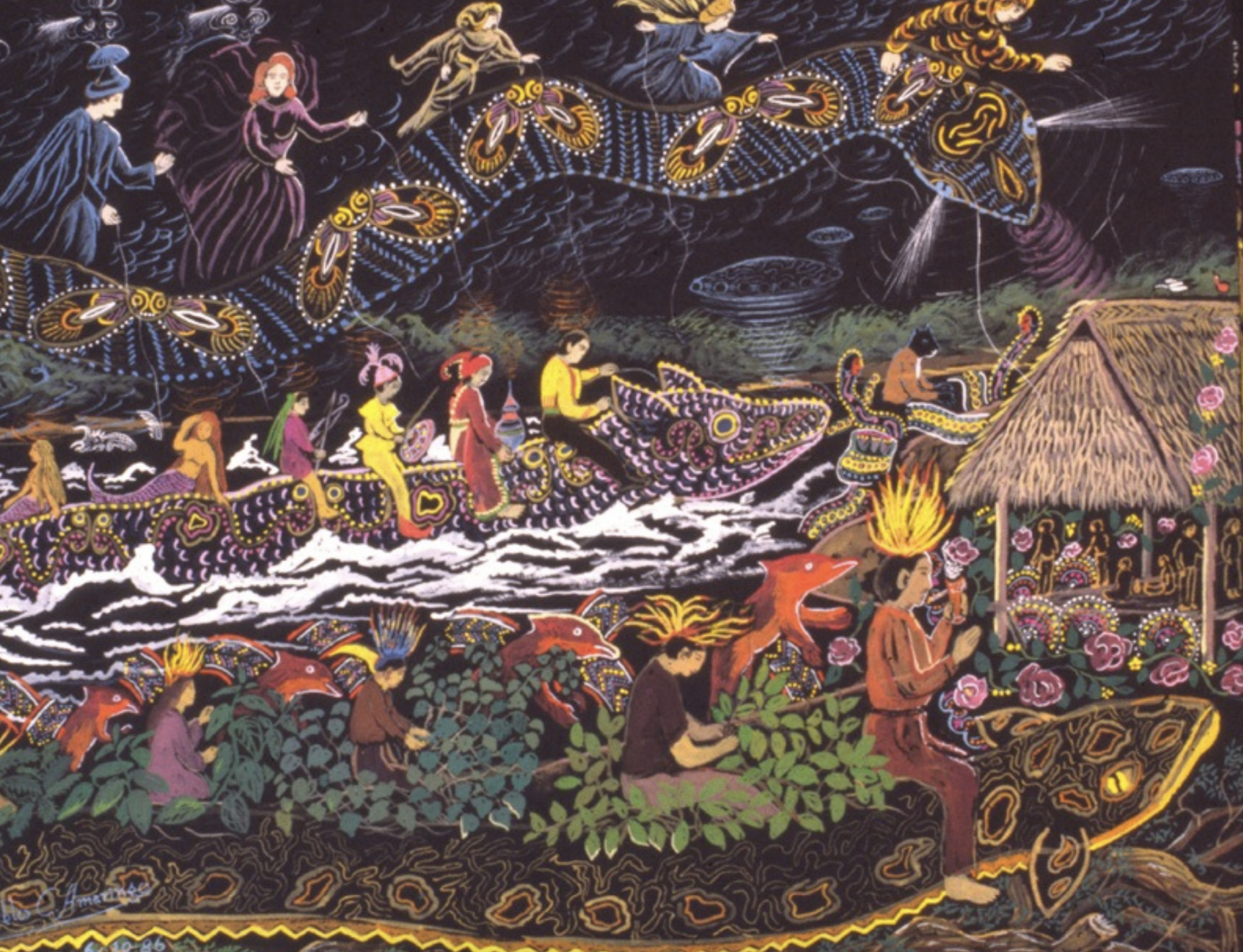
Painting by Pablo C. Amaringo, 1986.
JB: You said that one cannot understand the Amerindians without understanding their relationships to sacred plants. What do you mean by this?
LEL: If you go through the different ethnic groups in the Americas, there is immense cultural diversity. Tobacco is almost always there; it is one of the sacred, perhaps even the most sacred plant, from Canada to Tierra del Fuego. It's a sacred plant. It is a being. Besides the effects of tobacco, Nicotiana rustica is not the same as smoking a cigarette at all. It is used ritually and believed to be the food of the spirits. Some indigenous people say that when you smoke tobacco, the smoke goes all the way to the Milky Way. We know that it is a psychoactive plant; just drink some tobacco, and you will see.
The same for peyote and ayahuasca. They use the peyote and always considered it a sacred teacher. I think that we [Westerners] have neglected, or we have not noticed, the associations that all these people have with plants that alter your consciousness in one way or another.
Perhaps this comes from Westerner’s little interest in the plants themselves until very recently. The anthropologists, and especially the English working in Africa, would write, “They use some herb,” but they were not interested in identifying the herb. If you’re lucky, you might get a study of the plant, but it is described as if it was just some kind of object. The effects were not important because, from the point of view of the Western mind, those effects were just superstition or ritual. This is just wrong epistemology.
JB: How do the relationships between people and a sacred plant, like tobacco, differ across cultures? For example, in an Indigenous South American context versus a European context?
LEL: First, tobacco has been completely secularized [in the West]. An approach to tobacco as a sacred plant is completely disappearing. As we know, the tobacco companies are interested in getting people to smoke as much as possible. They add hundreds of additives and create an extremely addictive thing that causes people to die of cancer. This is completely paradoxical. As a sacred plant, tobacco is used medicinally. There are so many different uses, but it was appropriated by the Western culture and formed into an addictive object. People die of it. It is completely different. We, in the West, have lost the relationship with the sacred plants.
In the witch hunts, for example, it was a persecution of women who were considered dangerous because they knew about plants and fungi. They knew how to cure but also how to kill, and this kind of knowledge was associated with the devil. So, there has been this long tradition of persecution of those with plant knowledge in Europe, likely since the persecution of paganism. The natural world became a resource, nothing else. There is nothing sacred. We destroyed all subjectivity in nature. If you destroy subjectivity, there is no moral imperative towards the vegetal world. You can do whatever with an animal or a plant because they are basically objects. This is Descartes’ idea: only human beings, angels, and God have spirit. Everything else is a machine.
JB: You note the incredible richness of both biological and cultural diversity in the Americas, especially the Amazon. How do you see these two forms of diversity complementing one another?
LEL: For the first, we have the biological diversity in the Amazon, which is enormous. Now, I don't want to put the biological diversity here and the cultural diversity there, like two different worlds, because they intertwined. In great part, the Amazon is the product of the intervention of human beings through thousands of years. The idea now is that, to a great extent, the Amazon is an anthropogenic forest.
Human beings have been moving around among animals and bees and this and that, and they have been doing this for 10,000, perhaps even 12,000 years. These two worlds are intertwined. Take the fact that there are so many languages in the Amazon. Another area of the world with great linguistic diversity is the Papua New Guinea area, where there are hundreds of languages. In Papua New Guinea, there are geographical barrier mountains that spurred so many languages. The Amazon, though, is flat. From Iquitos to the mouth of the Amazon River, there is only 400 meters of difference.
How is it possible that an area like the Amazon—so flat with rivers traveling all over the place, where the movement of people is easy—has such diversity of language? There are something like five or six linguistic families here. In Europe, there is essentially one—the Indo-European, with only a few exceptions: Basque, Hungarian, Estonian, and Finnish. But in the Amazon, there are five or six linguistic families and something like 50 isolated languages, not related to any other language. What was happening that caused this?
This is something that has intrigued me very much because we know so little about the history of the Amazon. Only in the last 20 or 30 years have we begun to discredit the idea that the Amazon used to be this unpopulated place. Archaeologist Betty Meggers used to say the Amazon could not sustain large populations because there was not enough protein, but that is not true at all. There were large populations in the Amazon. They created the so-called “terra preta,” or the black earth, which is an anthropogenic soil that can be cultivated year after year.
We now also have evidence of historic urban cities. When Francisco de Orellana came down the Napo River into the Amazon in the 1500s, a friar, Gaspar de Carvajal, came with him. Gaspar documented this journey and described cities on both sides of the river. Other Europeans thought he made it all up. Now, we are finding more and more evidence that what he was saying is true.
The Amazon, past and present, has this huge biological, cultural, and linguistic diversity. Terence and I would speculate about this: what if the Amazon really is like some sort of cradle of Mesoamerican culture and Andean culture? I don't know if that’s true. The Amazon has remained a great mystery to me.
JB: As someone who works across cultures and is a translator of many different worldviews, what do you think can be learned from traditions of South America, especially for those of us who have forgotten our relationships with sacred plants?
LEL: One of the things that interests me now is the variety of studies by biologists, ecologists, evolutionary ecologists who are researching the intelligence of animals. They are finding the intelligence of crows, of dolphins, of elephants, of marmosets, bees, and many other animals.
Through the work of researchers like Suzanne Simard, Monica Gagliano, and Robin Wall Kimmerer, we are beginning to understand the intelligence in plants and fungi as well. The gap between animism and these advanced studies in Western science is really not so huge. There is subjectivity on both sides.
I think we need some sort of radical change of paradigm in this ecological crisis to understand that there is a mind in nature. We must develop ethical relationships with that mind. The Indigenous people say these plants and animals are people, that they are non-human persons.
The moment that you give personhood to a plant, an animal, a river, or a mountain, your relationship changes completely because it is no longer an object or a resource. It's a being that should have your respect. This is an extremely ecological way of thinking and very necessary in this moment of crisis that we are in.
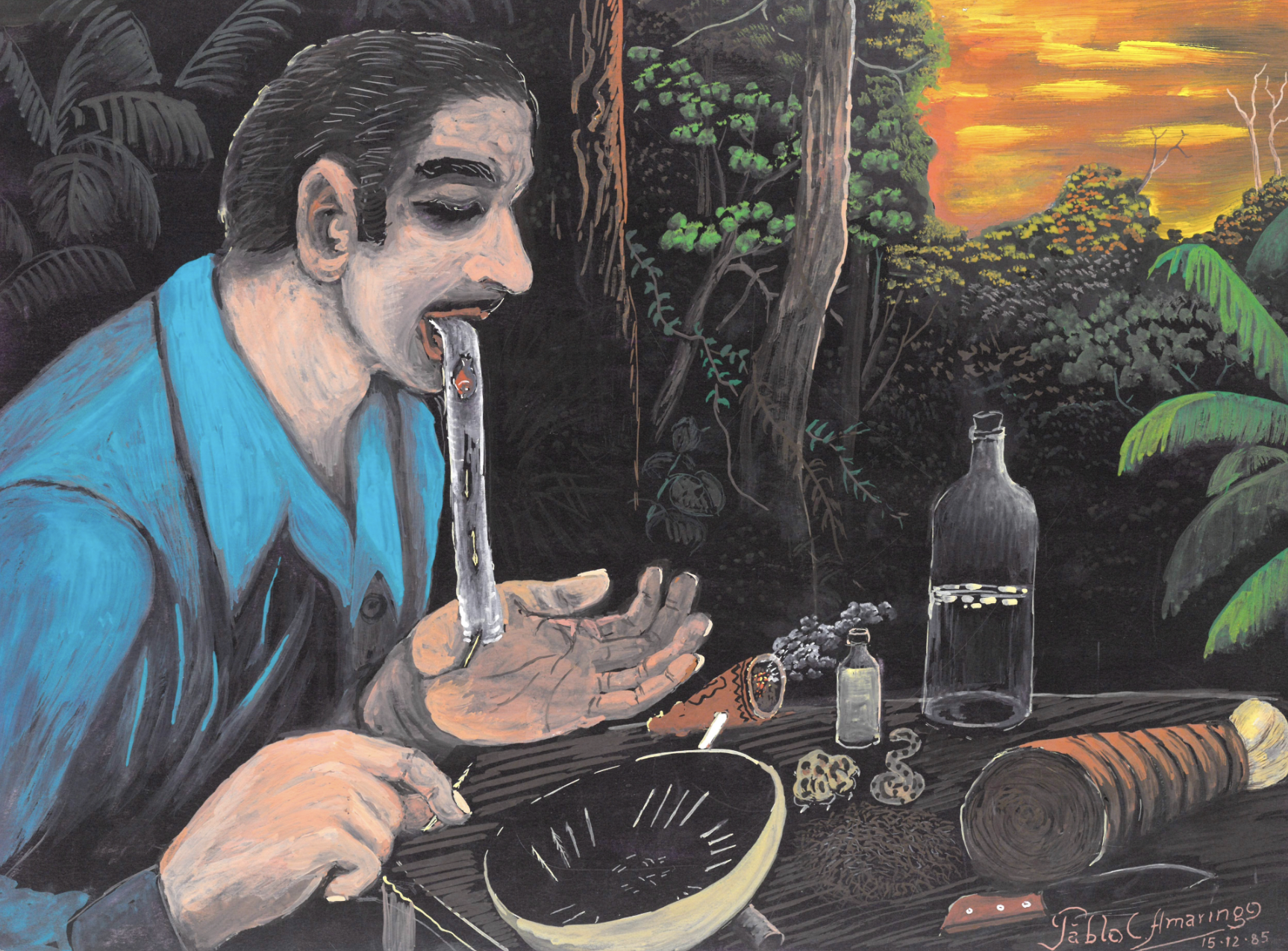
Painting by Pablo C. Amaringo, 1986.
JB: An important part of your story is your relationship with the Peruvian artist Pablo Amaringo. How did this relationship influence your understanding of sacred plants and visionary art?
LEL: I met Pablo through Dennis McKenna, who had met him on a previous trip to Pucallpa. I was finishing my doctoral dissertation at the time. Pablo’s knowledge of plants was astonishing. He had been a vegetalista, a person who has learned to heal and perform other shamanic tasks by ingesting certain vegetales—especially powerful plants. But Pablo had stopped doing that kind of work seven years before I met him.
When we met, he showed me these beautiful watercolors that he had made. He said, “I remember everything I have seen.” So, I said, “OK, do you remember the visions you had when you were taking ayahuasca?”
“I do,” he said. A few days later, he showed us his very first ayahuasca visions. That was the beginning of a long relationship that lasted years; one of the results is the book Ayahuasca Visions: The Religious Iconography of a Peruvian Shaman (North Atlantic Books, 1991).
It's one thing if you ask somebody a question about the spirit and they tell you about it. It’s entirely another thing if they respond with a painting, which is what Pablo did. There were many elements in his paintings that needed explanation, so he would make another painting to explain. And it was just like that. We continued exploring this extraordinary world he had. It was, to a certain extent, his own world. But at the same time, he was embedded in a tradition of the Brazilian Amazon, and many elements of his world were common to the people there.
When I started to make reproductions of his paintings to show local and Indigenous people, they immediately recognized that this is ayahuasca. But nobody had ever painted it. This world was not simply some imagination from a humble painter there in the Amazon. He was depicting something that the people immediately recognized.
The surprise is that, as you can see in Pablo's work, it was not only the spirit of nature. There were cities; there were princesses; there were warriors; there were UFOs. In this humble Amazonian man, all of this was intertwined. It was all part of the spirit world. In fact, I once asked him, “Is this a UFO?” He said, “Yeah, but these are not machines. These are spirits. They're coming from another dimension.”
JB: We are now in a moment that some call the “psychedelic renaissance.” This implies that the 1970s when you began your research, was a psychedelic “dark ages.” What do you make of this, and how does the idea of a “psychedelic renaissance” rewrite the history of sacred plants and psychedelics?
LEL: For me, it has been very interesting to hear, because I never stopped being interested in these things. For me personally there is no “renaissance.” I see all this interest now, but it has been my life. People of my generation—Jonathan Ott, Manuel Torres, Dennis McKenna, and Giorgio Samorini—have never stopped working on this subject.
When I was doing my fieldwork in the ’80s, I was worried that traditions were dying out. Don Emilio, my teacher, had no disciples. Jose Corral, another one, no disciples. So, I thought, this is going to disappear. I was totally mistaken. Because of the interest of Western people, there was also this kind of revival among the Indigenous people and in the art as well. We have this huge renaissance of psychedelics, which has had an impact on the visionary art.
I am only worried about one thing. There is this great emphasis—I don’t think it is negative—on the therapeutic effects of these plants. It is as if that is the only thing: ayahuasca, ketamine, or MDMA for PTSD or depression or this or that.
There is the danger that they will be turned into therapies that put the emphasis only on the individual—the individual's fear, the individual's trauma. There is a kind of narcissism in this. Healing can happen, and it's fantastic. But I think of more importance is that these plants or substances put us into contact with community, with other humans, and with the larger-than-human world. We need a relational epistemology. This is what we need most at this moment.
Author Biography
Luis Eduardo Luna was born in Florencia, Colombia. He has a B.A. from Universidad Complutense de Madrid (1972), an interdisciplinary Master’s from Oslo University (1980), and a Ph.D. from the Department of Comparative Religion at Stockholm University (1989). He was an associate of the Botanical Museum of Harvard University (1987). He was an Assistant Professor in Anthropology (1994-1998) at the Department of Anthropology of Santa Catarina Federal University (UFSC) in Florianópolis, Brazil. Besides publications in various journals, Dr. Luna is the author of Vegetalismo: Shamanism among the Mestizo Population of the Peruvian Amazon (1986), and co-author with Slawek Wojtowicz, Rick Strassman, and Ede Frecska of Inner Paths to Outer Space: Journeys Through Psychedelics and Other Spiritual Technologies (2008). He is co-editor with Steven White of Ayahuasca Reader: Encounters with the Amazon’s Sacred Vine (2000, 2016). Dr. Luna has lectured worldwide on indigenous and mestizo shamanism and has been a curator of visionary art exhibits in Europe, Latin America, the United States, and Japan. He is the Director of Wasiwaska, Research Center for the Study of Psycho-integrator Plants, Visionary Art and Consciousness, Florianópolis, Brazil (www.wasiwaska.org). He is currently an Honorary Research Fellow of the Department of Sociology, Philosophy, and Anthropology of University of Exeter, England.

References
- For background on Don Emilio, see: Luis Eduardo Luna, “The healing practices of a Peruvian shaman,” Journal of Ethnopharmacology 11(2) (1984): 123-33, doi: 10.1016/0378-8741(84)90035-7. [Return to Section]
Suggested Citation
Luna, Luis Eduardo. “Religion of the Garden: An Interview with Luis Eduardo Luna.” Interview by Jeffrey Breau. In Psychedelic Intersections: 2024 Conference Anthology, edited by Jeffrey Breau and Paul Gillis-Smith. Center for the Study of World Religions, Harvard Divinity School, 2025. © License: CC BY-NC. https://doi.org/10.70423/0001.11