


Beyond Counterculture: Towards a People’s History of Psychedelic Networks
Beyond Counterculture: Towards a People’s History of Psychedelic Networks
J. Christian Greer, Stanford University

Beyond Counterculture: Towards a People’s History of Psychedelic Networks
As a concept, counterculture is hardwired into our imagination. It would be difficult to understand the last 60 years of psytrance festivals, underground raves, New Age spirituality, cyberculture, and drop-out communalism without the narrative of counterculture. However, even a cursory inspection of the scholarship devoted to the topic reveals contradictions in how the counterculture is conceived.1 As the American historians Peter Braunstein and Michael William Doyle argue, “the term ‘counterculture’ reifies what should never properly be construed as a social movement,” and they insist that its meaning has been lost in “a nebula of signifiers comprehending bongs, protest demonstrations, ashrams, and social nudity.”2 Sociologists have likewise noted the under-theorization of the counterculture. They argue that the inherent dichotomization between counterculture and mainstream is largely irrelevant in a post-modern world defined by alienation, atomization, and cultural plurality.3 Considering all the problems with the concept of counterculture, why has it become integral to the United States’ historical imagination?
There are two reasons. First, the fundamental ambiguity of the term counterculture has made it remarkably versatile; it can be applied to almost any historical context in which groups of people challenge sociocultural norms outside the arena of politics. Second, the term has offered scholars a way to discuss psychedelic cultures without explicitly mentioning drugs, either out of personal bias, institutional pressure, or fear of social censure. In what follows, I show how the counterculture narrative is a product of the War on Drugs, which has informed a persistent scholarly bias against psychedelic drugs. The roots of this issue can be traced back to the book that popularized the concept of counterculture, Theodore Roszak’s The Making of a Counter-culture: Reflections on the Technocratic Society and Its Youthful Opposition (Doubleday & Company, Inc., 1969), which intentionally minimized the impact of psychedelics on postwar American society. Ultimately, this article demonstrates how “counterculture” remains a poorly defined way to talk about rapidly developing milieux, scenes, and networks born out of the religious awakening stimulated by psychedelics in the mid-1960s and proposes an alternative framework of “psychedelicism.”
How the Counterculture was Made
Though the initial formulation of “counterculture” occurred in sociological literature from the 1950s, the concept would have remained obscure academic jargon if it had not been for Roszak's massively popular book. This bestseller redefines the term counterculture as an exclusive descriptor for the flower children of the white middle class, producing the definition most familiar to us today.4 Responding to earlier sociological formulations, Roszak maintains the negativist conceptualization of counterculture as inherently “deviant” but inverts the moral valiance of such deviancy.5 In this text, Roszak argues that mainstream values have been corrupted to such a degree that they existentially threaten humanity. In opposing these values, the deviance of the counterculture is morally exemplary.
An ardent endorsement of the beatnik bohemians, The Making of a Counter-culture casts the Cold War military-industrial complex as evil and sixties love communitarians as the only salvation for humanity. According to Roszak’s paranoid vision of the impending apocalypse, the instrumental reasoning of the scientific worldview has driven humanity to the brink of atomic destruction. The only way for humanity to avoid an otherwise inevitable nuclear holocaust is a totalizing shift in human consciousness away from the “militant rationality” of the technocracy and towards the utopian worldview that animated the hipster dropouts on the margins of society.6 For this Berkeley professor of history, the hip youth’s experiments in communalism, free love, and ecological thinking (as opposed to the activism of the leftist revolutionaries, Black Power advocates, or women’s liberationists) represent the next stage in humanity’s spiritual evolution and an embryonic form of an emerging “superconsciousness.”7 Yet, his enthusiasm is tempered by his paternalistic disdain for the stoned insurgents’ “heavyweight obsession” with psychedelic drugs, which, he argues, do not expand consciousness but trap the youth in a “counterfeit infinity.”8 Ultimately, Roszak introduced the concept of counterculture into the public discourse as a means of obscuring the fact that psychedelics represented the “common denominator” of the hip revolt erupting around him.9
Roszak’s book was among the first serious engagements with the alternative spiritual awakening of the ’60s, and it laid the foundation for the serious study of the psychedelic cultures that had been largely disregarded by his peers in the academy.10 Such disregard betrayed the continued growth and diversification of acid culture through the mid-1970s, by which point psychedelics had saturated the fabric of American society, reconfiguring spirituality in the modern era.11 At the core of this reconfiguration was the simple fact that psychedelics seemingly democratized mystical experiences. It is hard to overestimate the significance of this religio-cultural shift.12 While Roszak’s work inspired a handful of other scholars to analyze the dope-smoking spiritual insurgency, their research likewise obscured the social impact of psychedelic drugs, focusing instead on a nebulous galaxy of “countercultural” institutions, such as drop-out communes, guerilla theatre, and ecological movements.13 The academic marginalization of psychedelics must be considered alongside the harsh realities of President Richard Nixon’s War on Drugs, which launched just a few months after the publication of Roszak’s book.
Before Roszak's book, the term “psychedelic movement” was a more popular reference point for what came to be known as the “counterculture” (viz. fig. 1). After 1969, counterculture became the dominant term, pushing even the idea of a “psychedelic movement” into obscurity (viz. fig. 2). The diverse network of psychedelic communities, along with their beliefs, values, and ritual protocols, were circumscribed by a Roszakian vision of the counterculture. This anti-psychedelic framework for postwar cultural rebellion shaped the public imagination in the decades that followed. This is exemplified in bestsellers like Charles Reich’s The Greening of America (Random House, 1970), which hailed the evolution in consciousness embodied by aquarian seekers as the only means of reversing America’s terminal decline while nonetheless diminishing the “longhaired rebels” embrace of psychedelic drugs.14 Conservative pundits like Robert Bork and politicians like Newt Gingrich likewise seized on counterculture, not as a salvific force, but as the source of America’s moral degeneration.15 Subsequently, the myth of a counterculture (vaguely defined) became integral to the way Americans viewed their history and the history of others.16
A Peoples’ History of Psychedelicism
Psychedelic networks are not merely aspects of the so-called counterculture. Indeed, counterculture is a poorly defined way to talk about the complex interweave of networks born out of the mid-1960s efflorescence of psychedelic enthusiasm.17 Elsewhere, I proposed “psychedelicism” as a value-neutral replacement for counterculture.18 Psychedelicism recenters psychedelic networks as social forces in their own right instead of presenting them as part of an amorphous mass of cultural opposition. Moreover, it does so without insisting that psychedelicists and psychedelicist collectivities are, amongst themselves, homogeneous. Not unlike other religious traditions—other “-isms” —, psychedelicism suggests an assortment of identities with their own distinct historical roots, legacies, institutions, and ideological descendants. This framing emphasizes how psychedelics inspired a multilayered tradition with a long history of heterogeneity, antagonisms, and cross-pollination. Foregrounding these complexities is what makes the psychedelicist approach a people’s history.19 It is a historiographic stance that rejects the imposition of meaning from above (e.g., “counterculture”) in favor of a bottom-up analysis derived from the primary sources themselves.
Formulated within sociological discourses concerning deviancy, the concept of “counterculture” implies opposition, antagonism, and rejection of mainstream norms. Alternatively, psychedelicism lends itself to analyzing how psychedelics have threaded their way into mainstream culture, from the medical industry to the military-industrial complex, from Madison Avenue to Hollywood, and from rural communes to cyberpunk collectives. As scholar Arun Saldanha argues, “the arrival of LSD in human history and evolution can be termed an ‘event’” that has altered the Western cultural superstructure.20 Recognizing this, psychedelicism implies creation, experimentation, and innovation, both within and against the mainstream.
Working from the bottom up, psychedelicism also offers a means of recovering histories otherwise lost. Chief among these histories are the threads of Black psychedelicism, which have received little attention. Psychedelicist ideologies proliferated across all strata of class, gender, and race, saturating the ultra-left as well as the ultra-right of American politics. Yet, the persistence of the hippie stereotype has informed the history of the counterculture and has, in turn, caused this history to be one primarily of “White” movements.
The move from the Roszakian logic of counterculture to the empirical program of psychedelicism challenges scholars to re-evaluate the last 60 years of American psychedelic and religious history. The development of psychedelicist cultures, their emergence, splintering, and innovations speak directly to the special talent Americans have in making and remaking religious meanings despite governmental opposition and public censure. Needless to say, it is up to us as scholars to lift the fog of the drug war so as to see the full landscape of psychedelicism.
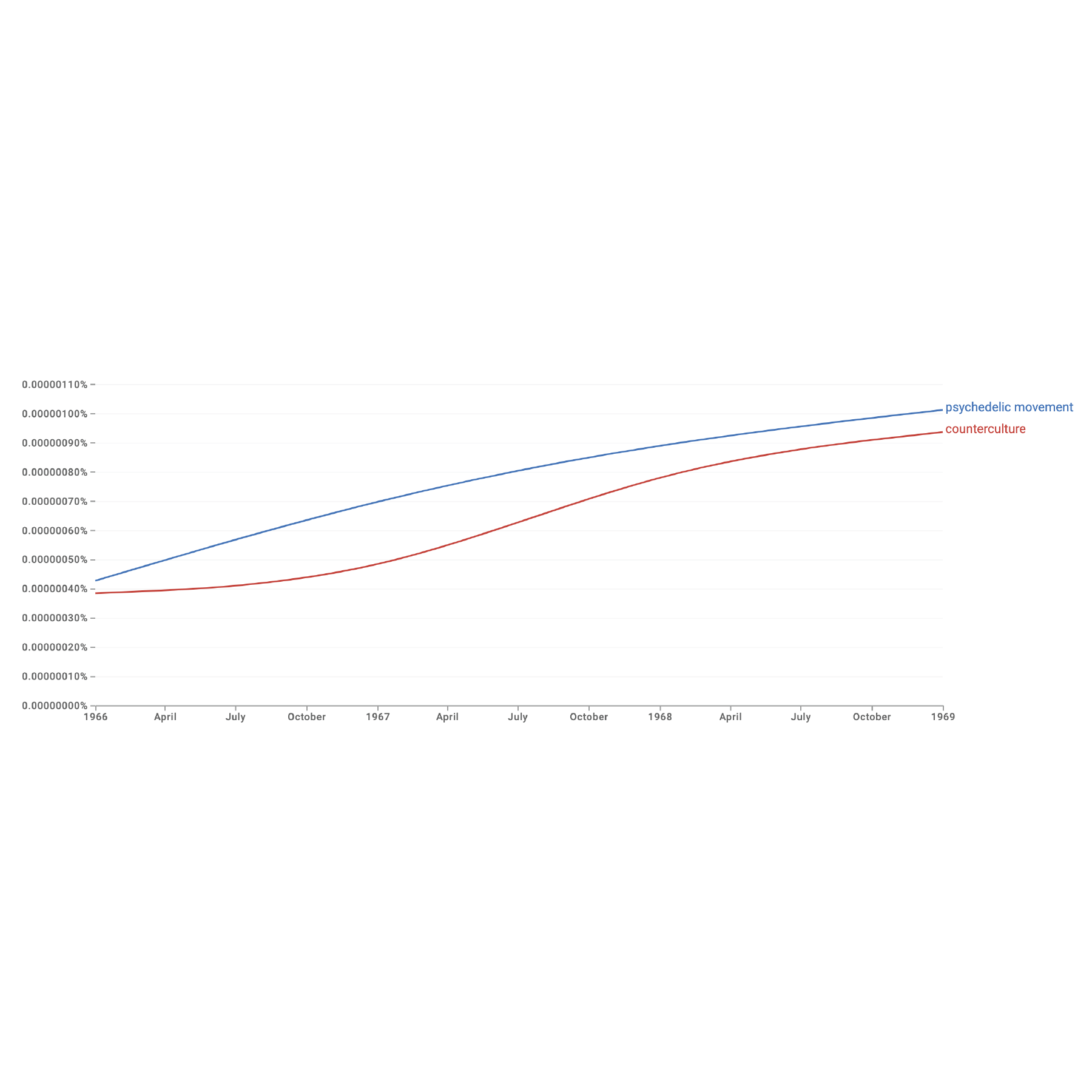
[Fig. 1: Illustrating data collected by Google Books Ngram Viewer, this graph plots the usage and frequency of specific terms in printed matter between a specified range of dates. The graph illustrates how the term “psychedelic movement” was used more often in printed matter compared to the term "counterculture” between 1966 and 1969.]
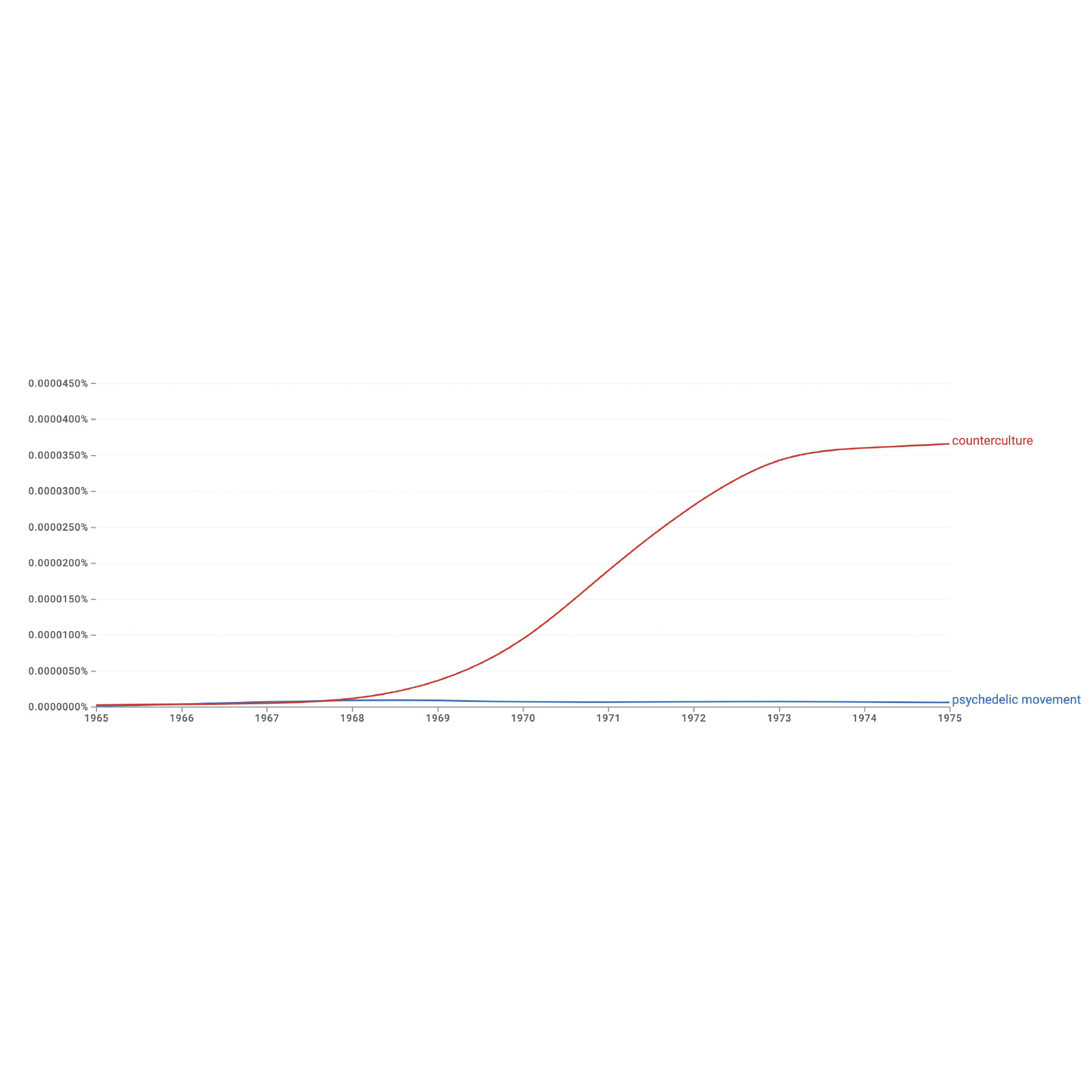
[Fig. 2: This graph makes clear that the term “psychedelic movement” became nearly defunct by the mid-1970s.]
Author Biography
Dr. J. Christian Greer is a scholar of Religious Studies with a special focus on psychedelic culture. While a postdoctoral researcher at Harvard
Divinity School, he led a series of seminars on global psychedelic spirituality, which culminated in the creation of the Harvard Psychedelic Walking Tour, a free audio guide detailing how the Harvard community has shaped the modern history of psychedelic culture. He is also the co-founder, and currently the co-chair of the Drugs and Religion program unit at the American Academy of Religion. His latest book, Kumano Kodo: Pilgrimage to Powerspots (co-authored with Dr. Michelle Oing) analyzes the pilgrimage folklore associated with the rainforests of Japan’s Kii Peninsula. His forthcoming book, Angelheaded Hipsters: Psychedelic Militancy in Nineteen Eighties North America (Oxford University Press), explores the expansion of psychedelic culture within fanzine net- works in the late Cold War era. He has recently launched “The Psychedelic Universe: Global Perspectives on Higher Consciousness,” an intensive summer school seminar hosted every June by the University of Amsterdam’s Graduate School of Social Sciences. He is currently a lecturer at Stanford University.

References
- Books like Ken Goffman’s popular nonfiction Counterculture Through the Ages (2004), alongside academic tomes like Milton Yinger’s Countercultures (1982), Anthony D’Andrea’s Global Nomads: Techno and New Age as Transnational Countercultures in Ibiza and Goa (2007), Christopher Dunn’s Contracultura (2016), and Gnostic Countercultures (2020) edited by April DeConick and Lautaro Roig Lanzillotta suggest that counterculture is a universal feature of society across space and time. However, this presumption is contradicted by scholars who interpret counterculture as an exclusive signifier for postwar American youths in revolt. This approach is exemplified by Bennet Berger’s The Survival of a Counterculture (1981), Gilbert Zicklin’s Countercultural Communes (1983), Fred Turner’s From Counterculture to Cyberculture (2007), and Damon Bach’s American Counterculture (2020), which work from the basic premise that the counterculture was a unique historical development that flourished among postwar America’s white middle class before spreading internationally. This school of thought encompasses research that traces the internationalization of the so-called hippie movement aboard, for example, Andy Roberts’ Albion Dreaming (2008); Patrick Barr-Melej’s Psychedelic Chile (2017); Margaret Munro-Clark’s Communes in Rural Australia (1986); José Agustín’s La Contracultura en México (2017); Katri Ratia’s Alternative Spirituality, Counterculture, and European Rainbow Gatherings (2023). [Return to Section]
- Peter Braunstein and Micheal William Doyle, “Introduction: Historicizing the American Counterculture of the 1960s and 1970s,” in Imagine Nation: The American Counterculture of the 1960s and 1970s, eds. Peter Braunstein and Micheal William Doyle (Routledge, 2002), 6;10. [Return to Section]
- Andy Bennett, “Reappraising ‘Counterculture,'” in Countercultures and Popular Music, eds. Jedediah Sklower and Sheila Whiteley (Routledge, 2014), 17-26. [Return to Section]
- The term “counter-cultures” was coined within The Social System (1951) by sociologist Talcott Parsons, though it was only used once and did not carry any major significance. It was subsequently adapted and expanded (first as “contraculture” and later as “counterculture”) in the work of Milton J. Yinger, also a sociologist of deviance, who defined countercultures as anti-hegemonic communities in opposition against the status quo, as distinct from subcultures, which represented innocuous social groupings. See Talcott Parsons, The Social System (The Free Press of Glencoe, 1951), 522; see also Milton Yinger, “Contraculture and Subculture,” American Sociological Review, 25(5) (1960); Braunstein and Doyle, “Introduction,” in Imagine Nation, 6-7. [Return to Section]
- For an extended discussion on the sociology of deviancy, see Manon Hedenborg White and Tim Rudbørg, eds. Esotericism and Deviance (Brill, 2024). [Return to Section]
- Theodore Roszak, The Making of a Counter Culture: Reflections on the Technocratic Society and Its Youthful Opposition (Double Day & Co., 1969), 244. [Return to Section]
- Ibid., 248. [Return to Section]
- Ibid., 155-177. [Return to Section]
- Ibid., 155; as Christopher Partridge has argued, though, Roszak’s condemnation of psychedelics did not extend to men of particular genius, such as Aldous Huxley, who he believed could usefully experiment with LSD. See Christopher Partridge, “A Beautiful Politics: Theodore Roszak's Romantic Radicalism and the Counterculture,” Journal for the Study of Radicalism, Volume 12, Number 2 (2018): 1-34. [Return to Section]
- Partridge, “A Beautiful Politics,” 1-3. [Return to Section]
- See, for example, J. Christian Greer, “The Greening of Psychedelics,” Harvard Divinity Bulletin, Autumn/Winter 2022. [Return to Section]
- In the last six years, a number of groundbreaking studies have historicized this development, including Christopher Partridge’s High Culture (2018), Erik Davis’ High Weirdness (2019); and Expanding Mindscapes (2023) edited by Erika Dyck and Chris Elcock; Benjamin Breen’s Tripping on Utopia (2024). [Return to Section]
- Roszak’s biased interpretation of the counterculture extended beyond a rejection of psychedelics to include modern technological innovation. While his anti-technology bias spoke to the ecological consciousness that motivated the “back to the land” movement of rural communes, it was totally out of step with the larger technophilia of the hip underground. Key examples include the culture of utopian engineering channeled into Stewart Brand’s Whole Earth Catalog, the electronic wizardry that went into the mind-bending stage productions of Grateful Dead concerts, as well as the innovative methods for recording trip reports, such as Timothy Leary’s “experimental typewriter.” For a succinct overview of rural communes, see Timothy Miller, “The Sixties-Era Communes,” in Imagine Nation: The American Counterculture of the 1960s and 1970s, eds. Peter Braunstein and Micheal William Doyle (Routledge, 2002), 327-352; for more on hip technophilia, see John Markoff's What the Dormouse Said (2005), Fred Turner's From Counterculture to Cyberculture (2006), and David Kaiser's How the Hippies Saved Physics (2011). [Return to Section]
- Charles Reich, Greening of America (Random House, 1972), 280-282. [Return to Section]
- Braunstein and Doyle, “Introduction,” in Imagine Nation, 6. [Return to Section]
- Thomas Frank, The Conquest of Cool: Business Culture, Counterculture, and the Rise of Hip Consumerism (University of Chicago Press, 1998), 1-3.
- The touchstones for this history remain Martin Lee and Bruce Shlain’s Acid Dreams: The Complete Social History of LSD (1985) and Jay Stevens’ Storming Heaven: LSD and the American Dream (1987). [Return to Section]
- J. Christian Green, “Foreword,” in Mike Marinacci, Psychedelic Cults and Outlaw Churches LSD, Cannabis, and Spiritual Sacraments in Underground America (Park Street Press, 2023), xiii-xvii; J. Christian Greer, “The Psychedelic Church Movement,” in Dictionary of Contemporary Esotericism, ed. Egil Asprem (Brill, 2022). [Return to Section]
- The founding document for this school of historiography is Howard Zinn’s A People’s History of the United States (1980). [Return to Section]
- Arun Saldanha, “The LSD-event: Badiou Not on Acid,” Theory & Event 10(4) (2007). [Return to Section]
Suggested Citation
Greer, J. Christian. “Beyond Counterculture: Towards a People’s History of Psychedelic Networks.” In Psychedelic Intersections: 2024 Conference Anthology, edited by Jeffrey Breau and Paul Gillis-Smith. Center for the Study of World Religions, Harvard Divinity School, 2025. © License: CC BY-NC. https://doi.org/10.70423/0001.07