


Copal Resin and Incense as a Conduit of Life and Death Forces: From Precolonial Mesoamerica to Contemporary Nahua Ceremony
Sensing and Censing with Copalli: Continuity of Sacred Tree Resin in Nahua Religion
Rebecca Mendoza, PhD Student, Committee on the Study of Religion, Harvard University
Sabina Cruz de la Cruz, Instructor, Instituto de Docencia e Investigación Etnológica de Zacatecas


Figure 1. Family altar. Photograph by Sabina Cruz de la Cruz.
Tla xihualhuian iztac cihuatl xictlacuicuiliti intonahualtezcauh
Please come forth, White Woman, clean our enchanted mirror.1
Summoning Copal: An Introduction
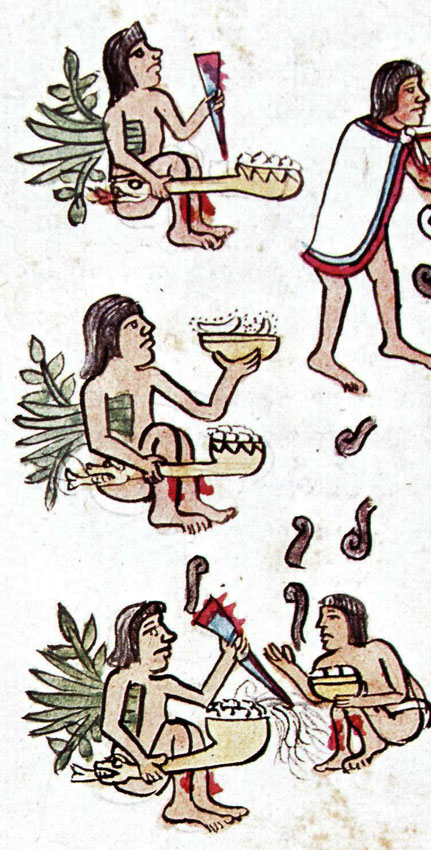
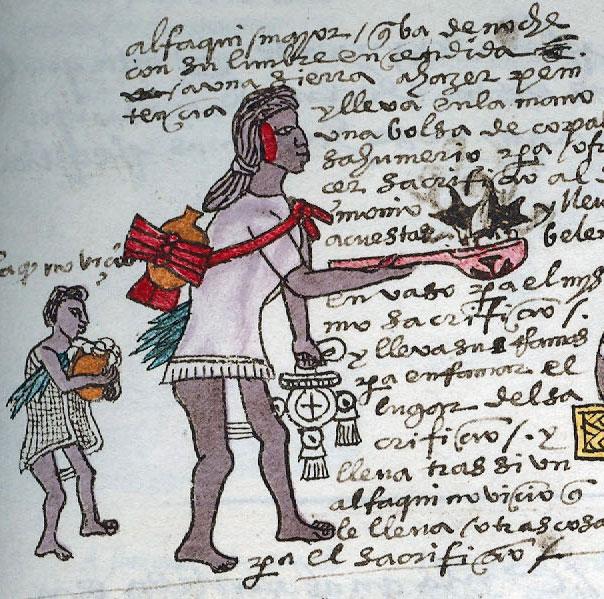
Copal leaves a trace through time as sticky residue in ancient incense burners, as painted swirls of smoke in both murals and pictorial codices produced by Indigenous scribes and artists. Copal survives as defined and described in colonial dictionaries and accounts of religious festivals, and as archaeological remains in sacred ceremonial fields sites across Mesoamerica. An aromatic tree resin, incense, and medicine, for centuries copal has healed wounds, calmed stomach pains and headaches, cleansed spaces, nourished the gods, and connected humans to their ancestors. Across what is now called North and Central America, copal is a familiar smell: familiar as in familia—familial and intimate. As familia, copal is a cherished and respected plant relative who has been present at times of need (calling for rain during drought or protecting the milpa, or cornfield, during planting and harvesting) or transition (marriages and births) and in times of suffering or sadness (physical illness, soul-loss, and a scent to accompany the dead).
Sabina Cruz de la Cruz, whose essay on her family’s personal relationship with copal is presented below, and I propose that thinking with copal requires different types of knowing: conocer rather than saber. We know copal (nosotras conocemos a copalli) not from a distance or as data, but through ongoing embodied encounters: inhaling thick smoke, feeling the heat of the charcoal or wood beneath the melting resin, being consumed by the presence of copal. We cannot satisfactorily describe the scent of copal (piney? citrusy? clean?). That fact alone reveals a necessity for proximity—perhaps there is no knowing copal without getting a good whiff, without sharing breath. Nevertheless, we do our best here to introduce the sacredness of copal with an intention to resist extractive imperial knowledge production pertaining to plants, alongside colleagues such as Subramanian, McMackin, Gagliano, and others in this volume.
In the Latin lexicon of the biological sciences, copal is an aromatic tree resin, an exudate from various species of the Burseracea family and the genus Bursera and Protium. But these are not the names we will use in this chapter. Instead, we will opt for the vernacular, the familiar, the names used by human familia who know copalli as part of an ancient and ongoing ecological and religious network. The Lakota philosopher Brian Burkhart warns against abstractions that “float free from the land,” arguing that Indigenous knowledge comes through epistemic locality, through kinship and ecological specificity.2 Copal is tethered to the land even as it ascends into the skies, melts into fire, and is consumed by deities of the above and below. Accordingly, we articulate copal as animate, flowing from bleeding trees and burning in clay censers made of the earth. Here, we write in English for a general audience, but the ancient and enduring languages of these lands are the authority in this chapter, and the experiences of Nahua people and Nahuatl grammar guide the way.3
This chapter moves both chronologically and cyclically: We chart evidence of copal’s power as a surviving healer in colonial-era incantations, narrate copal as a central figure in contemporary Nahua ceremonies, and ultimately envision a future where copal continues to be cared for as familia.
A “Censory” Grammar in the Colonial Record
The name copal, used in both English and Spanish, comes from the Nahuatl word copalli. In many Mayan languages, the resin is called pom, and a multiplicity of terms from across North and Central America are employed to describe an array of colors, scents, and characteristics (copal de oro, de piedra, copal negro, etc.).4 As I have learned from Cruz de la Cruz, in the Eastern Huasteca variant of Nahuatl, copal is known as iezzo cuahuitl, which translates to the blood of trees. The bark is petlayo tlen cuahuitl, the skin of the tree. As scholar Doris Heyden argues, in Mesoamerican thought the tree is not simply for construction, adornment of a garden, or bearing fruit; rather, “El árbol con sus productos era uno de nuestros protectores, era nuestro padre, nuestro abuelo” (“the tree and its products were our protectors, our father, our grandfather”).5 The body and blood of the tree are powerful plant-persons, social and religious entities with whom humans are expected to practice reciprocity and respect. These are not mere metaphors, and we should not be too quick to call this anthropomorphism—after all, Mesoamerican humans are made of maize.6 That is, plants are not necessarily taking on what might be labeled as personhood, but rather that humans are created and can be understood through planthood. While academics are anxious about humancentric models in this modern moment, this may be a result of overlooking the way in which “the human” is far from being a stable category across various cultures and cosmovisións, or worldviews.7
In addition to contemporary Nahuatl vernacular, we also find references to copal in colonial records. According to the seventeenth-century priest and ecclesiastical judge Hernando Ruiz de Alarcón (1597–1646), who chronicled the Nahua religion and ritual, it makes an appearance as an agential figure in various Nahuatl “incantations” that “managed to survive a century of persecution from the church.”8 Spanish missionaries zealously destroyed pictorial manuscripts, religious materials, and sacred places in the process of forced conversion across Mesoamerica, often leaving behind only their own written records. While these texts are biased and often violent in their treatment of Indigenous people and practices, when read with a critical lens they can become subversive sources for recovering Indigenous lifeways. In that spirit, we find evidence of copal in Ruiz de Alarcón’s Treatise on the Heathen Superstitions that Live Among the Indians Native to this New Spain.9
He compiled The Treatise while visiting Indigenous peoples accused of sorcery in northern Guerrero and Morelos, Mexico, between 1617 and 1629. He transcribed their incantations in Nahuatl and described their rituals in Spanish with the intent of extirpation, the descriptions served as a manual for the Spanish clergy so they could continue to “root out” the “syncretic elements . . . that threatened the purity of Christianity” among the new converts.10 In its final version the manuscript included six treatises and seventy-three chapters on subjects including idolatry, hallucinogenic plant medicines, and incantations for divination, health, emotions, and daily duties pertaining to agriculture and hunting. Copal is mentioned in various incantations, offering healing for both spiritual and physical ailments.
In the treatise, copal is often referred to as iztac cihuatl, or “White Woman.” This name is an indicator that they were likely using copal blanco, a white resin that creates thick white smoke when burned (likely Bursera bipinnata or B. copallifera, both of which continue to grow in the region).
In addition to taking a name in these ritual contexts, the vocative is employed to summon copal. It is important to note that the vocative is not required in order to address someone in Nahuatl, neither in classical nor contemporary variants. It is possible to direct speech to a particular person without using the vocative. In early colonial Nahuatl documents the vocative reveals a level of formality similar to, and sometimes in conjunction with, the reverential form (a noun root “-tzin-tli” used for nouns, personal pronouns, names, and relational words). These heightened registers of speech are the way in which Nahuatl speakers show their respect, often likened to addressing a noble person as “Oh my lord.”11 Horacio Carochi, a Jesuit father known for his Arte de la Lengua Mexicana, published this Nahuatl grammar in 1645, the year before Ruiz de Alarcón’s death. As such, Carochi was documenting the language only decades after the reciting and recording of these incantations.12 For instance in the epigraph of this chapter a healer calls to copal to command that it cure the patient’s eyes: Tla xihualhuian iztac cihuatl xictlacuicuiliti intonahualtezcauh (Please come forth, White Woman, clean our enchanted mirror. . . )13. Here the enchanted mirror refers to the eye, which is injured or not seeing clearly. While Hassig and Andrews translate this command as “Come on, White Woman,” in the Nahuatl the grammatical implications are the same: copal is spoken to as an agential ally with the ability to heal. In another case, the White Woman is summoned to stop a patient’s mouth from bleeding:
Please come forth, White Woman, my mother. What have you been thinking? For now you will utterly destroy The Blue-green Pain, The Dark Pain. White Woman, my mother, What have you been thinking? Soon you will penetrate The Seven Caves, you will place with care Red Woman... Right now!14
Ruiz de Alarcón notes that after this incantation, the patient is given copal to drink and “he remains very content.”15 We find copal and other entities capitalized in English as a way of marking the vocative, in other words, the plants and the pain alike are spoken to in the same way one would speak to an elder, noble person, or beloved being worthy of respect.
The Mesoamerican historian Alfredo López Austin refers to this genre of language as nahuallatolli, a magical language used by “brujos, curanderos, and adivinos.”16 In his analysis of Ruiz de Alarcón, the first theme López Austin notes is the personification of inanimate beings (“la personificación de los seres inanimados”)17. What if, instead, we understood this language as acknowledging or even activating animacy? Just as copal is the tree’s blood—a flowing life force that can scab over and protect the tree’s sliced body—so too is the white smoke or copal tea a healer of eyes and mouth. The grammar in these incantations reveal another layer of reality, as Natalia Schwien Scott has argued:
Linguistic constructions, such as the use of the vocative and the ascription of agency, express an acknowledgment of non-human personhood, broadly recognizing a plant’s embodied ability to engage in its wider community—human and more-than-human.18
Though Schwien Scott’s claim is founded on incantations in northern European folklore collections, her argument is relevant in the Mesoamerican context as well.19 Furthermore, the grammar of animacy applied to copal in Ruiz de Alarcón’s treatise is also extended to various deities, plants, and other more-than-humans such as cotton, salt, and fire.
Copal’s place in an animate, interconnected cosmos is far from static. While Ruiz de Alarcón’s work sought to detect and erase Indigenous religious traditions, his treatise offers a unique opportunity to see how Nahua communities maintained their traditions and resisted Christian dominance.20 Today, four hundred years later, copal remains alive in both the language and practices of Nahua communities. The narration by Sabina Cruz de la Cruz in the next section tells a story of relationality with copal. We have also included images from the past and present to emphasize the ongoing survival and dynamic nature of Nahua religious traditions.
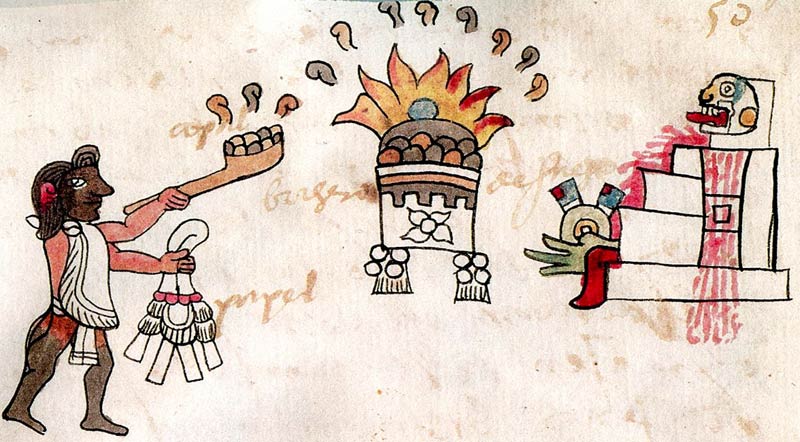
Sabina Cruz de la Cruz’s account below of her family’s experience of knowing copal is a snapshot of the deep roots of relationships families across Mexico, Central America, and in the diaspora have with the plant. Like Ruiz de Alarcón’s named and unnamed sources from the 1620s, Cruz de la Cruz gives us insights into profound traditions of healing with plant medicines and allies in the 2020s. Copal is not only a bounded subject rooted in time and place; it must also be understood as a verb. In Nahuatl, popochhuia means to smoke or fumigate something, and in Spanish one will often say copalear to refer specifically to applying copal smoke to a person, place, water, altar, or offerings. In English we use the verb smudge to describe this tradition, though, in this case, it would more literally translate as “to copal.” In the examples we have shared here, we see a glimpse of the rich Nahuatl grammar of ritual relationships with more-than-human agents. Copal, tobacco, and dozens of other powerful plants bleed and burn alongside the bodies of other beings. They are sliced and sacrificed to balance the cosmos, partners in the process of healing. Like humans, animals, stones, bones, feathers, fire, and more, copal is animated by life force.21
This vibrant relationality is also evidenced by archaeological evidence in places like the Maya’s Sacred Cenote at Chichén Itzá and in the offering caches below the Mexica’s Templo Mayor in Mexico City. Archaeologists and ethnobotanists such as Aurora Montúfar López, Naoli Victoria Lona, Edelmira Linares, Judith X. Becerra, and others provide robust data and detailed descriptions of copal’s presence in these ceremonial sites in conversation with contemporary communities.22 On one hand their research reveals the complexity of sacrificial assemblages in which copal is accompanied by and precisely arranged alongside animals, shells, stones, ancestral remains, and other precious offerings. As archaeologist Erika Lucero Robles Cortés has argued based on her research at the Templo Mayor, these offering caches are organized based on complex cosmological structures and often appear to be associated with particular deities based on patterns of adornment.23 Archaeological assemblages reveal the rich relationality between various other-than-human entities. On the other hand, it is impossible to ignore the enduring presence of copal in contemporary society. Through community engaged research scholars find deep roots of knowledge archived in the trees, land, memories, and rituals where copal continues to burn. According to López Austin, a set of fundamental realities have been relatively “resistant to historical change,” and these can be seen as a “hard nucleus” of the Mesoamerican cosmovision.24 Across various ethnic groups, complex concepts and important ceremonies survive colonialism through creativity, resistance, and mysterious forms of transmission. These ancient ways are embedded in the material world, made manifest in tangible and intangible entities. As an enduring and fundamental part of precolonial Mesoamerica and contemporary Mexico, we find that copal itself constitutes just such a “hard nucleus.”
To close, we offer an invitation and caution as we look forward to the future of relationships with copal. As the global spiritual marketplace increases demand for “authentic” or “alternative” ways of relating with plants, we can be grateful for the continuity of traditions, as articulated here by Cruz de la Cruz, for engaging with copal trees and their resin to guide us both conceptually and practically. Yet we remember the need to attend hierarchies of power as they are enacted both in interspecies encounters (humans and nonhumans) and in relationships across social and political boundaries (relating, for example, to indigeneity, nationality, citizenship, and acknowledgement in spheres of knowledge production).
Ultimately, we urge respect for the sacred. Malhuilli is a term applied to sacred places and practices, but not all people have the don (gift), calling, or training to summon copal with authority. We honor the copal trees that offer us their blood as resin but also the copaleros who care for the trees and the ritual specialists who share and guard knowledge of copal. May we all continue to engage in material economies that are not merely sustainable, but generative for all parties, human and plant alike.
Copal in Contemporary Nahua Curanderismo (healing)25
When I was a child, I remember every Sunday morning both my mother and father would take the hot ember from the tlixictli (stove) and place it in the popochcomitl (copal burner/incense holder). Then they would put a small portion of copalli (copal/incense) on the altar and begin the ritual of burning the copal. This copal has indescribable but beautiful aroma. It was always kept on the altar. When they began teaching me how to do this at the altar, I felt something profound, and I participated with copal both at my childhood home and at my paternal grandparents’ house in Tecomate, Veracruz, Mexico.
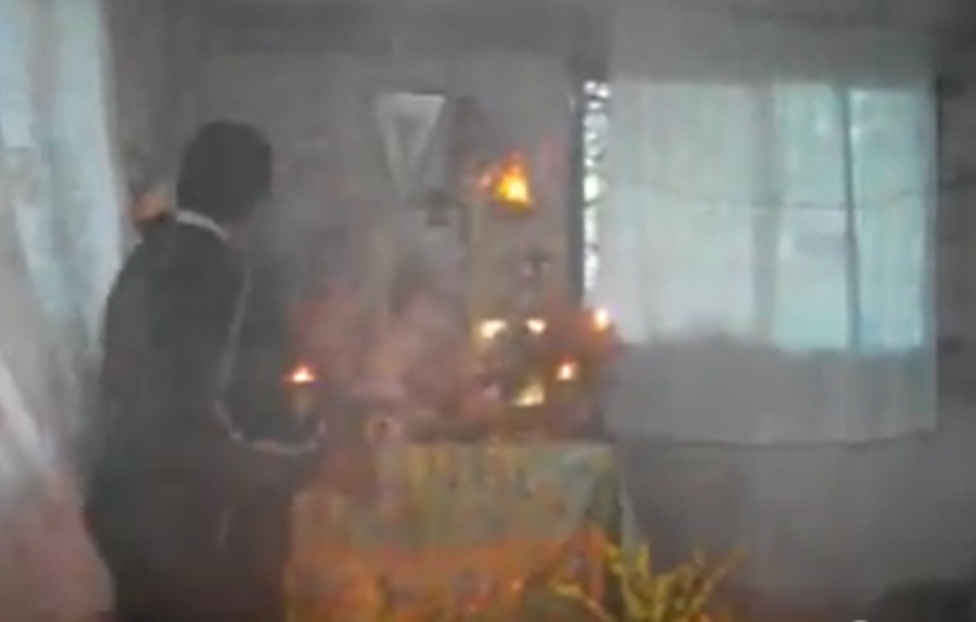
As the years went by and I got older, I would go with my grandparents to the chapel in the village for mass or to say a rosary. There were so many people attending that not everyone could fit inside the building, but the entire area smelled of copal and the smoke engulfed the crowd. There was a positive, uplifting energy because of the presence of the copal. In general, what I felt—and still feel—when I smell copal is peace, positive energy, and the thoughts that everything will be okay and better things will come. To this day, I burn copal.
To me, copal is sacred not as a symbol, but because of what it does. It can liberate you from bad energies with its properties of purification and protection. The moment I perceive copal, it gives me strength. Both the tree and the prepared copal are considered sacred by Indigenous communities past and present, and we treat the resin, bark, and trees with great care. The tree, copalcuahuitl, is typically found in the hills, what we call tzacualli (“sacred mountain”). In addition to the name copalli we call the resin iezzo cuahuitl, the blood of trees. In Nahuatl, we do not call copal a “thing” (tlamantli/cosa); instead, we always call it by its name. We do not “possess” copal, grammatically the resin is possessed by the tree. It is the tree’s blood, just as our body parts belong to us. Thus, copal is harvested carefully—both tree and resin are treated with utmost respect. The trees cannot be constantly cut open and must be given time to rest every few years, which takes time. The mature trees are the most reliable. Copaleros, those who harvest copal, sing, pray, and talk to the trees to ensure a good harvest and good energies.
Protium copal is the species that grows closest to my pueblo. We buy it in the market when we need to prepare for ceremonies. In our region, it is brown, mixed with the wood from the tree, and wrapped in a corn husk for safekeeping until it is time for a ceremony. We break off small pieces to burn. In other places, different tree species and types of cultivation produce pure white copal, black copal, and more.26 Even insects participate in copal cultivation and collect the resin, mixing it with bark and dirt to make their homes.
Copal is a sacred element. It is an unwavering part of our culture alongside broader spirituality and a rich history, connecting Indigenous peoples with the sacredness of nature through our beliefs and rituals. It serves as a bridge between the earthly world and the divine: it is from the earth, ascends to the sky, and works in both visible and invisible ways. The earth and all our medicinal herbs are sacred too, and people offer them when performing spiritual work. For example, when a cleansing ceremony is performed, the tepahtihquetl (healer) may ask for a small portion of soil from the cornfield to use in prayer, invoking the land where crops grow or where livestock live. In traditional medicine or curanderismo, copal smoke sweeps away bad energies from the body and from spaces, accompanied by prayers and chants depending on the nature of the work. This healing work cannot be done by just any person. It is done by ritual specialists who have a gift and are trained to heal.
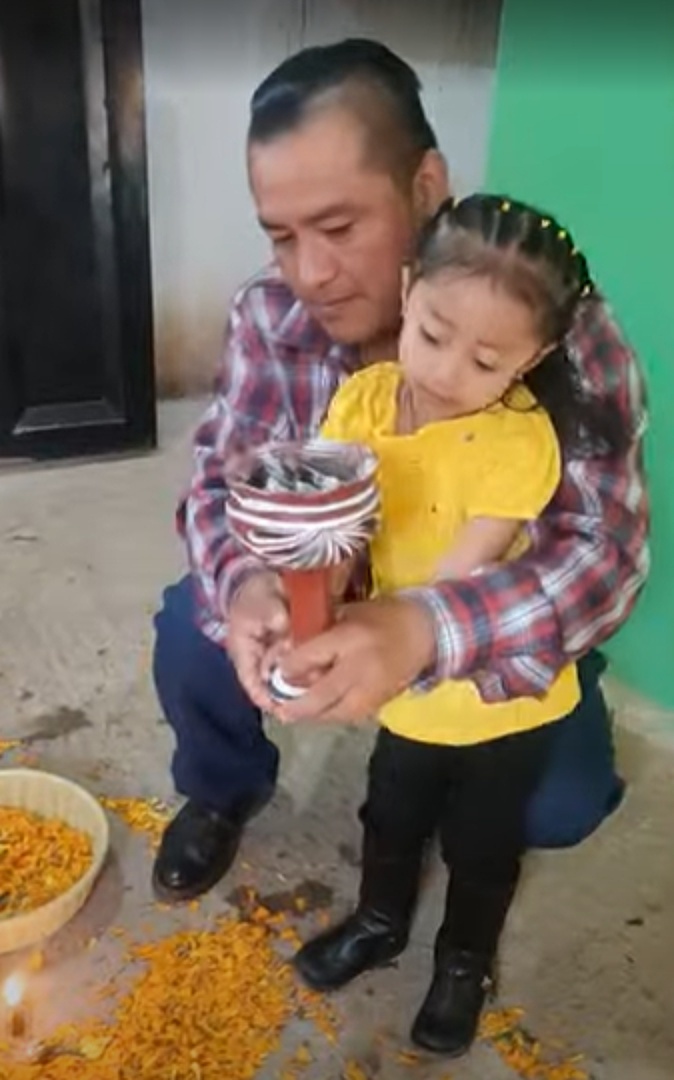
In other cases, copal is part of a home remedy, prepared as a tea to ease stomach pain; in the past the resin would be applied to open wounds. The smoke itself has become popular outside of the pueblo for promoting relaxation and aiding meditation.
In the Huasteca region and across Mexico and Central America, copal plays an important role in religious practices both in the ancestral Indigenous traditions of Mesoamerica and in current syncretic practices that mix precolonial elements with Catholicism, including in the celebration of the Día de los Muertos, one of the traditions my parents taught me, still practiced in my community. In English, the “Day of the Dead” festival celebrates the time of year when we welcome our deceased loved ones: October 31, November 1 (a special day for children), and November 2. People prepare for these days up to a month in advance, decorating the tlaixpan (altar) with flowers we call cempohualxochitl, chiyanxochitl, and mano de león and making offerings such as tamales, chocolate, fruits, and candles, and always burning copal. The smell and smoke of the copal guides our departed loved ones to the front door along the marigold-petal path into the home, along with a lit candle and holy water. The strong aroma of copal fills the house and we feel the presence of the departed. Once we sense that they have arrived at the ofrenda, everyone in the house participates in a ritual with copal. We then wait 20 to 30 minutes before we eat the food from the offerings.
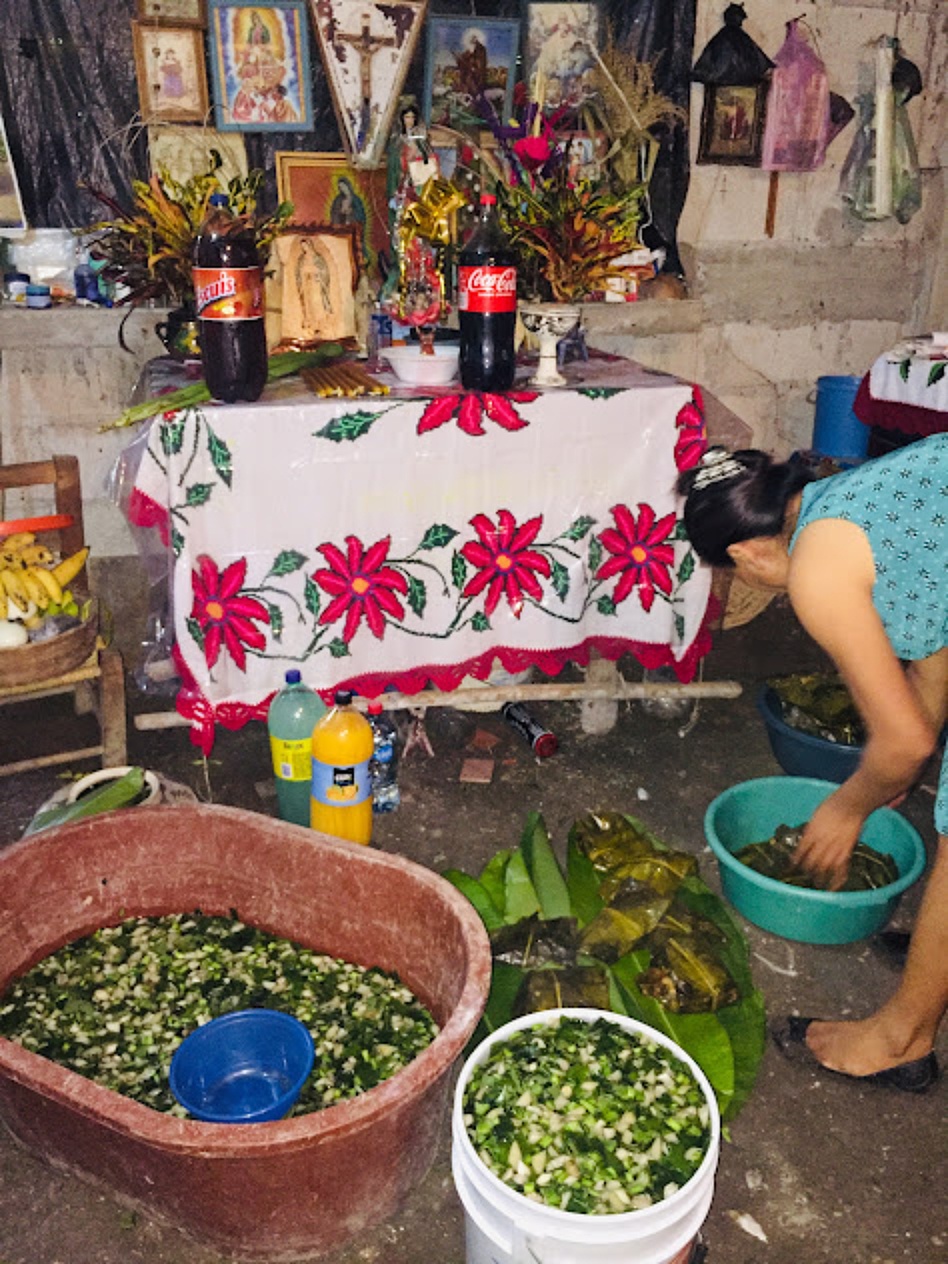
In Zacatecas, where I live now, my husband and I have our own altar year-round—a table with images of those we have faith in, such as the Virgin of Guadalupe, the Sacred Heart, and Jesus, among others, and every Sunday we light a candle on the altar for them. Even though we do not live in Tecomate, we still celebrate Day of the Dead every year, setting up our altar with flowers and offer tamales, atole, coffee, camotes, and other things we know our relatives enjoyed. We prepare to welcome our loved ones’ souls while teaching our 4-year-old daughter to do the same. She never forgets to say a prayer at the altar, dipping her fingers into the holy water and marking a cross on her forehead. When she was younger, she was also ritually bathed with herbs and copal to ensure her wellness as she grows.
For us, copal is something very beautiful and important. The aroma is powerful, and I can’t always explain in words what I feel. What I can explain is that copal connects me to the customs of my home, my ancestors, my family, and the earth. In every ceremony, ritual, or healing practice, copal is always present.
Acknowledgments – Thank you to Natalia Schwien Scott and Rachael Petersen for your excellent editorial feedback and for the invitation to share our love for copal. We also thank our families and ancestors for your love and guidance as we carry forward traditions in old and new ways.
Author Biographies
Rebecca Mendoza
Rebecca’s research focuses on Indigenous religious traditions of the Americas with a focus on precolonial and decolonial theory grounded in Mexico and the contemporary borderlands of Mexico and the U.S. Broadly, her scholarship centers on Indigenous ontologies, material religion, and ritual survivance pertaining to kinship among humans, plants, animals, ancestors, and land. Her interdisciplinary approach bridges ancient Mesoamerican materials and cosmovision with contemporary Indigenous, Mexican, and Chicanx communities. Rebecca graduated from Harvard Divinity School (MDiv) and the University of Oregon (BA) with professional experience in community organizing, advocacy, education, and storytelling. She was a 2022 Summer Pre-Columbian Fellow at Dumbarton Oaks, a Graduate Student Associate at the David Rockefeller Center for Latin American Studies, and in 2023 she was awarded the Ford Pre-Doctoral Fellowship.

Sabina Cruz de la Cruz
Sabina Cruz is from Tecomate, Chicontepec, Veracruz, and is a native speaker of the Nahuatl language. She is a Nahuatl language and culture instructor at the University of Los Angeles, California (UCLA). She works at the Institute of Teaching and Ethnological Research of Zacatecas (IDIEZ), where she also participates as an instructor in fall courses in Zacatecas. She graduated from the Autonomous University of Zacatecas with a law degree and holds a master’s in historical education. In 2009, 2011, 2013, and 2015, she was a Nahuatl language instructor in the Department of Anthropology at Tulane University in New Orleans. From 2015 to 2017, she also worked as a Nahuatl instructor in the Teresa Lozano Long Institute of Latin American Studies and Collections LLILAS BENSON department at the University of Texas. She is the author of an article in the Ethnohistory journal “Tepahtihquetl pan ce pilalteptzin” translated from Nahuatl to English in 2019. She participated in the translation and research for the Florentine Codex book at the Getty Research Institute of Los Angeles. Her research focuses on traditional medicine, and she has participated in ethnohistory conferences and at LASA.

Footnotes
- An incantation for curing eyes with tobacco and copal, which sometimes summoned as “White Woman” due to the color of smoke. Attribution is unclear but the quote could be from Marta Monica, a healer from Teteltzinco, Mexico. Hernando Ruiz de Alarcón, Aztec Sorcerers in Seventeenth Century Mexico: The Treatise on Superstitions by Hernando Ruiz de Alarcón, trans. Michael D. Coe and Gordon Whittaker (Institute for Mesoamerican Studies, State University of New York at Albany, 1982), 236. [Return to Section]
- Brian Burkhart, Indigenizing Philosophy through the Land: A Trickster Methodology for Decolonizing Environmental Ethics and Indigenous Futures (Michigan State University Press, 2019). [Return to Section]
- Nahuatl was the lingua franca of Central Mexico as the language of the Mexica (Aztec) empire at the time of Spanish arrival. Today dozens of variants are still spoken by more than a million people, primarily in Central Mexico. Sabina Cruz de la Cruz is a Native speaker and teacher of the language, particularly the Eastern Huastecan variant of Veracruz, Mexico. We have opted to use the orthography Cruz de la Cruz has used throughout her life and in her teaching. Unless otherwise noted Cruz de la Cruz has provided all Nahuatl translations to Spanish and Mendoza has translated from Spanish to English. [Return to Section]
- Aurora Montúfar López, “Copal de Bursera bipinnata. Una resina mesoamericana de uso ritual,” Revista Trace 70 (July 8, 2016): 45. [Return to Section]
- Doris Heyden, “El árbol en el mito y el símbolo,” in Estudios de Cultura Náhuatl 23 (1993): 201. [Return to Section]
- For examples of Mesoamerican creation accounts see the K’iche’ Maya Popol Wuj and the Mexica (Aztec) Legend of the Suns. These sacred histories reveal a wide cast of agential more-than-human characters. See also James Maffie, “The Nature of Mexica Ethics,” in Comparative Metaethics: Neglected Perspectives on the Foundations of Morality, ed. Colin Marshall, 1st ed. (Routledge, 2019), 61. [Return to Section]
- In addition to Brian Burkhart see work from scholars such as Sylvia Wynter, Zakiyyah Iman Jackson, and Donna Haraway. [Return to Section]
- Ruiz de Alarcón, Aztec Sorcerers, 1. [Return to Section]
- I have relied on Coe and Whittaker, referenced in footnote 1, and on Hernando Ruiz de Alarcón, Treatise on the Heathen Superstitions that Today Live Among the Indians Native to this New Spain, 1629, trans. Ross Hassig and J. Richard Andrews (University of Oklahoma Press, 1984), 7.
- Ruiz de Alarcón, Treatise on the Heathen Superstitions, 7. [Return to Section]
- Thank you to John Sullivan, Nadia Marin-Guadarrama, and Verónica Rodríguez Hernández for explaining this concept to me in further detail and providing examples such as the Bancroft Documents, the Florentine Codex, and Fray Juan de Mijangos’ Espejo divino. [Return to Section]
- Horacio Carochi with James Lockhart, Grammar of the Mexican Language: With an Explanation of Its Adverbs (1645). UCLA Latin American Studies 89 (Stanford University Press; UCLA Latin American Center Publications, 2001), 43-45; Regarding the vocative, Carochi mentions a gendered distinction in which men added an “e” when they would employ the vocative (regardless of the gender of the person they were speaking to) whereas women did not add the “e” in their use of the vocative but did “raise the last syllable a great deal.” He also writes: “when the noun has the particle tzin, sign of reverence or love, for the vocative one can add e to the tzin as in nopiltzine, my child, and it is a tender manner of speaking. It is more manly and less formal to turn the tzin into tze and say nopiltze, but it does now show as much love.” It is unclear if Carochi is making an observation about gender and language or if his informants are explaining these distinctions. Regardless, we find evidence of the vocative employed in the mid-sixteenth century to convey respect and care. [Return to Section]
- Ruiz de Alarcón, Aztec Sorcerers, 236. [Return to Section]
- Ibid., 256. [Return to Section]
- Ibid. This seems to indicate that the ritual was efficacious, yet it is not in Ruiz de Alarcón’s best interest to affirm that it was effective and therefore ends this chapter calling the people wretched and foolish for their faith. [Return to Section]
- Alfredo Lopez Austin, “Términos del nahuallatolli,” Historia Mexicana 17.1 (July 1, 1967): 1. [Return to Section]
- Ibid, 5. [Return to Section]
- Natalia Schwien Scott, “The Plant Delighteth: Plant Personhood in the Study of Western Esotericism,” Pomegranate, January 1, 2025, 168. [Return to Section]
- For more in-depth engagement with animacy see Stephen Houston, The Life Within: Classic Maya and the Matter of Permanence (Yale University Press, 2014) and James Maffie, Aztec Philosophy: Understanding a World in Motion (University Press of Colorado, 2015). [Return to Section]
- Hassig and Andrews hypothesize that these survived because they are mostly minor rituals that had no Catholic replacement or at least no satisfying replacement, such as hunting, curing, birthing, and divination (23). I would assert that it reveals the way in which the sacred and secular were likely not seen as distinct in the Indigenous worldview. These are not merely religious practices but ways of engaging with the cosmos that reveal potential incommensurability with Catholic cosmovision. The religious historian Jennifer Scheper Hughes’s research reveals the diversity of Mexican Catholicism(s) and has allowed for a unique blending of precolonial epistemologies and practices. [Return to Section]
- There are many terms in Nahuatl and in Indigenous languages across the globe that have been translated as “soul” or “spirit.” I have opted for life force here, though energy would also be a good option in English. Of course, the English translations are limited in their ability to capture Mesoamerican cosmovisions and the agency Mesoamericans assigned to more-than-humans. Accordingly, there are many debates around terms like tonalli or teotl as foundational animating forces. [Return to Section]
- Naoli Victoria Lona, “Objects Made of Copal Resin: A Radiological Analysis,” Boletín de La Sociedad Geológica Mexicana 64.2 (2012): 207–13; Naoli Victoria Lona, “Copal para los dioses,” Arqueología Mexicana, June 26, 2020, https://arqueologiamexicana.mx/mexico-antiguo/copal-para-los-dioses; Aurora Adela Montúfar López, “Ofrendas de Copal: Un Estudio Comparativo Entre El Templo Mayor de Tenochtitlan y Temalacatzingo, Guerrero” (PhD Dissertation, Mexico, D.F., Universidad Nacional Autónoma de México, 2012); Aurora Montúfar López, “Copal de Bursera bipinnata. Una resina mesoamericana de uso ritual,” Revista Trace 70 (July 8, 2016): 45; Aurora Montúfar, Los copales mexicanos y la resina sagrada del Templo Mayor de Tenochtitlan, ed, Colección científica (Instituto Nacional de Antropología e Historia (Mexico); México, D.F.: Instituto Nacional de Antropología e Historia, 2007), 1; Edelmira Linares et al., Plantas Medicinales de Mexico: Usos y Remedios Tradicionales (Mexico: Universidad nacional autonoma de Mexico, 1999); Robert A Bye and Edelmira Linares, “The Role of Plants Found in the Mexican Markets and Their Importance in Ethnobotanical Studies,” Journal of Ethnobiology 3.1 (May 1983): 1–13; Judith X. Becerra and David Yetman, Elephant Trees, Copales, and Cuajiotes: A Natural History of Bursera (Tucson: University of Arizona Press, 2024). [Return to Section]
- Erika Lucero Robles Cortés, Los cocodrilos, símbolos de la tierra en las ofrendas del Templo Mayor, Primera edición (Ancient Cultures Institute, 2022). [Return to Section]
- Alfredo López Austin, “Cosmovision,” in The Oxford Encyclopedia of Mesoamerican Cultures, trans. Scott Sessions (Oxford University Press, 2001). [Return to Section]
- This section was written by Sabina Cruz de la Cruz and translated by Rebecca J. Mendoza. Photographs are by Cruz de la Cruz. [Return to Section]
- B. bipinanata and B. copallifera are known as copal blanco or santo (among other names), and they grow from Chihuahua and Durango down the Pacific Coast into Honduras and El Salvador. There are nearly 100 species in the Burseraceae family. See: Jorge Larson and Lucila Neyra González, Copales: Diversidad y Cultura (Comisión Nacional para el Conocimiento y Uso de la Biodiversidad [CONABIO], 2012). [Return to Section]
Suggested Citation
Mendoza, Rebecca and Sabina Cruc de la Cruz. "Sensing and Censing with Copalli: Continuity of Sacred Tree Resin in Nahua Religion" in Thinking with Plants and Fungi: Interdisciplinary Explorations of Ecology, Mind, and the More-than-Human World, edited by Rachael Petersen, Russell Powell, and Natalia Scott Schwein. Center for the Study of World Religions, Harvard Divinity School, 2026. https://doi.org/10.70423/0003.09