


“She Sees the Is beyond the Seems”: Gurdjieff, Phenomenology, and Embodied Wisdom
“She Sees the Is beyond the Seems”: Gurdjieff, Phenomenology, and Embodied Wisdom
David Seamon

“She Sees the Is beyond the Seems”: Gurdjieff, Phenomenology, and Embodied Wisdom
“She sees the Is beyond the Seems.” I draw on this striking line from Catholic-mystic poet Francis Thompson (1859–1907) because the reality of seeing is a core principle of both the Gurdjieff Work and phenomenology.1 Phenomenology aims for accurate descriptions of human life and experience; the Gurdjieff Work aims for a powerful means to realize one’s life and experience as they can become a more grounded, vibrant reality. Thompson’s line headlines a pivotal question: How are we to see in a more thorough, real way, whether in academic research or in practicing Gurdjieff’s method of self-transformation? I suggest here that Gurdjieff’s system of understanding provides one of the most accurate, comprehensive phenomenologies of human being and human experience yet delineated, a claim I illustrate by considering the session theme of “Embodied Wisdom.”
I first discovered the Gurdjieff Work in spring 1971, when I was a doctoral student at Clark University in Worcester, Massachusetts. By chance, a fellow graduate student introduced me to P. D. Ouspensky’s In Search of the Miraculous, a remarkable book that motivated me to join a Gurdjieff group. About the same time, I learned of phenomenology via my doctoral advisor. In the early 1970s, research in the social sciences was largely quantitative and positivistic, but my advisor had become interested in how interpretive traditions like hermeneutics and phenomenology might be useful for knowing more about human worlds.
The central focus of phenomenological work is understanding human experience, action, and consciousness. Phenomenologists argue that, as we are as typical human beings living typical everyday lives, we forget that those lives might be otherwise—a state of affairs identified phenomenologically as the natural attitude, called that because we are ordinarily unaware of the “natural” givenness of the world in which we find ourselves. Phenomenology founder Edmund Husserl associated the natural attitude with “a life lived in obscurity, the unexamined life, life lived according to everyday habituality . . . .”2
In turn, Edmund Husserl (1859–1938) identified this situation of pre-given, unnoticed taken-for-grantedness as the lifeworld—the typical structure of lived givenness ordinarily out of sight and only coming into ordinary consciousness when, in some out-of-the-ordinary fashion, the lifeworld’s everydayness is called into question.3 Most of the time in typical living, we are caught up in the natural attitude and do not realize that our lifeworld could be otherwise. We assume that the world in which we find ourselves is the only world—a taken-for-granted medium in which our lives unfold, much of the time with little or no conscious attention or directedness.
Although Gurdjieff more than likely knew nothing about phenomenology, one finds many parallels, since one of his system’s key psychological contributions is a precise delineation of the lived nature of human life and human experience.4 In phenomenological research, a primary aim is to find conceptual and practical means to shift from the natural attitude to the phenomenological attitude, whereby one sees the topic of interest—the phenomenon—in a more through, accurate way unobscured by the natural attitude and lifeworld. One attempts to set aside one’s taken-for-granted understandings, attitudes, and prejudices and to return to “the things themselves,” as Husserl encapsulated the process.5 The Gurdjieff Work emphasizes self-observation as a major practical means for exploring and understanding human experience so that one sees more exactly who she is and can therefore perhaps change in ways otherwise impossible. The individual aims to probe and recognize more fully the lived nature of his or her everyday experiences and situations.6 The effort is to encounter moments of “clear seeing” whereby we realize aspects of our human situation of which before we were unaware or only vaguely familiar.
Three Centers and Four Centers
This “clear seeing” does not happen arbitrarily in the Gurdjieff Work but is directed to key themes—for example, “human life is largely habitual” or “human beings are most of the time not present to the moment at hand.” Directly relevant to this session’s theme of “bodily wisdom” is Gurdjieff’s claim of human “three-centeredness,” which refers to human experience incorporating three broad modes of awareness, intention, and action—bodily, emotional, and intellectual aspects, or “centers,” as Gurdjieff called them.7 Recognizing that it incorporates both instinctive and learned processes and behaviors, Gurdjieff described the bodily center as two separate realms of experience—the instinctive and moving centers. The former includes all automatic, “instinctive” workings of the body (e.g., breathing, digesting, or responding to illness); the latter includes all learned bodily behaviors that originally required directed attention but, through repetition and practice, have become “second nature” (e.g., catching a ball, driving a car, keyboarding). Gurdjieff emphasized that these instinctive and moving aspects of the bodily center must be studied separately and, in this sense, human beings can be described as both “three-centered” (thinking, feeling, bodily) and “four-centered” (thinking, feeling, moving, instinctive). Table 1 summarizes the experiential range of each of the four centers.
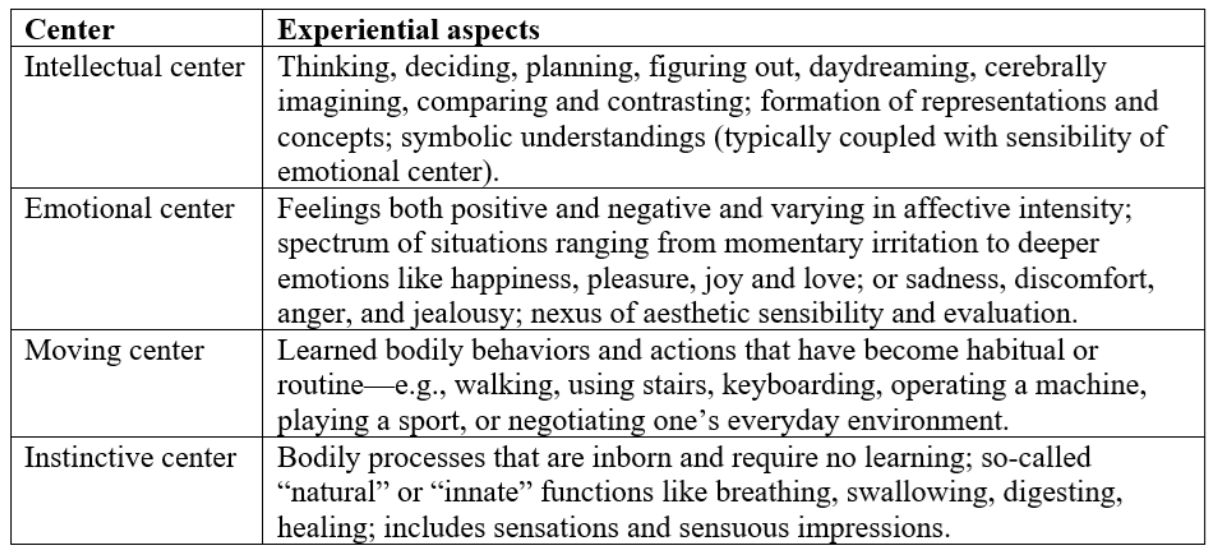
Table 1. The four centers, according to Gurdjieff; revised version of Seamon.8
Gurdjieff’s identification of these centers and their spectra of experience is a major contribution to the phenomenology of human experience because it offers a clarity of integration that can be verified via personal self-observation. Gurdjieff’s understanding of the four centers becomes even more striking phenomenologically because it demonstrates how experiences associated with each of the centers can be pinpointed more precisely via the degree of attention present in the particular thought, feeling, or bodily action. He spoke of no attention, which grounds automatic, habitual behaviors and situations (e.g., swallowing, walking, or tying a shoe); attracted attention, which relates to experiences and encounters whereby one is drawn to and immersed in something in the world (e.g., playing a favorite sport, watching a popular movie, or working through a daily crossword); and directed attention, referring to situations in which one makes an intentional effort to hold his or her awareness to the task at hand (e.g., mastering a new exercise routine, learning to watercolor, or studying a new language).
Experientially, this range of attention means that each of the four centers incorporates situations of no attention, attracted attention, or directed attention as described in the four-by-three matrix of Table 2. As indicated by the table’s headings in the far-left column, Gurdjieff used the phrase “moving part” for no attention, since these processes and actions are instinctive or habitual and therefore “just happen.” Likewise, he used the phrase “emotional part” for attracted attention, since the allure of the thing to which one is attracted involves varying degrees of emotional intensity. In the same way, he used the phrase “intellectual part” for directed attention, since intentional cerebral effort is required to keep the attention focused and active. As Table 2 indicates, one can speak of the moving part of the intellectual center, the emotional part of the moving center, the intellectual part of the instinctive center, the emotional part of the emotional center, and so forth. Each of these designations points to particular modes of human experience different from others. In this sense, Gurdjieff’s understanding of human being via the four centers is valuable phenomenologically because its structure offers an organized, holistic way to locate and describe the extraordinary variety of human consciousness, experience, knowing, and action.9
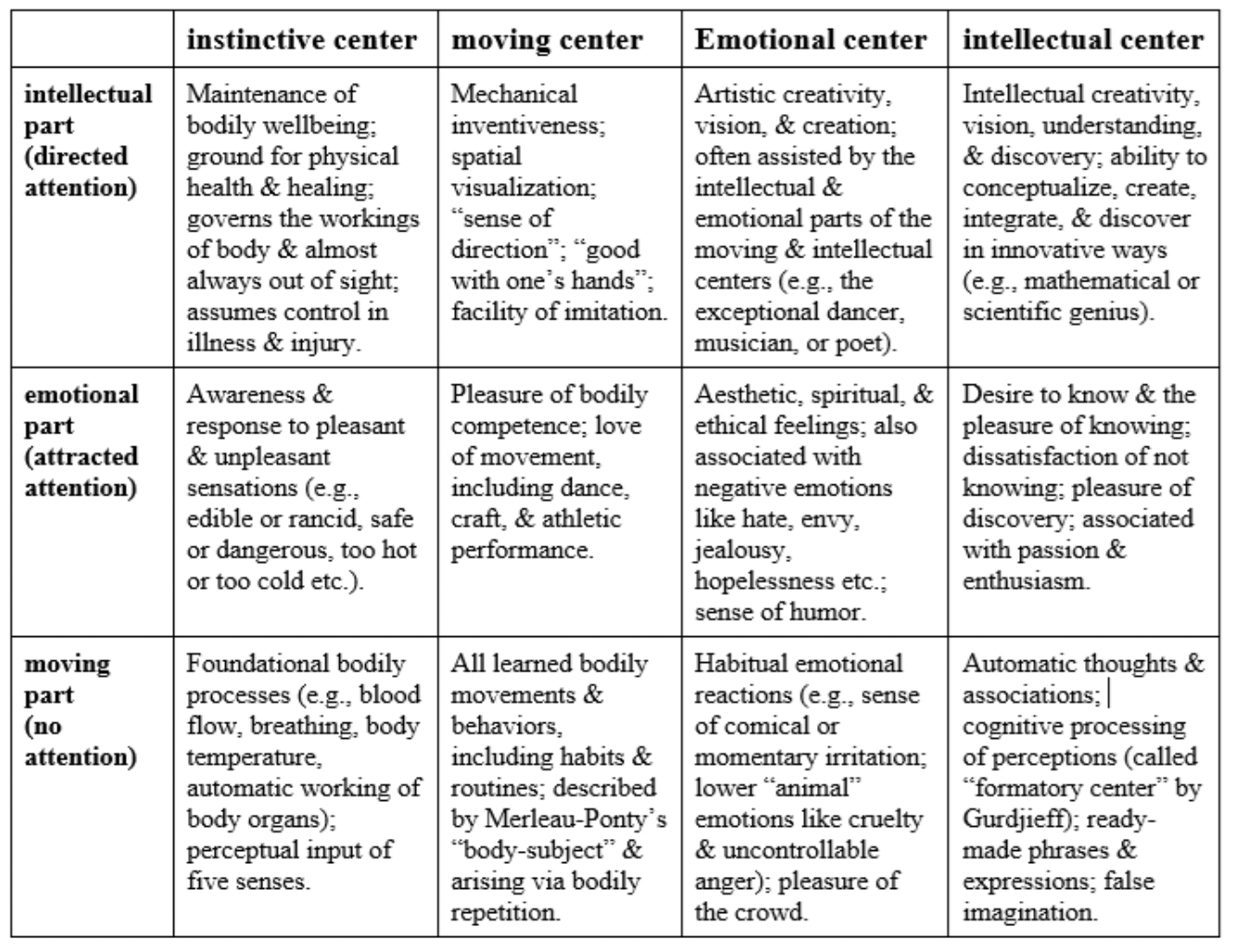
Table 2. Parts of the four centers, according to Gurdjieff; revised version of Seamon.10
Integrating Bodily Experiences
Table 3 relates directly to the session theme of “embodied wisdom” in that it provides an overview of the integrated ways in which the instinctive and moving centers found the lived parameters of human lives and worlds. Involving no attention, the moving parts of these bodily centers establish the habitual foundation of human lifeworlds, presupposing a lived body that functions appropriately via natural, innate processes and learned routines and patterns. Involving attracted attention, the emotional parts of these two centers unfold via the inducement of the experience or situation—e.g., an alluring sight or smell; the pleasure of performing a bodily action like rowing or cycling; or the enjoyment of watching the skilled movements of a talented dancer, mime, or athlete. Involving directed attention, the intellectual parts of the instinctive and moving centers are considerably different in their manifestations, in that the former can be pictured as the “animal mind” of the human being, directing or holding back energy to the other centers and taking control of the organism in times of illness, emergency, or danger. In contrast, the intellectual part of the moving center is a major ground for mechanical inventiveness. This part of the moving center figures out how things work and allows the person to devise better ways of devising, envisioning, inventing, and repairing. It is also the inner place from which actors and mimes activate convincing imitation.
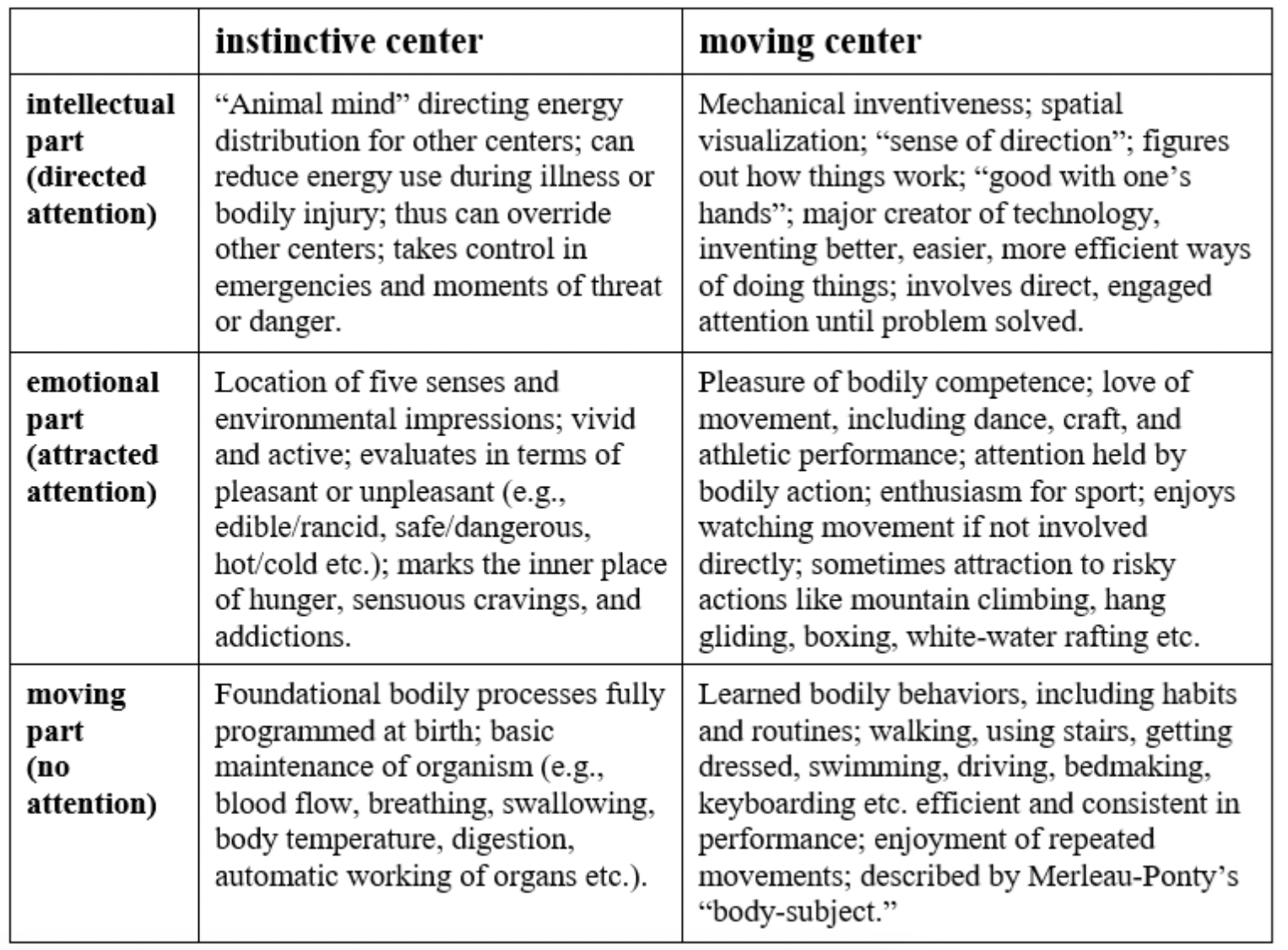
Table 3. A more detailed explication of the three parts of the instinctive and moving centers, according to Gurdjieff; based partly on Table 2 above.
The matrices of Tables 2 and 3 are significant phenomenologically because these designations contribute to a central phenomenological aim of locating and describing the complex spectrum of human behaviors, experiences, and modes of awareness. Gurdjieff’s four centers are perhaps most directly relatable to psychologist Howard Gardner’s theory of multiple intelligences, which he defined as particular modes of awareness, knowledge, and skills whereby human beings manipulate and improve their worlds—e.g., linguistic, logical-mathematical, musical, interpersonal, and so forth.11,12
In relation to Gurdjieff’s presentation of the bodily aspects of human experience, Gardner’s most relevant intelligence is bodily-kinesthetic, which refers to the ability to control one’s bodily movements and to finetune motor control to handle objects and carry out tasks skillfully and efficiently.13,14 This mode of bodily intelligence obviously parallels the three parts of the moving center, though one can argue that Gurdjieff’s understanding is more thorough and interconnected because it illustrates how modes of attention play a central role in the particular bodily action or skill. More broadly, Gurdjieff’s presentation of the four centers is more grounded and comprehensive than Gardner’s and can well be said to be the most thorough phenomenology yet devised, though whether academic researchers will ever realize its remarkable value remains a question unanswerable presently.
Really Seeing Experience
In real-life situations and in different ways for each of us, the parts of the four centers work smoothly together or disjunctively in conflict. A primary aim in the Gurdjieff Work is to become so alert to the four centers and their range of experience that one can see, in the moment, the complete “inner terrain” of a particular situation or event as one lives it. One must test the matrix via self-observation and really see in one’s own experience that it provides an accurate delineation of who and what one is as a human being. Becoming familiar with centers and their parts helps individuals to see what sides of themselves dominate and what sides are less developed and might be strengthened. One aim is to become more balanced in terms of the centers and their parts. In this way, one also becomes stronger in terms of being, which in the Gurdjieff Work is defined as the “amount that one can bear.”15
Gurdjieff’s phenomenology of human experience offers a remarkable portrait of what human beings are and, in this sense, offers one in-depth rendition of Thompson’s “Is” rather than “Seems” for human life. Unlike the aims of phenomenology, however, Gurdjieff’s rendition is not an end in itself but one pathway essential for self-transformation.
Author Biography
David Seamon is Professor Emeritus of Environment-Behavior and Place Studies in the Department of Architecture at Kansas State University in Manhattan, Kansas USA. His research and writings focus on a phenomenological approach to place, architecture, and environmental experience and meaning. His most recent books are Life Takes Place (Routledge, 2018); and Phenomenological Perspectives on Place, Lifeworlds, and Lived Emplacement (Routledge, 2023). He has been involved in Gurdjieff groups since the 1970s.

References
- This line is from Francis Thompson’s poem, “The Singer Saith of his Song” in The Complete Poetic Works of Francis Thompson, ed. Wilfred Meynell (New York: Boni and Liveright, 1913), 358–59. [Return to Section]
- Dermott Moran, “Edmund Husserl’s Phenomenology of Habituality and Habitus,” Journal of the British Society for Phenomenology, 42, no. 1 (2011): 53–77; 28. [Return to Section]
- David Seamon, Phenomenological Perspectives on Place, Lifeworlds, and Lived Emplacement (London and New York: Routledge, 2023). [Return to Section]
- Garrett Thomson, On Gurdjieff (London: Wadsworth/Thompson, 2003), 59–60. [Return to Section]
- Dermot Moran, Introduction to Phenomenology (London and New York: Routledge, 2000), 5. [Return to Section]
- P. D. Ouspensky, In Search of the Miraculous (New York: Harcourt Brace, 1949), 105–18. [Return to Section]
- Ouspensky, In Search of the Miraculous. [Return to Section]
- David Seamon, “Seeing the World with Fresh Eyes,” Religion and the Arts, 21:1-2 (2017): 163. Special Issue: "G. I. Gurdjieff, The Arts, and the Production of Culture." [Return to Section]
- For further discussion of the centers and their parts, see Maurice Nicoll, Psychological Commentaries on the Teaching of Gurdjieff & Ouspensky, 5 vols. (London: Stuart & Watkins, 1952–1956), 68–83, 392–98; P. D. Ouspensky, The Psychology of Man’s Possible Evolution (New York: The Hedgehog Press Inc., 1950), 58–62, 76–91, 96–114; P. D. Ouspensky, The Fourth Way (London and New York: Vintage, 1957), 56–68. In fact, the four centers and their three parts can be further differentiated in that each part is further divided into three parts—moving, emotional, intellectual. For example, one can observe situations relating to the intellectual part of the emotional part of the intellectual center (I find myself deeply involved in studying the many chapters in a new handbook on phenomenology and deciding which entries are worth reading). This complex explication of centers and their parts offers further evidence that Gurdjieff’s system offers remarkable insights for a phenomenology of human experience. For further discussion of parts of parts of centers, see Nicoll, Psychological Commentaries, 68–87; 1041–46. [Return to Section]
- Seamon, “Seeing the World with Fresh Eyes”, 164. [Return to Section]
- Gardner’s formal definition of intelligence is “the ability to solve problems or to create products that are valued within one or more cultural settings.” Howard Gardner, Frames of Mind: The Theory of Multiple Intelligences, 3rd ed. (New York: Basic Books, 2011), xxvii. Gardner’s work can be identified as implicitly phenomenological, since much of his argument is drawn from qualitative descriptions of real-world experience in a wide range of time and places. [Return to Section]
- Gardner Frames of Mind. [Return to Section]
- Gardner’s detailed examples of this mode of intelligence are dance, acting, and athletics (Gardner, Frames of Mind, 235–48). Also related to Gurdjieff’s moving center is Gardner’s discussion of “spatial intelligence,” which refers to the ability to realize spatial relationships, whether in the physical world (e.g., geographical orientation) or imaginatively (cerebral picturings). As with Gurdjieff’s centers and parts of centers, the intelligences that Garner identifies interrelate and are mutually supportive: “In the normal course of events, the intelligences actually interact and build upon, one another from the beginning of life” (Gardner, Frames of Mind, 29). [Return to Section]
- Gardner, Frames of Mind, ch. 9. [Return to Section]
- In this article, I can indicate only a few of the many ways conceptually that Gurdjieff extended our understanding of human being and human experience. Beyond four-centeredness, Gurdjieff argued that humanness incorporates three broader, intermeshed dimensions—what he called function, being, and will. On these three aspects of humanness, see J. G. Bennett, Deeper Man. (Winnepeg: Turnstone, 1978), 18–40; Ouspensky, The Fourth Way, 302–30. [Return to Section]
Suggested Citation
Seamon, David. "'She Sees the Is beyond the Seems': Gurdjieff, Phenomenology, and Embodied Wisdom" in The Teachings & Legacy of G.I.Gurdjieff: Conference Anthology, edited by Carole Cusack and Gosia Sklodowska. Center for the Study of World Religions, Harvard Divinity School, 2025. © License: CC BY-NC. https://doi.org/10.70423/0002.08