


An Immersion in Emerson / Emerson as Large Language Model
What can Emerson teach us about reading in an age of automated language? David LaRocca makes the case for lingering with difficult sentences long enough to let them change how we think and speak, especially those sentences we initially don't understand.
By David LaRocca | Edited by Russell C. Powell
TO THOSE WHO HAVE PUT EMERSON ASIDE:
Perhaps you remember him, if you remember him at all, as a collection of banal, shopworn exhortations: trust yourself, resist conformity, discover the extraordinary in the ordinary. Or you recall something harder to dismiss because it was harder to grasp: a prose whose successive radiations never quite disclosed what they proposed to illuminate. At once too obvious and too obscure. Emerson’s apparent simplicity suggests his thoughts are saccharine, while his density makes him seem impenetrable. These opposing judgments can coexist in the same reader, and often do.[1] In these few paragraphs, in the space this Initiative affords, I would like to invite you back to Emerson through an experience that precedes either judgment: the discovery that someone else’s words have reached you before you know what to make of them.
Early in John Williams’ 1965 novel Stoner, a precarious, accidental student from an unlettered family encounters Shakespeare in a college literature class. His instructor, Archer Sloane, presses him to explain a sonnet. The “class had read two plays by Shakespeare and was ending the week with a study of the sonnets.”[2] Students hesitate to explicate the text. “Mr. Stoner, what does the sonnet mean?” demands Sloane. As Stoner’s silence prevails, Sloane recites the sonnet again. “Sloane’s eyes came back to William Stoner, and he said dryly, ‘Mr. Shakespeare speaks to you across three hundred years, Mr. Stoner; do you hear him?’”[3] Stoner hears something he cannot yet put into words. He can produce only a starting phrase, “It means,” and then, after a pause, says it again. “Class is dismissed,” declares Sloane.
What happens after such a moment? The life of reading need not consist entirely in remembering the hour when a voice from the page first found us. The question rather is how an encounter may become a relationship, and a relationship may develop into a durable practice. How might we remain available to a text’s language without demanding that it reproduce earlier revelations? How do we stay open to surprises of a different kind?

Ralph Waldo Emerson’s writing offers company here. In “The American Scholar,” he reproduces a scene of reading: “We read the verses of one of the great English poets, of Chaucer, of Marvell, of Dryden, with the most modern joy,—with a pleasure, I mean, which is in great part caused by the abstraction of all time from their verses. There is some awe mixed with the joy of our surprise, when this poet, who lived in some past world, two or three hundred years ago, says that which lies close to my own soul, that which I also had wellnigh thought and said.”[4] That wellnigh holds open the distance between recognition and comprehension. Reading gives us access to something intimate that we have yet to articulate, supplying the language in which we begin to recognize how “the inmost in due time becomes the outmost.”[5]
Emerson interests me as an inhabitant of this interval. “We know more from nature than we can at will communicate,” he writes in Nature.[6] The difficulty is familiar: a perception arrives before we have the words for it; an available expression seems to deform what we mean when we say it. We might take this as evidence that our deepest experiences should remain unarticulated, silent. Yet Emerson keeps trying out his sentences, first in his journals, then on the dais, later in shuffled and reformulated lectures and essays. His prose makes repeated sorties to the same targets, doubles back after what eludes it, changing the figure, the scale, the angle of approach. The unsaid becomes a motivating reason to continue saying things.
To spend time with these Emersonian approaches is to enter an atmosphere in which thinking itself becomes perceptible. Thought alive in grammar. We learn the pressure of an Emersonian sentence, its gathering confidence, its sudden qualification, its striking metaphor or metonymy. We recognize his talent, as a minister’s son and former minister, for parable and homiletics; we begin to hear the play within an assertion that once sounded merely oracular.
I am tempted to call Emerson—across his journals, letters, lectures, essays, collected works, and miscellany—a large language model, using the term as a metaphor for the reader’s immersion in language. Prolonged exposure to language—even the language of just one writer—can alter the ways we attend, associate, and respond to the world beyond those texts. Emerson’s works, to be sure, gather other voices, inherited figures, collected observations, and varied experiments. “Our knowledge is the amassed thought and experience of innumerable minds,” he writes.[7]Immersion in this body of language exercises our capacity to form a thought, recognize its necessarily borrowed terms (for we did not invent the language in which we think), and discover what we can cogently and responsibly say by means of them. Yet immersion alone cannot do the work of judgment: we must distinguish among the claims that move us, test them against experience, reject what does not withstand scrutiny, and venture an answer of our own.[8]
The analogy also, as we should expect, summons Emerson’s resistance. “This vast memory is only raw material,” he insists.[9] Accumulation can supply only so much, and often too much; it perpetually leaves the decisive work unfinished, for us to pick up and sort through. “Trust thyself,” for instance, may sound like a bromide until we ask which self deserves our confidence, and how its intimations can be distinguished from prejudice.[10] “Whenever a true theory appears, it will be its own evidence” sounds self-certifying, though Emerson immediately adds that it must explain all phenomena.[11] We may still ask how to distinguish that explanatory power from the felt force of revelation. Such sentences invite assent before we have settled what assenting to them would mean. Reading Emerson thus requires, quite consistently, learning to recognize that temptation in our pleasure with his prose. His language becomes a resource for our projects only when we can do something with it beyond repeating its assurances.
Consider a sentence from “The Poet”: “For all symbols are fluxional; all language is vehicular and transitive, and is good, as ferries and horses are, for conveyance, not as farms and houses are, for homestead.”[12] At first, the terms may suggest a parable that thickens, then disappears, in the mist. But the sentence supplies a landscape for our reflection. A ferry does its work by carrying us elsewhere; we misunderstand its usefulness if we try to settle aboard it; the horse too carries us onward. But another layer awaits the etymologist who notes that the Greek word for transport is μεταφορά [metaforá]. Language buoys us between the locks as we pass from one body of water to another, changing elevation and direction as we go.
The sentence from “The Poet” performs its claim. Its figures carry us toward a distinction we can use without mentioning either horses or houses. Leaving a figure behind does not make it dispensable to the journey it enabled.[13]
Early in “The Poet,” Emerson imagines the reader’s wish that a poet will disclose the relations of things and make life comprehensible. “Such is the hope, but the fruition is postponed.”[14] The supposed guide carries the novice into fog, performing an ascent whose destination perhaps even he cannot reach. Eloquence, as the rivalry between Socrates and the Sophists made manifest long ago, can exploit our willingness to follow and accept. Emerson’s description supplies a critique of his own writing wherever it leaves us admiring one of those cloudy elevations we cannot reach, much less inhabit. Even our willing immersion in Emerson cannot exempt him from the demand that ideas become clearer in due course.
Of himself, Emerson wrote in 1859: “I am a natural reader and only a writer in the absence of natural writers. In a true time I should never have written.”[15] For Emerson, reading is an intuitive practice, whereas writing becomes a task he undertakes when the books he needs are missing. In reflecting on this passage decades later, his son, Edward, wrote of an 1867 journal entry by his father: “after saying that in proportion to your reality of life and perception will be your difficulty in finding yourself expressed in others’ words or deeds, [Emerson] interrupts himself,—‘and yet—and yet—when the visions of my books come over me as I sit writing, when the remembrance of some poet comes, I accept it with pure joy, and quit my thinking as sad lumbering work; and hasten to my little heaven, if it is then accessible, as angels might.’”[16] Emerson’s hesitation is precious. Someone so insistent on the authority of one’s perception acknowledges the relief of being reached, even displaced, by another voice. Reading, if the books be worthy, can offer renewal through moments, even seasons, of dependence.
In the current era of burgeoning artificial intelligence, the rapid and ceaseless supply of responses may prove irresistible to readers impatient with the time a difficult text requires.[17] We linger over lines whose sense and usefulness haven’t yet become apparent; we re-read to deepen the grooves of comprehension and mount a reply.[18] “It means.” And so a quiet satisfaction awaits us as readers of Emerson, from our first encounters in youth to our returns in middle age. We discover how our responses have changed, whether his sentences still stir idle thoughts into action and kindle the mind.[19] “Man Thinking must not be subdued by his instruments.”[20] The book, too, is among those instruments.
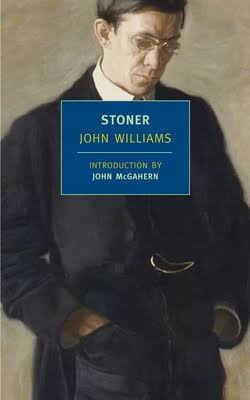
None of the foregoing presumes an easy or even satisfying uptake of Emerson’s brand of Transcendentalism, however. His religious and philosophical commitments will present real questions, and further familiarity with them might only sharpen one’s disagreements. But we can begin, as young William Stoner did, with the experience Emerson repeatedly describes: words meeting a mind that has its own unfinished business. Before the sonnet’s recitation, Stoner struggles in his literature course. Williams writes:
[He] pondered the words that Archer Sloane spoke in class, as if beneath their flat, dry meaning he might discover a clue that would lead him where he was intended to go; he hunched forward over the desk-top of a chair too small to hold him comfortably, grasping the edges of the desk-top so tightly that his knuckles showed white against his brown hard skin; he frowned intently and gnawed at his underlip.[21]
What could these words possibly mean? The thousands of pages that comprise Emerson’s oeuvre suggest how an education may continue from there, from that frustrated but energized moment of encounter with a library of texts. We learn to abide, to remain without a response long enough for distinctions to form, words to arrive, and another person—a fellow student, a professor, an untutored accomplice—to question them. With each return to Emerson’s sentences, our responses accumulate; and as we retrace those lines, we carry our earlier readings into the next encounter. The more we read, the deeper our immersion in his exuberant language—and the more radiant its refractions.[22]
“We hear, that we may speak. The Arabian proverb says, ‘A fig tree, looking on a fig tree, becometh fruitful,’” Emerson writes.[23] Like Emerson’s own parables of reading, much is contained—and much is begun—in our “looking” upon the text that lies before us. Amid this abundance of automated language via neural networks, perhaps we can make time to be caught up with Emerson once again, or for the first time: to linger in the company of his sentences so that something we have almost thought becomes something we can begin to say, to claim as our own, or to recognize as more fittingly freed from the bounds of individual authorship. We need not know at once what to say in return. “It means”—and we read on.
David LaRocca, Ph.D., graduated from Harvard Divinity School in 2003 and subsequently served as Harvard University’s Sinclair Kennedy Fellow in the United Kingdom. Advised by Stanley Cavell during his doctoral research, he also worked as Cavell’s research assistant and edited Emerson's Transcendental Etudes. He is the author or contributing editor of twenty-three books, including On Emerson, Estimating Emerson: An Anthology of Criticism from Carlyle to Cavell, A Power to Translate the World: New Essays on Emerson and International Culture, The Bloomsbury Anthology of Transcendental Thought, and Emerson’s English Traits and the Natural History of Metaphor. A recipient of the Ralph Waldo Emerson Society’s Distinguished Achievement Award, LaRocca brings philosophy into conversation with literature and cinema. His most recent authored books are Werner Herzog / Rogue Filmmaker and Metafiction on Screen.
[1] For the contested nature of Emerson’s legacy, see the contributions by sixty-seven authors collected in Estimating Emerson: An Anthology of Criticism from Carlyle to Cavell, ed. David LaRocca (New York: Bloomsbury, 2013), and my introduction, “A Conversation Among Critics,” 1–25.
[2] John Williams, Stoner (New York: New York Review Books, 2006 [1965]), 11.
[3] Williams, Stoner, 13.
[4] Ralph Waldo Emerson, “The American Scholar,” in The Complete Works of Ralph Waldo Emerson, ed. Edward Waldo Emerson (Boston: Houghton, Mifflin and Company, 1903–04), vol. I, 91–92; italics in original.
[5] Emerson, “Self-Reliance,” The Complete Works, vol. II, 45. For sustained philosophical readings of Emerson, see Stanley Cavell, Emerson’s Transcendental Etudes, ed. David Justin Hodge (Stanford: Stanford University Press, 2003), a collection I edited under my bachelor surname.
[6] Emerson, Nature, The Complete Works, vol. I, 31.
[7] Emerson, “Quotation and Originality,” The Complete Works, vol. VIII, 200.
[8] Emerson makes action essential to scholarship: “Without it thought can never ripen into truth,” “The American Scholar,” The Complete Works, vol. I, 94. A reading may be tested in how we respond to another person, handle disagreement, or revise a judgment when events resist it. In “Quotation and Originality,” Emerson describes the reader as “fired and guided” by a writer’s distinctions, lessons, and poetry (The Complete Works, vol. VIII, 191). For more on immersion, see Paul H. Fry, “Immersion: The Spectator Gets Into It” (165–78), and a reply by Garrett Stewart, “Wading In, Weighing In” (179–86) in Bandwidths: Reading Across Media with Garrett Stewart, ed. David LaRocca (New York: Bloomsbury, 2026).
[9] Emerson, “Quotation and Originality,” The Complete Works, vol. VIII, 204.
[10] Emerson, “Self-Reliance,” The Complete Works, vol. II, 47; see also 63–64 on the “aboriginal Self.”
[11] Emerson, Nature, The Complete Works, vol. I, 4.
[12] Emerson, “The Poet,” The Complete Works, vol. III, 34. Earlier in “The Poet,” Emerson values an imaginative book initially for “stimulating us through its tropes,” before we reach the author’s precise meaning (32).
[13] “Every thought is a prison also,” Emerson writes in “Intellect,” The Complete Works, vol. II, 339. For a fuller discussion of metaphor’s role in Emerson’s thinking, see my Emerson’s English Traits and the Natural History of Metaphor (New York: Bloomsbury, 2013).
[14] Emerson, “The Poet,” The Complete Works, vol. III, 12–13.
[15] Edward Waldo Emerson, notes to “Books,” The Complete Works, vol. VII, 403.
[16] Edward Waldo Emerson, notes to “Books,” The Complete Works, vol. VII, 404.
[17] See James Marriott, The New Dark Ages: The Death of Reading and the Dawn of the Post-Literate Society (New York: Doubleday, 2026).
[18] Emerson advised his cousin Elizabeth Tucker: “The best of all ways to make one’s reading valuable is to write about it.” Letter, February 1, 1832, quoted in Edward Waldo Emerson’s notes to “Books,” The Complete Works, vol. VII, 403.
[19] Emerson’s assertion that “books are for the scholar’s idle times” places a limit on their authority. His next sentence privileges direct perception: “When he can read God directly, the hour is too precious to be wasted in other men’s transcripts of their readings.” Books offer a resource during intervals when that illumination fails; their value does not make reading sovereign over experience. In a still further sense, books serve to agitate, then activate us to further reading and perhaps to further writing. Emerson, “The American Scholar,” The Complete Works, vol. I, 91. The image of kindling the mind pays homage to Robert D. Richardson, Jr.’s fine biography, Emerson: The Mind on Fire (Berkeley: University of California Press, 1995).
[20] Emerson, “The American Scholar,” The Complete Works, vol. I, 91.
[21] Williams, Stoner, 11.
[22] For a related account of reading as refraction, see Garrett Stewart, Closer Reading: Garrett Stewart’s Essays in Refraction, ed. David LaRocca (New York: Bloomsbury, 2026), including my introduction, “Reading Prismatically / A Spectrum Analysis,” 1–19. Stewart’s recourse to Cavell’s theory of reflexive self-reading through encounters with Emerson and Thoreau parallels my own indebtedness to Timothy Gould’s “Models of Reading” (ch. 4) and “Reading and Its Reversals” (ch. 5) in Hearing Things: Voice and Method in the Writing of Stanley Cavell (Chicago: University of Chicago Press, 1998). See the endnote to Stewart’s discussion of “Poe’s Imp-Aired Words” (ch. 4), in The Deed of Reading: Literature * Writing * Language * Philosophy (Ithaca: Cornell University Press, 2015), 239, n. 13. See also his discussion of “reversible intersubjectivity, as implicated in our response to Cavell’s own style,” in “The Avoidance of Stanley Cavell,” Closer Reading (ch. 3).
[23] Emerson, “The American Scholar,” The Complete Works, vol. I, 91.