


Two Perspectives on Emerson's Journals
As editor of Emerson's extensive journals, Lawrence Rosenwald reflects on what it meant to go from being a disciple of Emerson's to deciding what of his words to cut. Here, he reflects on what the relationship between reading and editing—and the change in perspective that shifting from one to the other—asks of us.
By Lawrence Rosenwald | Edited by Russell C. Powell
The first time I read Emerson’s journals, I was reading as a scholar preparing a celebratory analysis, a case for their importance and majesty. My attitude was discipular or apostolary or evangelical, religious terms suggesting both reverence and a need to make the case.

I was also an assistant professor at Wellesley College, hoping that what I wrote about the journals would help get me tenure. I had written a fair amount about other diaries—Cotton Mather's, Samuel Sewall's—but never about one as magnificent as Emerson's, so I was also an apprentice, seeking admission to a guild of critics devoted to such magnificence. The evangelical case I was making needed to be something more than “Behold the Lamb of God” or “Sh’ma yisrael,” of course. It needed to be scholarly, original, attractive to a university press. But “evangelical” is still the right word.
I was also a man in my late thirties. Looking at that sentence, I note how few critics talk about their age, in itself or in relation to the age of those they are writing about. Many critics write about late style, of course, Theodor Adorno and Edward Said among them, focusing on the age, or the nearness to death, of the writers they choose to present. Few of them write about their own age, though, their own nearness to or remoteness from death. Surely young critics will be influenced by their youth in how they look at late Beethoven. Adorno was thirty-four when he published his groundbreaking essay on that topic, but this fact is in the essay invisible. Said was quite near to death when he published On Late Style. He died before finishing it, but this fact is evoked once only in the book’s text.
I was, when I got tenure, just the age Emerson was when he published his first series of essays. But I thought of him as vastly older than I was, as an eminence, "Mr. America" in Harold Bloom's phrase; and I thought of myself as an apprentice. He was above and I below, in stature and (as I imagined, wrongly) in age.
I had of course read Emerson's rebuke of that way of thinking, which he wrote in 1837, at the age of thirty-four, in "The American Scholar": “Meek young persons grow up in libraries, believing it their duty to accept the views which Cicero . . . Locke . . . Bacon have given, forgetful that Cicero, Locke, and Bacon were only young persons in libraries when they wrote these books.”[1]
Substitute Emerson for Cicero and company, and me for the meek young persons in the library, and the comment still holds.
I did not, I should say, believe it was my duty to accept all of Emerson's views. I rejected his appalling reflections on slavery in a journal entry from 1852, for instance:
I waked at night, and bemoaned myself, because I had not thrown myself into this deplorable question of Slavery, which seems to want nothing so much as a few assured voices. But then, in hours of sanity, I recover myself, and say, "God must govern his own world, and knows his way out of this pit, without my desertion of my post, which has none to guard it but me.” I have quite other slaves to free than those negroes, to wit, imprisoned spirits, imprisoned thoughts, far back in the brain of man,--far retired in the heaven of invention, and which, important to the republic of Man, have no watchman, or lover, or defender, but I.[2]
Emerson’s equation of imprisoned thoughts with imprisoned human beings is unbearable, and I felt no need to accept it. But I did think it was my duty, which was also my pleasure, to make a case for him as a writer of journals.
When Oxford published my book, Emerson and the Art of the Diary, in 1988, I thought I was done with Emerson. I'd had my say; I didn't want to turn to another Transcendentalist diary or another genre of Emerson's writing. I turned instead to questions of translation and literary multilingualism. But in 2002 I was invited to edit Emerson's journals for the Library of America.
It was of course my book that had brought me to the Library's attention, and when I was interviewed I made clear that if I edited the Library edition I would do it in accord with the principles my book implied, i.e., a refusal to make the journals a single chronological sequence, a commitment to proceeding from original volume to original volume, a commitment to preserve the form that Emerson was best at, namely, the paragraph. So, my own book’s discipular principles shaped my choices as an editor.
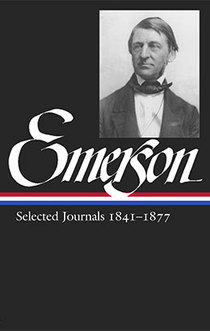
But an editor is what I now was. I had become less discipular in my thoughts about Emerson, too, and no doubt that made the shift in role from disciple to editor easier. I was also older: fifty-four when the first query came from the Library, fifty-seven when I signed the contract, sixty-two when the two volumes were published. Older, that is, than Emerson had been when he wrote his best journals.
What did it mean to be Emerson's editor? I was not, of course, doing the hard and astonishingly productive work done by Emerson's editors in the sixteen-volume Harvard edition that is one of the glories of editorial scholarship; rather I relied on that work, in grateful certainty that theirs was the best possible text. What I was doing was something simpler: reading, or rather re-reading, all Emerson’s journals, deciding what to keep and what not to, and aiming at a edition of two Library volumes, totaling some 1,800 pages.
When I read the journals for the first time, I saw the early journals as documents revealing how a writer found his form. Emerson began—at the age of sixteen—by imitating orators, by quoting orators. The prose is formal, full of pomp, long-winded. It was not until later that he found, and brilliantly fused, two better models for writing a journal: the commonplace book, as described by John Locke, and the Puritan diary of spiritual experiences, as inculcated in him by his brilliant, visionary aunt Mary Moody Emerson. Reading those early journals, I felt for the young man—the boy, really—groping, intuitive, imitative, passive. (My own early journals, which I began at the age of seventeen, are all too similar.) And I could feel for Emerson partly because I knew what he could not know, namely, that he would find his form, that his floundering would be productive.
Reading the journals for the second time, I had to view those early volumes not as the drama of the writer in formation, but as writing to keep or cut. “Read the best books first, or you may not get a chance,” wrote Thoreau, and I had a similar feeling about the journals.[3] So from those early volumes, each one called "Wide Wide World" and given a number, I kept only ninety pages, only five percent of the Library edition. What to a discipular critic was a writer finding his form was to an editor second-rate writing.
Something similar happened with the later journals. When I first read them, I saw the drama of Emerson struggling with dementia – loss of focus, memory, executive function. The journals are sparser, full of brief notations. The miscellaneous notebooks are abundant, many of them being indices, or indices of indices, means for Emerson to fix on paper what he could not hold in mind, each more labored than the last, the continuing struggle gallant but in vain. When I read them as editor, knowing this drama could not be represented by any possible sampling of the late journals, I felt obliged to cut most of what Emerson wrote. The journals he kept after the age of sixty-two, the age I was when the Library edition came out, occupy less than sixty pages out of 1,800.
There was a kind of editing I was not doing, a more aggressive kind that puts the editor on a still higher plane. Committed as I was to the unit of the paragraph, I was almost never, within this or that paragraph, choosing better sentences and rejecting worse.
I knew the powers of that mode of editing. Richard Poirier, who had founded the Library and still worked there, a lover and celebrated scholar of Emerson, was reading the journals along with me, and sending me his suggestions for inclusion and exclusion, always prefacing them with an amiable note saying that he knew the final choices were mine to make, but that he would keep sending me suggestions nonetheless, for whatever use they might be. His suggestions were brilliant; he had fine and rigorous taste, and the sentences he wanted to cut were invariably worse than the sentences he wanted to keep. I wondered what it might be like to be Poirier’s kind of editor, with Poirier’s kind of confidence and authority, his willingness to impose his own judgments on Emerson’s prose even at the level of the sentence. But I had a different set of principles, and a less confident sense of my own judgment.
Age being so central to these reflections, I should note that Poirier was in his eighties at this time, with the authority age makes possible. I should also note that when he died, in 2009, he had on his desk at the Library a volume of the Journals, and no doubt some of his notes on it. It felt right and inevitable to dedicate the Library edition to him, who had done so much to make it better.

The accidents of my own life have led me to be both disciple and editor in relation to Emerson and his journals, but might there be a lesson to be discerned in those accidents? We cannot, after all, expect that our relations to every author we discuss will include both a discipular role and an editorial one.
To be only a disciple implies a limitation; one is not fully oneself, not on a footing of equality, of I and Thou. Thou is there, I is not. To be an editor implies the opposite limitation; the author is not quite there, being only the producer of raw material. The I is there, the Thou is not.
I dislike claims that the truth is equidistant from two extremes, since often each extreme has its truth, and the middle has neither. Instead, by way of conclusion, and in the context of Martin Buber’s distinction between I and Thou, I offer a story about Buber. He was invited by some students to a shabbat lunch, and over lunch one or another student, or perhaps all of them, asked him whether he believed in God. He equivocated, evaded, leaving the students unhappy and himself still more so. On the way home, though, he saw what he should have said, which was this. “If you mean a God in the third person, the subject of biblical narrations, who destroyed Sodom and Gomorrah, then my answer is No. If you mean a God in the second person, an interlocutor, to whom I can speak, who can speak to me, then my answer is Yes.” A good model for the relationship we should have with the writers we describe, exalt, and edit.
Lawrence Rosenwald is Anne Pierce Rogers Professor of English Emeritus at Wellesley College, where he taught from 1980 until 2022. He has written extensively about diaries, words and music, translation, literary multilingualism, and literature and pacifism, and is currently working on a book on that last subject. Along with serving as editor of the Library of America's publication of Emerson's journals, Lawrence has published translations of both prose and verse from Latin, German, French, Italian, and Yiddish, and has written and performed more than 50 verse scripts for early opera and early music theater.
Notes
[1] Ralph Waldo Emerson, Essays & Lectures, ed. Joel Porte (New York: Library of America, 1983), 57.
[2]
[3] Henry David Thoreau, A Week on the Concord and Merrimack Rivers (Boston: Houghton Mifflin Company, 1961), 98.