


Grappling with the T-word
What exactly is "Transcendentalism"? Robert Thorson argues that the movement’s notorious definitional fuzziness obscures its enduring significance, and turns to Thoreau's own understanding of the "T-word" to offer a more precise account.
By Robert Thorson | Edited by Russell C. Powell
The scholarly literature on transcendentalism is full of good descriptions, but not of good definitions. In The Transcendentalists and Their World, Robert Gross consciously left the movement undefined because its original practitioners consciously left it undefined themselves.[1] Laura Dassow Walls, in her biography of Henry David Thoreau, found transcendentalism to be a “new view reshaping everything – philosophy, theology, science, law, the trades and professions."[2] Randall Fuller describes a distinctly American variant of European Romanticism, arising in the “mid-1830s as an intoxicating set of philosophical, literary, and spiritual tendencies united by discontent with American life."[3] The historian Philip Gura, perhaps exasperated by transcendentalism’s many definitions, simply collapses the discussion down to: “people know what to expect.”[4]

As the STEM scientist in me read these, and other accounts, the absence of a clear definition kept me confused. I’m not alone. In one of his last works, the late historian and writer Robert Richardson demurred when writing: “Transcendentalism has not been a very useful label, but it has been impossible to get rid of.”[5] Its imprecision as a lower-case philosophy-theology collides with its importance as an upper-case historical movement.
The Oxford English Dictionary lists four definitions seldom used in the scholarly literature. Rather than parse them here, I unpack the word itself. As with sexism, racism, and capitalism, the T-word is an “…ism,” meaning a culturally shared set of ideas. As with transgender and transdisciplinary, the “trans…” part of the word means to cross over or beyond something. Finally, the Latin root “scandere” means to climb, as in “ascend.”
Linking prefix, root, and suffix, and confining ourselves to the context of early-nineteenth-century New England, Transcendentalism was the product of a coalition of thinkers attempting to surmount a challenging obstacle – their own intellectual culture. This was clearest for the Transcendental Club, a symposium of friends and colleagues that began meeting in September 1836, sometimes at Ralph Waldo Emerson’s home, to discuss new books and ideas they thought were being given insufficient attention by the New England intelligentsia. Their oppositional views—"who we’re not"—were stronger than their affirmations of —“who we are.” Though the club launched a journal, The Dial, its peak circulation never exceeded 300 subscribers, and it shut down in 1844 after only four years of struggle.[6]
Having been trained as a research geologist, my only formal study of both transcendentalism and Transcendentalism came during freshman English. But as a Thoreau scholar, I’ve been forced to grapple with the mushy challenges the two words present.
In 1833, Thoreau was teenager in college before the Transcendental Club began meeting. His initial grappling with its ideas came in the winter of 1835-1836 via the mentorship of Orestes Brownson, who later converted to Catholicism. By the time Thoreau graduated in 1837, he had befriended the movement’s leading figure, Emerson, with whom Thoreau would maintain a complex friendship for the rest of his life. Soon after, though, Thoreau was questioning Emerson’s transcendental assumptions. By the early 1850s, he was a sojourning scientist with a focus on seasonal phenology. And by 1860, he was using the T-word mainly as self-deprecating humor. Critically, he never gave his own definition(s) of the terms.
In my work to sort out Thoreau’s encounter with transcendentalism, I’ve developed six empirical definitions. By “empirical,” I mean what can be found from Thoreau’s own descriptions in his Journal.
First is the philosophical basis of classic Emersonian Transcendentalism, a.k.a. Platonic idealism. Nature in this world is a set of symbols used to understand a separate world of Spirit, where the Oversoul resides. Thoreau junked this idea in the Friday chapter of his 1849 book A Week on the Concord and Merrimack Rivers when he wrote: “Is not Nature, rightly read, that of which she is commonly taken to be the symbol merely?”[7] Earlier, he had written, “Let us not underrate the value of a fact; it will one day flower into a truth.” Along these lines, Richard Schneider elegantly captured how, for Thoreau, meaning arises from earthly materiality: “For Thoreau spirit is found in nature, not through it—a crucial distinction.”[8]

Second in my list of empirical definitions is the historic movement headquartered in Concord and Boston. This group used the good book of Nature for spiritual guidance rather than the Good Book of the Christian bible. The anonymous publication of Nature in 1836 by a lapsed Unitarian minister—Emerson himself—helped galvanize the movement’s beginnings.
Third is the transcendence of scientific induction, the distillation of general laws from the fusion of more specific laws (a.k.a., "eureka" moments). Induction always arrives unbidden with a flash of insight that leads to new means of investigation, thereby transcending the facts as we knew them before. For example, in Thoreau's 1854 Journal, he asks: “What is the difference,” between “the law by which a brook finds its river, the instinct by which a bird performs its migration and the knowledge by which a man steers his ship around the world?”[9] The answer to his question is Isaac Newton’s general law of gravity, which links these three seemingly distinct phenomena to Earth’s potential energy, magnetism, and sphericity, respectively. Hence why, in a March 1853 Journal entry, Thoreau announced his interest in the “science which deals with the higher law” of induction.
Fourth is the emotional transcendence of subjective, poetic, and aesthetic feeling above and beyond the merely cognitive understanding of information. “Nothing is so truly bounded and obedient to law as music,” Thoreau wrote in his Journal, “but nothing so surely breaks all petty and narrow bonds."[10] Music is transcendent. Acoustics is not.
The fifth definition of Transcendentalism seen in Thoreau’s Journal is his use of the term as a counterpoint label that is distinct from the historic movement. The more scientific Thoreau became, and the more historical Transcendentalism waned, the more Thoreau used the term. According to William Rossi, “Thoreau begins self-consciously to refer to himself as a 'transcendentalist' in the same moment that his scientific interest in Concord environs starts to intensify.”[11] In contrast to Emerson, Thoreau, Lawrence Buell writes, "persisted in calling himself a Transcendentalist for the rest of his life, in full awareness that the term had long since become a synonym for an oddball. Why? Partly, it seemed to anticipate and disarm imagined resistance with a bit of whimsical humor."[12] In the final and most important science published in his lifetime, “The Succession of Forest Trees,” Thoreau opens with a self-denigrating joke about being a transcendentalist.[13]
Seven years before he wrote that article, Thoreau respectfully declined an invitation to join the American Association for the Advancement of Sciences, mainly because they met in faraway Washington D.C. In his response letter, according to John Hildebidle, “Thoreau never says... that he thinks what he is doing is not science, but rather that it may not be seen so by others because of the transcendentalist (or more broadly the philosophical) component.”[14] But in his private journal, Thoreau couldn’t resist responding more flippantly: “The fact is I am a mystic, a transcendentalist, and a natural philosopher to boot.”[15]
My sixth and final definition is the riddle that the later Thoreau lived, and which Richardson nailed down. If “Thoreau can still be called a transcendentalist,” Richardson writes, “it is because he can transcend idealism, Platonism, and Kantianism in a quest to experience things as they are.”[16] Outgrowing transcendentalism, then, is also a form of transcendentalism.
My engagement with Harvard’s Transcendentalism Initiative during the workshop of October 2025 overlapped with completing my latest book, The Walden Experiments: The Science of Henry David Thoreau.[17] Many of my takeaways from the workshop found their way into the book. Most importantly, they sharpened my epilogue, which presents my understanding of Thoreau’s final version of transcendentalism.
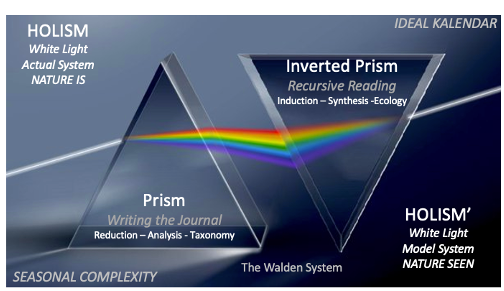
There, I use Isaac Newton’s famous double-prism experiment in optics as an analogy for what Thoreau was doing at Walden.[18] In Newton’s experiment, a clear glass prism is used to refract the full spectrum of incoming “white” light into the colors of the rainbow. A second prism is inverted and positioned to refract the colored spectrum from the first prism back into a single beam of white light that approximates that of the original. In Walden, Thoreau’s analytical, scientific mind acted as the first prism to refract the incoming material sensations of light, sound, smell, touch, and taste into familiar concepts. The result was natural history. He then used the second prism of his synthetic mind to re-refract those particulars into an integrated intellectual system. The result was a deeply satisfying understanding that fell short of the intuitively sensed reality beyond his cognitive grasp.
This shortcoming was satisfactory for Thoreau because it fostered humility. He understood that “the universe is wider than our views of it.”[19] The closer he came to modeling his experience via empirical science, the closer he came to experiencing reality’s governing “Universal Intelligence.”[20] He continues: “The Highest that we can attain to is not knowledge, but Sympathy with Intelligence.”[21] True science, he understood, was “con-science, scientia, a moral knowledge.”
For both workshops of last October and this September, my recommendation was, and still is, three-fold. First, I suggest we come up with a consensus definition of transcendentalism, even if its original practitioners consciously chose not to. A clear definition could act as a fence, enclosing the thing we care about while exclosing everything else. Not having a shared definition limits our communication with each other and makes it hard for wider society to know what we’re doing. In science, things without definitions either remain in the shadows or disappear.
My second recommendation was that we identify, clarify, and boldface the many offshoots of Transcendentalism that continued to ramify through American cultural history. The American environmental movement, the Civil Rights Movement, multiwave feminism, global sustainability, and technology studies all bear the influence of transcendentalist thought. By hard-wiring current issues back to the same historic root, we can strengthen the Transcendentalism Initiative’s raison d’etre.
Finally, I suggest we wrangle our ideas into a consensus document we can sign and share with each other and the wider world, as with the Mayflower Compact or the U.S. Constitution. Without a written consensus, we will continue to talk past one another, hedge our common identity(s), and appear fuzzy to outsiders. While the Transcendentalists themselves appeared fuzzy to outsiders, our charge today is to make their commitments and concerns clear. That starts with healthy debate about what transcendentalism (and Transcendentalism) truly is.
Robert M. Thorson is an affiliate of the Transcendental Initiative, a professor of Earth Sciences at the University of Connecticut, and someone who has been strongly influenced by Henry David Thoreau since 1968. He is the author of Walden's Shore: Henry David Thoreau and Nineteenth-Century Science (Harvard University Press, 2015), The Boatman: Henry David Thoreau's River Years (Harvard University Press, 2019), and most recently The Walden Experiments: The Science of Henry David Thoreau (Princeton University Press, 2026).
Notes
[1] Robert A. Gross, The Transcendentalists and Their World (New York: Farrar, Straus and Giroux, 2021), 312-319.
[2] Laura Dassow Walls, Henry David Thoreau: A Life (Chicago: University of Chicago Press, 2017), 88.
[3] Randall Fuller, The Book that Changed America: How Darwin’s Theory of Evolution Ignited a Nation (New York: Penguin, 2017), 53.
[4] Philip F. Gura, American Transcendentalism: A History (New York: Hill and Wang, 2007), 208.
[5] Robert D. Richardson, “Upstream with the transcendentalists,” The Thoreau Society Bulletin 311 (Fall 2020), 15.
[6] The Dial has been periodically revived. Its current version is The Dial: A Journal of the Emerson Society. https://thedialjournal.org/?page_id=9.
[7] Henry D. Thoreau, “A Natural History of Massachusetts,” in Walden, The Maine Woods, and Collected Essays & Poems, Robert Sayre and Elizabeth Hall Witherell, eds. (New York: Library of America College Editions, 2007), 567.
[8] Richard Schneider, "Walden," in The Cambridge Companion to Henry David Thoreau, Joel Meyerson, ed. (Cambridge: Cambridge, Univ. Press, 1995), 92-106, 100.
[9] Henry D. Thoreau, Journal, May 17, 1854.
[10] Thoreau, Journal, Feb 5, 1854.
[11] William Rossi, in Richard J. Schneider, ed., Thoreau’s Sense of Place (Iowa City: University of Iowa Press, 2000, 28.
[12] Lawrence Buell, Henry David Thoreau: Thinking Disobediently, (New York: Oxford University Press, 2023), 50.
[13] John Hildebidle, Thoreau: A Naturalists Liberty (Cambridge, MA: Harvard University Press, 1983), 95. Hildebidle suggests that such a disclaimer or caveat "would not have been so necessary a generation before: and it would not have been tenable a generation afterward."
[14] William Rossi, “Thoreau as a Philosophical Naturalist Writer,” in Edmund A. Schofield and Robert C. Baron, eds., Thoreau’s World and Ours: A Natural Legacy (Golden. CO: North American Press, 1993), 65.
[15] Thoreau, Journal, March 5, 1853.
[16] Robert D. Richardson, “Henry Thoreau’s Perpetual Grief and Unquenchable Life,” boundary 2 49, no. 4 (2022): 114.
[17] Robert M. Thorson, The Walden Experiments: The Science of Henry David Thoreau (Princeton, NJ: Princeton University Press, 2026).
[18] Ibid., 244-245.
[19] Henry D. Thoreau, Walden, ed., Lyndon Shanley (Princeton, NJ: Princeton University Press, 1971), 320.
[20] Thoreau, Journal, December 2, 1853.
[21] Henry David Thoreau, “Walking,” Atlantic Monthly June 1862, https://www.theatlantic.com/magazine/archive/1862/06/walking/304674/.