


Aztec Ritual with Psilocybe Mushrooms (Teonanacatl)
The Florentine Codex is the result of a collective effort led by Fray Bernardino de Sahagún, a Franciscan friar educated at the University of Salamanca. Sahagún settled in Mexico in 1529 and taught from 1536 onwards at the Royal College of Santa Cruz in Tlatelolco, the first institution of higher education in America after the Spanish colonization. Indigenous students who were trilingual, that is, who spoke Nahuatl, Spanish, and Latin, participated in the preparation of the codex, as did elders and authorities from the Nahua communities where the information was collected, namely Tepeapulco and Tlatelolco.
Research leading to the publication of the codex spanned more than thirty years, starting in 1547. The resulting codex is written in both the original Nahuatl language and Spanish. It also features drawings and illustrations by Nahua artists. The information is highly reliable due to the methodology employed. Fray Bernardino de Sahagún, who was very skilled in Nahuatl language, has been considered the first anthropologist because of the methodology applied. First, questionnaires were drafted. Second, elderly people who were experts in Aztec religion and culture were contacted by local authorities. Third, several interviews in different villages were performed in Nahuatl language. And fourth, the information was translated and gathered by trilingual students. Finally, the information was compared to discarded inaccuracies and false testimonies and to preserve the common features. The outcome was a twelve-volume encyclopedia known as Florentine Codex.
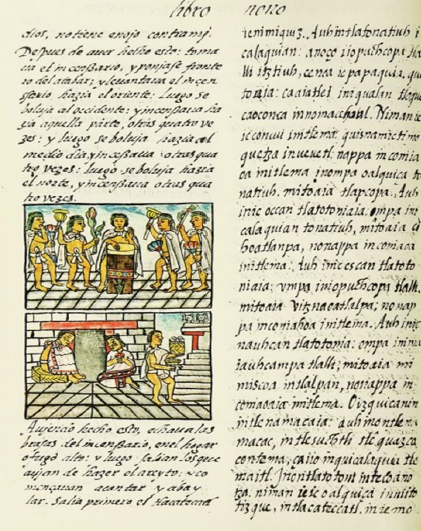
The ritual described below is in Book IX, which discusses merchants (pochtecas). Based on information provided by other historical sources, ceremonies involving visionary mushrooms were performed by members of the ruling classes (rulers, priests, and merchants). Mushrooms were highly prized and purchased at high prices. The purpose of the ritual was to make an offering to the gods in gratitude for a successful expedition. The ritual took place in a private residence, specifically in the home of the merchant who made the offering. The priests arrived at that location to perform the ceremony. A significant feature is the collective character of the ritual and the fact that participants shared and talked about the visions they had. Dancing and singing were part of the ritual but also weeping and introspection. It is worth highlighting that some participants were in command of their senses. So, the consumption of Psilocybe mushrooms does not mean a loss of consciousness.
A notable aspect of this historical source is the summary of recorded visions of the participants in the ritual, which are very helpful in better understanding the cultural context behind the codex. The visions are culturally situated and refer to norms and patterns of behavior distinctive to Aztec worldview. Many recorded visions foresee the future, and see, in the language of the codex, what would befall those who had eaten no mushrooms.
Other sections of the Florentine Codex provide further information on visionary mushrooms, including their therapeutic properties and their cultural uses by specific sectors of the population, such as women and young people. To date, there is no detailed study that fully explains the different cultural uses of visionary mushrooms recorded in the Florentine Codex.
Due to the methodology, the Florentine Codex has been recognized as the most complete source for studying Aztec culture. It is especially invaluable for a better understanding of the diverse cultural uses that visionary mushrooms have had throughout history, as well as the various contexts in which the Aztecs performed these rituals.
And when the effects of the mushrooms had left them, they consulted among themselves and told one another what they had seen in vision. And they saw in vision what would befall those who had eaten no mushrooms, and what they went about doing. Some were perhaps thieves, some perhaps committed adultery. Howsoever many things were, all were told—that one would take captives, one would become a seasoned warrior, a leader of the youths, one would die in battle, become rich, buy slaves, provide banquets, ceremonially bathe slaves, commit adultery, be strangled, perish in the water, drown. Whatsoever was to befall one, they then saw all [in vision]. Perhaps he would go to his death in Anahuac.
And when the division of the night arrived, when it was exactly midnight, the one who provided the banquet thereupon paid his debt [to the gods]. He burned paper spattered with rubber; he did as had been told above. And once again chocolate was drunk; two or three times during the night chocolate was served. And so they danced all night; indeed, they sang until the dawn broke.
Source
This primary source contains the earliest description of a Psilocybe mushrooms ritual in history. It was compiled in Nahuatl language and Spanish. It provides information about the ritual and visions experienced by the participants. The ritual was offered by merchants to express their gratitude to the gods for a successful expedition.
Fray Bernardino de Sahagún. The Florentine Codex: Book 9, translated by Charles E. Dibble and Arthur J. O. Anderson (The School of American Research and the University of Utah Press, [1959] 1976), 38–40.
At the very first, mushrooms had been served. They ate them at the time when, they said, the shell trumpets were blown. They ate no more food; they only drank chocolate during the night. And they ate mushrooms with honey. When the mushrooms took effect on them, then they danced, then they wept. But some, while still in command of their senses entered and [sat] there by the house on their seats; they danced no more, but only sat there nodding.
One saw in vision that already he would die, [and] there continued weeping. One saw in vision that he would die in battle; one saw in vision that he would be eaten by the wild beasts; one saw in vision that he would take captives in war; one saw in vision that he would be rich, wealthy; one saw in vision that he would buy slaves—he would be a slave owner; one saw in vision that he would commit adultery—he would be struck by stones—he would be stoned; one saw in vision that he would steal—he would also be stoned, one saw in vision that his head would be crushed by stones—they would condemn him; one saw in vision that he would perish in the water; one saw in vision he would live in peace in tranquility, until he died; one saw in vision that he would fall from a roof-top—he would fall to his death. However, many things were to befall one, he then saw all in vision: even that he would be drowned.
Sacred Plants and Fungi of the Americas
Visit the CSWR Digital Platform "Sacred Plants and Fungi of the Americas" for more information on Psilocybe aztecorum
Bibliography
Akers, Brian P., ed. The Sacred Mushrooms of Mexico. Lanham, MD: University Press of America, 2007.
Flores Farfán, José Antonio, and Jan G.R. Elferink. The Aztec Mind: Nahuatl Ethnobotany, Mental Health and Psychoactive Drug among Ancient Mexicans. Munich: Lincom Europa, 2015
Guzmán, Gastón. “Variation, Distribution, Ethnomycological Data and Relationships of Psilocybe aztecorum, a Mexican Hallucinogenic Mushroom.” Mycologia 70, no. 2 (1978): 385–396. https://doi.org/10.1080/00275514.1978.12020239.
Bernardino de Sahagún. Florentine Codex: General History of the Things of New Spain. Book 9, chap. 8. Translated by Charles E. Dibble and Arthur J. O. Anderson. Santa Fe, NM: School of American Research; Salt Lake City: University of Utah Press, 1976. (Originally published 1959.)
Richard Evans Schultes, Albert Hofmann, and Christian Rätsch. Plants of the Gods: Their Sacred, Healing, and Hallucinogenic Powers. Rochester, VT: Healing Arts Press, 1992.
Osiris Sinuhé González Romero
Osiris González Romero is a Research Fellow at “Glo-Phi: Philosophizing in a Global World Center for Advanced Studies”, Hildesheim University, Germany. He is a former Postdoctoral Fellow at the Center for the Study of World Religions, Harvard Divinity School, and also at the University of Saskatchewan, Canada, Department of History. He earned his PhD in the Heritage of Indigenous Peoples from Leiden University. His research focuses on Indigenous Philosophies, Philosophy, Mesoamerican and Latin American Studies, Psychedelic Studies and Aesthetics.

Suggested Citation
Romero, Osiris Sinuhé González. "Aztec Ritual with Psilocybe Mushrooms (Teonanacatl)." Archive of Mystical Experiences. Center for the Study of World Religions, Harvard Divinity School, 2026.