


The Largesse of Thoreau and Whitman
Jane Bennett returns to the first and only meeting of Henry David Thoreau and Walt Whitman for how it helps disclose a personhood large enough to be human and ahuman at once, illumining the self's animal, mineral, and even atmospheric vibrancy.
By Jane Bennett, Guest Contributor | Edited by Russell C. Powell
On November 10, 1856, Thoreau and his friend Bronson Alcott visited Walt Whitman and his mother at the Whitman house in Brooklyn, New York. Thoreau gives an account of the social call in two letters to Harrison Blake. In the first, written nine days after the visit, Thoreau is quite ambivalent about the poet. Alluding, it seems, to Whitman’s unseemly self-confidence, Thoreau reports that Whitman “is apparently the greatest democrat the world has seen.” (Thoreau adds, however, that the dismissal of “kings and aristocracy” is “long deserved.”) He then notes Whitman’s “coarse nature,” but also his “sweet disposition.” Thoreau’s initial conclusion: Whitman is “essentially strange.”[1]
In the second letter, a month later and after Thoreau has digested the visit and, perhaps even more importantly, read the book of Whitman’s poems that Whitman gave to him (in particular, the ones that would become “Song of Myself” and “Crossing Brooklyn Ferry”), Thoreau is more positive. Although the “sensual” quality of the poetry is “disagreeable,” Whitman speaks “more truth than any American or modern that I know. I have found his poem exhilarating, encouraging.” Thoreau’s summary judgment now is that Whitman’s “great primitive poem” is “awe-fully good” (it “stirs me well up”) and “we ought to rejoice greatly in him.”[2]
Thoreau, who had told Whitman that he himself “did not think much of America or of politics,” is encouraged by the poetry of the self-proclaimed “bard of democracy.” Why? Just what is it about the poetry that gives Thoreau cause for rejoicing?
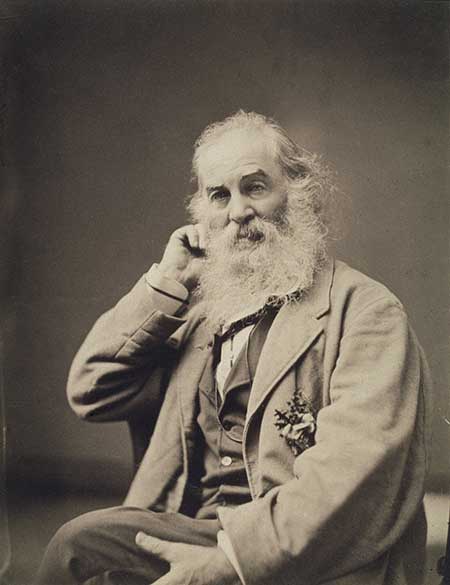
I’d like to plant the seed that it was the peculiar model of self that the poems “promulge” (to use one of Whitman’s middle-voiced verbs[3]): the distinctive “I” that lives in Leaves of Grass is internally very heterogeneous, and it keeps shifting shape as it breathes the world in and out, in and out. This is an “I” that acknowledges all dimensions of itself—poetic, ethical, divine, animal, vegetal, mineral. As per two famous lines from Whitman’s “Song of Myself”: “I am large, I contain multitudes” and “I find I incorporate gneiss, coal, long-threaded moss, fruits, grains, esculent roots, And am stucco’d with quadrupeds and birds all over.”[4]
Whitman’s “dilated” self, at once human, nonhuman, and more-than-human, has person-ality (that is to say, can take the form of a person or personae). But another layer of its existence is as apersonal as gneiss or gravity, or rain (“I am the Poem of Earth, said the voice of the rain, / Eternal I rise impalpable out of the land and the bottomless sea, / Upward to heaven, whence, vaguely form’d, altogether changed, and yet the same, …”[5]). Such a figure of self would intrigue Thoreau, even provoke awe in him, in part because it resonates with Thoreau’s own radically ecological (as opposed to anthropocentric) sense of being. You know the famous quote in the “Solitude” chapter of Walden, where Thoreau says he is “sensible of a certain doubleness by which I can stand as remote from myself as another. However intense my experience, I am conscious of the presence and criticism of a part of me, which, as it were, is not a part of me, but spectator, sharing no experience, but taking note of it”? Yes, but Thoreau’s self is more than double; it continues to multiply beyond just two parts; it becomes quite a crowd.[6] I say this because for Thoreau to be human is also to be ahuman, for example, vegetal: “Am I not partly leaves and vegetable mould myself?” (from his “Solitude” chapter of Walden) or “I am of kin to the sod, and partake largely of its dull patience” (from another letter to Harrison Blake, May 2, 1848). Or mineral: “What is man but a mass of thawing clay? The ball of the human finger is but a drop congealed. The fingers and toes flow to their extent from the thawing mass of the body … The nose is a manifest congealed drop of stalactite” (from the “Spring” chapter of Walden).
Like many of Thoreau’s readers, I find him to be exquisitely sensitive to the vitality and influence of nonhuman elements and forces, elements and forces that he experienced as living within as well as amidst his body.[7] The “primitive vigor” of these nonhuman or “wild” forces is “in our brains and bowels” too.[8]
I’ll end with a specific passage from Thoreau’s journal (July 23, 1851) that highlights his experience of his inner vegetality. It describes the atmospherics of a midsummer day when Thoreau, out for a walk, finds it to be just too hot to think. And in the void created by the withdrawal of words and thoughts, what can now come to the fore is another of Thoreau’s faculties, not cognition or even imagination but a vegetable capacity: a more subtle receptivity to an apersonal realm that crosses the border between the outdoors and his insides. This reception is presented as being prior to, other to, or unfiltered by thought and language. On that hot day out in a field of rye, Thoreau the plant-man receives existence with equanimity and without any judgment:

... out of doors my thought is commonly drowned as it were & and shrunken, pressed down by stupendous piles of light ethereal influence—for the pressure of the atmosphere is still 15 pounds to a square inch—I can do little more than preserve the equilibrium & resist the pressure of the atmosphere—I can only nod like the ryeheads in the breeze. I expand more surely in my chamber, as far as expression goes, as if that pressure were taken off; but here out-doors is the place to store up influences.
In that passage, the thought-full stratum of Thoreau’s self falls back or asleep, overwhelmed by a wildness that takes the shape not of a definitive thing or bounded object but of an “atmosphere”—of “stupendous piles of light ethereal influences.” The passage acknowledges the real efficacy of that anexact[9] admixture of barometric pressure, breeze, heat, sunshine, and the waving rhythm of rye. These “influences,” with a vitality depicted as more than what is usually meant when one speaks of “the weather,” have power. They suspend the activity of thought and enhance a more vegetal faculty internal to the man: Thoreau now nods, like the ryeheads in the breeze.
Nodding supplants thinking—but only for a while. Later, back in his chamber, the power to think and speak and write resurfaces and once again “expands.” He can now write up[10] the self-experience of being vegetal as well as ambulatory and literary and poetic. Inside the house, Thoreau is again able to express the inflow, to ruminate on his encounters—indeed, you and I only hear news of rye heads and stupendous, ethereal influences by way of the thoughtful words of one who is large and contains multitudes.
Jane Bennett is Andrew W. Mellon Professor of the Humanities at Johns Hopkins University. Her books include Influx & Efflux: Writing up with Walt Whitman (2020); Vibrant Matter: A Political Ecology of Things (2010); and Thoreau's Nature (1994). Bennett is one of the founders of the journal Theory & Event, as well as the former editor of Political Theory.
[1] Henry Thoreau, letter to Harrison Blake, November 19, 1856, in Letters to a Spiritual Seeker, ed. Bradley P. Dean (New York: W.W. Norton & Co., 2004), p. 139.
[2] Henry Thoreau, letter to Harrison Blake, December 7, 1856, in Letters to a Spiritual Seeker, pp. 143-44.
[3] Middle-voiced verbs name actions emerging from within an ongoing process, rather than action modeled as an intervention from an external vantage, where the subject of a predicate can either direct activity (active voice) or be acted upon (passive voice). Along with “to promulge,” other middle-voiced verbs in Leaves of Grass include “to partake,” “to inaugurate,” “to inflect.” I talk more about this in Influx & Efflux: Writing Up with Walt Whitman (Durham, N.C.: Duke University Press, 2020).
[4] Walt Whitman, “Song of Myself,” in Leaves of Grass and Other Writings, ed. Michael Moon (New York: W. W. Norton, 2002), section 51 and section 31.
[5]Walt Whitman, “The Voice of the Rain,” in Leaves of Grass and Other Writings, p. 444.
[6] In “Introduction: Rhizome” to A Thousand Plateaus, Gilles Deleuze and Felix Guattari write: “The two of us wrote Anti-Oedipus together. Since each of us was several, there was already quite a crowd.” A Thousand Plateaus, trans. Brian Massumi (Minneapolis: University of Minnesota Press, 1986), p. 3.)
[7] See Rochelle Johnson, “'This Enchantment is No Delusion': Henry David Thoreau, the New Materialisms, and Ineffable Materiality," ISLE: Interdisciplinary Studies in Literature and the Environment , vol. 24, no. 3 (2014): 606-635; and also her "'The Only Real Elysium': Thoreau's Meeting of Spirit and Matter," Thoreau Society Bulletin, no. 287, Fall (2014): 7.
[8] “It is in vain to dream of a wildness distant from ourselves. There is none such. It is in the bog in our brains and bowels, the primitive vigour of Nature in us, that inspires that dream.” Henry David Thoreau, Journal, August 30, 1856.
[9] “Anexact” is Deleuze’s term, borrowed from Husserl’s interest in a “region of vague and material” forces that are “vagabond, anexact and yet rigorous” without being “fixed, metrical and formal.” That which is “anexact” is essentially, not deficiently, cloudy in consistency or underdetermined in shape. See Deleuze and Guattari, A Thousand Plateaus, p. 407.
[10] “It is the art of mankind to polish the world, and everyone who works is scrubbing in some part.” Henry Thoreau, letter to Harrison Blake, December 19, 1853, in Letters to a Spiritual Seeker, p. 96.