


Thoreau’s “Succession of Forest Trees” and the Challenge of Change
What if the future of forests depends less on human management than on our willingness to learn from other species? Dan McKanan returns to Thoreau’s “Succession of Forest Trees” to trace a forgotten, democratic vision of ecological change.
By Dan McKanan. Edited by Russell C. Powell
Henry David Thoreau is many things to many people: an apostle of simplicity, a brilliant nature writer, a theorist of civil disobedience, one of the first Americans to turn to Asia for spiritual insight, and a creative interpreter of Darwin whose scientific career was cut all too short. Each of these legacies has caught my attention at different points in my scholarly career, but in recent years I’ve been especially drawn to his late scientific writings, such as his essay on “The Succession of Forest Trees.”[1] In that essay, first delivered at an agricultural fair, Thoreau seeks to answer a question that many of his neighbors had asked: why is it that when you chop down a forest of one sort of tree, a different sort of forest sprouts up in its place?
Thoreau lived at a special time in the history of New England forests. For the previous two hundred years, the area around Boston had become progressively less forested, so that in Thoreau’s time it was almost entirely pasture, neighborhood, and cropland. But in the nearly two hundred years since Thoreau’s time, New England has been largely reforested, in part because Thoreau was not the only New Englander who believed that "each town should have... a primitive forest of five hundred or a thousand acres, where a stick should never be cut for fuel."[2] And yet, the forest today is not at all the same as it was four hundred years ago. So we might well ask the same question as Thoreau’s farmer friends: why is tomorrow’s forest so different from yesterday’s?
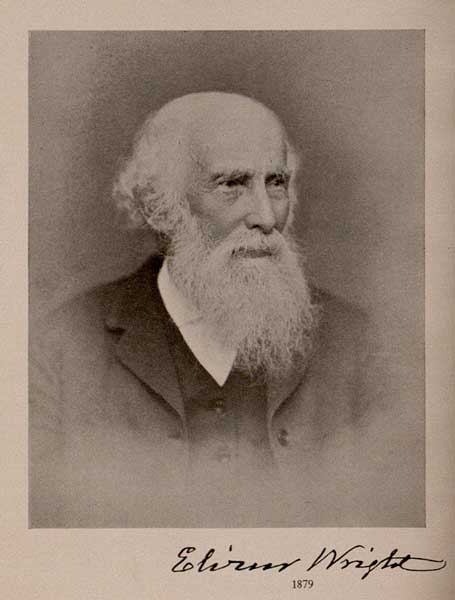
This question is important to me because I have been researching the Boston forest movement of the late nineteenth century. In the generation after Thoreau’s death, a movement rose up of forest lovers who were radically democratic in their belief that all people should have a vital relationship to the forest. They were also interspecies democrats who believed that trees and birds have intrinsic value and the capacity to contribute to the well-being of the forest. The most inspiring of these activists, from my perspective, were the former abolitionist editor Elizur Wright, the nature writer Wilson Flagg, and the botanist Cyrus Tracy. All devoted their elder years to the cause of the forest. They built a movement by inviting their neighbors into the woods for festivals that blended citizen science, speechmaking, and pageantry. Their efforts led to the preservation of the first large city-owned forest in Lynn, Massachusetts, and of the first metropolitan park network in the rocky hills surrounding Boston.
Yet the professional park managers who took control of the forests in the 1890s narrowed these activists’ vision of preservation and allowed the popular movement to die. The Metropolitan Park Commission preserved ten thousand acres of forest, but also caused significant ecological harm by building Boston’s first highway network, damming the Charles and Mystic Rivers, and spraying pesticides to eliminate invasive moths. “The Succession of Forest Trees” reveals some Thoreauvian wisdom that, if further developed, might have helped prevent this outcome.
Thoreau’s answer to his neighbors’ curiosity may seem too simple to carry much wisdom. There was no real mystery to forest succession, he said; it was simply the result of seeds being carried from one place to another by wind, water, birds, and squirrels. Each year, animals planted the very seeds that they also consumed, but only when old forests were cut down could the recently planted trees grow to maturity. He also suggested that when one species of tree had depleted the nutrients it needed from the soil, it left behind a soil that might be more suitable for another.
This answer contains two insights that are often neglected by conservationists, both in Thoreau’s time and our own. First, Thoreau’s explanation of forest succession is radically ecological: he saw that forests change because of the interaction of all the different species that inhabit them. Thoreau was one of the first American readers of Darwin, and while other readers found in Darwin a message about “red in tooth and claw” competition, Thoreau recognized the evolutionary importance of cooperation among species.
To see the significance of this ecological approach, we can compare Thoreau’s view with that of his contemporary George Perkins Marsh. Many timelines of conservation history identify Thoreau and Marsh as the two nineteenth-century founding fathers, while entirely omitting the activists that are the focus of my current research.
In an 1847 address and an 1867 book, Marsh acknowledged that humans were to blame for the loss of the forest. But even more so, he affirmed that deforestation was a problem that only “civilized man” could solve. By “restor[ing] disturbed harmonies” and “improv[ing] waste and exhausted regions,” humans could demonstrate that we are “a power of a higher order than any of the other forms of animated life.”[3] For Thoreau, on the contrary, deforestation was a problem that humans could best solve by apprenticing ourselves to all the other creatures that have been replanting forests since time immemorial. “When we experiment in planting forests, we find ourselves at last doing as Nature does. Would it not be well to consult with Nature in the outset?”[4]
More specifically, Marsh’s vision hinged on the idea that both animals and “savages” have a purely destructive relationship to nature: they take without giving anything in return. Echoing the anti-Indigenous rhetoric of a genocidal culture, Marsh wrote that “the arts of the savage are the arts of destruction.” Only with the rise of agriculture, he asserted, did humans begin to “repay to the earth all that we reap from her bosom.”[5] In keeping with this vision, early foresters and park managers took an agricultural approach to the forest: it was a space to be managed according to scientific insight, not a community of fellow beings deserving of mutual relationship.
Thoreau saw things differently. Agricultural humans were no better, and perhaps not all that different, from their Indigenous neighbors or from any number of other species. This insight flowed from his careful observation of the red squirrels in his neighborhood. In keeping with its Latin name, Tamias, the squirrel was a good steward, consuming many seeds but also dispensing and planting them in sufficient numbers to replenish the forest. In every case, he wrote, “the consumer is compelled to be at the same time the disperser and planter and this is the tax which he pays to nature.”[6]
Thoreau’s contrast with Marsh is still instructive for us today. We often assume that because humans caused climate change, we bear sole responsibility for mitigating it. I certainly agree that we should not evade that responsibility, but I suspect Thoreau would begin by looking for the ways in which other species might have already begun the work.
That brings me to a second bit of Thoreauvian wisdom. For him, the first thing to notice about forests is that they are always changing. And yet many conservationists and preservationists who honor Thoreau as the ancestor of their tribe assume that the goal is to hold the forces of change at bay. The forest managers of the 1890s believed that the “best” forest would consist of pine trees sprouted from seeds, so they concocted elaborate plans to chop down stump-sprouted hardwoods and replace them with pine seedlings. They had scarcely begun to implement those plans when a different species emerged with a different idea. Lymantria dispar, which was given the racist name “gypsy moth,” began its North American journey just a few miles from the place where Elizur Wright gathered tree-loving neighbors for annual “Forest Festivals.”[7] It changed the forest far faster than the managers could, and in its wake arrived other newcomers: the fungi known as chestnut blight and Dutch elm disease, as well as the plants known as Japanese knotweed and black swallowwort. Each threw forest systems off balance, as was perhaps inevitable given the enormous disruption of deforestation that had already taken place. But all the same, the forests of New England came back, just not according to the foresters’ blueprint.
It is impossible to know exactly what Thoreau would have to say, in detail, about all of this. What side would he take in the ongoing debate about “invasive species”? Might he have been the first to poke holes in the theory of “climax forests” characterized by stable harmony? Would he have endorsed theories of “chaos ecology"? But I think he would bring a healthy dose of humility to our current challenge of fostering new patterns of biodiversity in a permanently warmer world. Perhaps, Thoreau might say, the goal is not to resist change, but to become more open to changes made by species other than ourselves.
Dan McKanan serves as the Ralph Waldo Emerson Unitarian Universalist Senior Lecturer at Harvard Divinity School, where he has taught since 2008. He is the author of six books, including Camphill and the Future: Spirituality and Disability in an Evolving Communal Movement (University of California Press, 2020), Eco-Alchemy: Anthroposophy and the History and Future of Environmentalism (University of California Press, 2017) and Prophetic Encounters: Religion and the American Radical Tradition (Beacon Press, 2011), which won the Frederic G. Melcher Book Award.
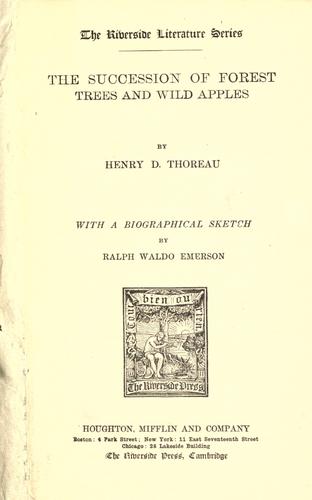
[1] Henry David Thoreau, The Succession of Forest Trees and Wild Apples, with a biographical sketch by Ralph Waldo Emerson (Boston: Houghton, Mifflin, 1887), 33-52.
[2] Henry David Thoreau, Journal, October 15, 1859, in The Writings of Henry David Thoreau: Journal, ed. Bradford Torrey (Boston: Houghton Mifflin, 1906), 12:387.
[3] George Perkins Marsh, Man and Nature: or, Physical Geography as Modified by Human Action (London: Sampson Low, 1864), iii.
[4] Thoreau, Succession, 46.
[5] Marsh, “Address, Agricultural Society of Rutland County, 1847,” in So Great a Vision: The Conservation Writings of George Perkins Marsh, ed. Stephen C. Trombulak (Hanover, NH: University Press of New England, 2001) 5.
[6] Thoreau, Succession, 47, 51.
[7] Dan McKanan, “Between John Brown and Eugenics: The Radicalism of Forest Preservation in Nineteenth-Century Massachusetts,” Journal for the Study of Radicalism 17/2 (Fall 2023): 21-50.