


Exploring the Parafloral: Mediumship and Plant-Human Entanglement
By Emily Leon / Edited by Rachael Petersen
Spiritualism is a system and a movement that emerged in the mid-nineteenth century, asserting a spirit world alongside our reality. Followers believe this realm can be accessed through mediums, who function as intermediaries between the living and the dead. While spirit communication may be hard for some to accept, by the late-nineteenth century, spiritualism had nearly 10 million followers.

Plants may not be the first thing that comes to mind when one thinks of spiritualism. For many, “spirit” connotes the immaterial; “spiritualism” may invoke séances, ectoplasm, or disembodied voices. One might imagine spiritualism had no place for tending to plants, life-sustaining organisms rooted in the material world. Yet, the emblem of spiritualism is the sunflower, accompanied by the motto: As the sunflower turns its face to the Light of the Sun – so let Spiritualism turn the face of humanity to the Light of Truth (fig. 1). My research suggests plants were central, not peripheral, to spiritualist practice and visual culture.
Take, for example, automatic drawing. While spirits are invoked through human agency, automatic drawing is considered an involuntary act in which a medium’s hand is guided by a spirit. This was common in spiritualist circles, serving as a channel for spirit communication. While many automatic drawings depict humans and spirits, botanical imagery features extensively.
In 2017, while conducting archival research on Swedish artist Hilma af Klint’s séance group, The Five, I was struck by the pervasive botanical imagery in her work, but also in spirit art created by men, women, and children across cultures and time periods. This led me to rethink the common, human-centered interpretation of plants as metaphors for inner life, where nature serves primarily as a projection surface for human emotion.
My research, which I call parafloral, invites a new direction for the study of mediumistic practice: an ecocritical approach. This framework foregrounds the ecological dimensions of spiritualism, embracing what Karl Kusserow, in Picture Ecology: Art and Ecocriticism in Planetary Perspective (2021), describes as “a more expansive consideration of nature and ecology, including the human-nonhuman nexus.” At the center of this study are the oft-overlooked relationships among spiritualism, vegetal life, mediumship, and the animate natural world, highlighting an ecological connection.
Much of my work is attuned to automatism and the tidal wave of botanical life depicted in automatic drawings, while more broadly addressing the marginalization of vegetal life in spiritualism and mediumistic practice. How might we approach esoteric works not through a human-centered lens, but from an ecological perspective that recognizes the agency and participation of the nonhuman? I explore the ecological dynamics not only within images but within the practice of mediumship itself, from garden séances to apport phenomena—that is, spiritual manifestations involving physical objects, which frequently included flowers. Apport phenomena gave rise to a category of practitioners known as “flower mediums,” offering one example of the entanglement between mediums and botanical life.

A compelling case is found in ‘Twixt Two Worlds: A Narrative of the Life and Work of William Eglinton (1886).On June 22, 1886, a garden séance was held at Aldwyn Tower, the home of Dr. T. L. Nichols, who observed the event with his wife from a balcony. Medium William Eglinton lay on a bench, covered by a rug, said to be controlled by the spirit “Dr. Richards,” while the sitters, seated 37 feet away, witnessed a “thin, whiteish cloud” forming over his body. As spirit voices emerged and moved through the garden (marked by asterisks on the séance plan), the spirit “Joey” reportedly plucked stems and placed roses on the sitters’ shoulders (fig. 2). Unusual for being held outdoors without a spirit cabinet, the séance marked a shift in mediumistic practice. Though meant to prove Eglinton was not a fraud, the séance also gestures toward a cross-species ecology, one where plants, spirits, and mediums comingle in a living, interconnected landscape.
The garden séance is noteworthy for its novelty. Held in the open air, it underscores nature’s role, the garden functioning as a space that allowed Dr. Nichols and his wife to observe and detect trickery or phony spirit mediumship. This séance reflects broader themes in my research, such as the ecological dynamics of mediumship.

Other accounts of human-nonhuman interaction I consider include automatic drawings produced by mediums in spiritualist groups such as the Edelweiss Society, a Swedish religious association founded in 1890 by Huldine Beamish. In an 1892 drawing, Beamish invites floral contemplation through a tangled network of flowers in motion, flanking an arched doorway (fig. 3). A similar fusion of vegetal imagery and spiritual presence appears in William Wilkinson’s Spirit Drawings: A Personal Narrative (1864), which recounts how, under spirit guidance, his wife and surviving child produced involuntary drawings featuring intricate symbols and a new system of flowers unknown to the material world. Wilkinson describes one automatic drawing of “a church surrounded with flower forms.”
Maria Löwstädt, a member of the Edelweiss Society, produced over 200 drawings. In many, doorways serve as central motifs, accompanied by specters and flanked by flowers. One drawing depicts a floating, rootless flower that links her initial “M” to a bloom, while a rooted flower behind it releases pollen-like dots, suggesting spiritual nourishment and vegetal transformation (fig. 4). These images depict spirit and plant as deeply interwoven, revealing a symbiosis between spirits and plants and the material mode of production of automatic drawing.

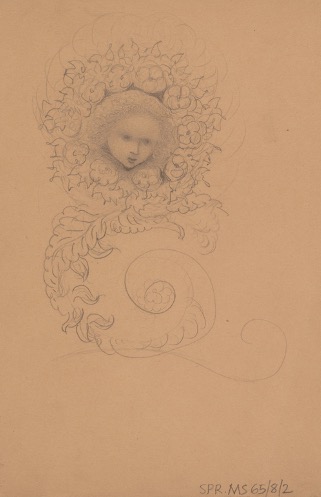
Rather than offering a window into a medium’s inner psyche or emotional life, these images express interdependence, a proliferation of botanical forms in motion, shape-shifting across realms, becoming vegetal, between presence and absence, form and formlessness, spirit, plant, person. Through representations of dehiscent seed pods, botanical initialism (fig. 5), and herbaceous faces (fig. 6), these drawings suggest an uncanny entanglement with a living cosmos. They reveal the inherent interconnectedness of all life forms, both human and nonhuman.

This intersection between ecological thinking and spiritualism opens new avenues for inquiry, particularly into how visual and material culture reflects spirit, plant, and human entanglement, an underexamined theme in scholarship. Although recent exhibitions like The Botanical Mind, Floral Fantasies, and, most recently, Hilma af Klint: What Stands Behind the Flowers reflect growing interest in spirituality and plant-human entanglement, scholarship rarely addresses where vegetal and spirit life merge in the visual and material culture of spiritualism. Even as modernist abstraction is being increasingly reframed through an ecological and esoteric lens, sometimes in response to environmental crises, this specific convergence remains largely unexplored.
Plants should not be relegated to the margins of the discourse on spiritualism and mediumship. We must understand plants as part of the aesthetic ecology of automatic drawings—one that raises profound questions. Why does mediumistic drawing so often intersect with organic and botanical themes? Why plants during this process? What function do plants serve in the world of mediumship?
But answering these questions isn’t straightforward. The study of esoteric phenomena, such as automatic drawing, requires that we expand notions of agency and intention to include nonhuman life and nonconscious modes of artistic production. It resists conventional explanation and defies simple categorization. Studying strange phenomena requires making our very modes of thought strange.
To attend to the parafloral is to reorient our gaze: from human-centered expression to the broader field of ecological and spiritual entanglement. What if automatic drawings are not simply reflections of a medium’s subconscious, but co-productions—traces of contact between human, plant, and spirit? What if vegetal imagery is not symbolic, but symptomatic of a deeper ontological participation? An ecocritical approach allows us to ask not only what these images mean, but what they do—how they enact forms of relation, perception, and copresence that challenge the boundaries between material and immaterial, self and other, life and afterlife. In these drawings, plants are not marginal motifs; they are agents, collaborators, and messengers in a cosmology that refuses to segregate nature from spirit. To take the vegetal seriously is to expand the scope of what mediumistic art can reveal—not just about the dead, but about life itself, in all its diffuse, interwoven, and more-than-human forms.

Emily Leon is a transdisciplinary writer and researcher based in Western Massachusetts, where she works in the Art Department at Williams College. Her work sits at the intersection of art history, religious studies, and science, with a particular focus on modernism, abstraction, and the esoteric interests of late nineteenth- and early twentieth-century artists.
Her current research explores the role of plants in the visual and material culture of spiritualism. She has presented on this topic at the Association for Art History’s 2025 annual conference in a session on art, esotericism, and the ecological imagination and at the Southwest Popular/American Culture Association’s 2025 summer salon in a session on the occult arts. An expanded article on this research will appear in a special issue of Paranthropology: Journal of Anthropological Approaches to the Paranormal, edited by Jack Hunter, PhD. As part of her continued effort to challenge conventional narratives and methodology in the study of art history and esoteric art, she is contributing a chapter on the Swedish artist Hilma af Klint to a forthcoming edited volume provisionally titled Beyond Hilma af Klint: Rediscovering Swedish Women Modernists.