


Frontiers in American Religion
This Research Reflection by guest contributor Nicholas Covaleski is part of an ongoing series spotlighting the academic study of religions.
The frontier myth is the most pervasive in the United States culture. Its central claim is that crossing new frontiers is an engine for national expansion and explains what is most valuable to national identity. For many Americans, the frontier myth offers a roadmap for societal regeneration, a sacred history that mythologizes the perpetual self-transcendence of the national community through the crossing of liminal frontiers. The deliberate repetition of this sacred history––crossing new frontiers over and again to generate collective spiritual renewal––plays out throughout American history, from Colonial times to the present day. Indeed, pulling on the thread of frontier mythology reveals how certain dimensions of America’s settler-colonial past continue to affect its ostensibly disenchanted cultural present.
The frontier myth tells a tale of intrepid colonists taming wild and uncharted territories. In the seventeenth century, that wilderness began at the outskirts of New England. In the eighteenth century, it lay beyond the Appalachians and into the Ohio River Valley. In the nineteenth century, pioneers blazed across the one-hundredth meridian––the “blood meridian,” as Cormac McCarthy famously called it in 1985––and into the wide-open space of the American West. The rough and rugged frontier landscape transformed the Colonists’ European culture into something new: the rough and rugged American. Following the first pioneers came the homesteading settlers, whose expansion across so much “free land”—Indigenous peoples had occupied much of this land for generations—created a distinctly American form of social and political equality.
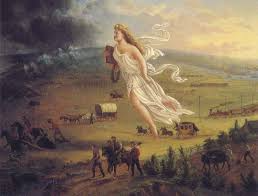
If we understand myth as ideology in narrative form, then the frontier myth is the nation’s most longstanding ideological expression of Colonial expansion, encoding a conception of the world in which uncharted territories represent opportunities to expand the empire. On this understanding, the myth of the frontier is nothing more than a mechanism for camouflaging the state’s interests. The explicitly religious content of frontier mythology––its providential teleology and visions of the West as a new Garden of Eden, for example––functions solely to veil material agendas.
But there are other ways to understand myth, including the frontier myth, that point to a greater religious significance. Historian of religion Mircea Eliade maintains that myths are sacred histories about how reality came into existence through the acts of gods, ancestors, or civilizing heroes, and that the ritual re-enactment of these sacred histories projects participants “back to the beginning of time” and, thereby, stimulates collective rebirth and renewal.
An Eliadean reading casts the frontier myth as a sacred history that explains the original creation of “the American People” as a distinct spiritual community. Within this sacred history, each new frontier zone marks a site of liminality. In his research on the Ndembu people of Zambia and their initiation rites, Victor Turner describes a liminal period as one in which ritual participants are suspended “betwixt and between” the conventional roles and hierarchies that they inhabited outside the liminal stages of transition. Within these liminal stages, such differences dissolve, generating a temporary community, which Turner famously called a communitas, that is characterized by comradeship and egalitarianism. Applying Turner’s insights within the mythological world of the American West, the crossing of frontiers continuously regenerates a “frontier communitas” in which previous differences stemming from the Old World dissolved into new egalitarian communities, typically made up of white, Anglo-American men bonding over a common experience of “becoming American.” Crossing new frontiers functions as a ritual initiation into a shared identity.
This sacred history, therefore, provides a roadmap for the perpetual regeneration of the original creation: the archetypal frontier communitas. As new frontiers are settled, they become the sort of repressive and hierarchical social systems from which the pioneers had once escaped––what I call a normative frontier communitas––at which point it becomes necessary to chart the next frontier. Crossing and settling never slow but repeat ad infinitum. Through constant crossing––and constant expansion––a frontier community engages in a process of perpetual self-transcendence in pursuit of endless social regeneration.
The myth of the frontier lives on in modern U.S. culture. New pioneers––astronauts, hippies, and tech-gurus––have charted new frontiers, such as the outer space beyond Earth’s atmosphere, North America’s deserts, forests, and farmlands where back-to-the-landers experimented with communal living, and digital cyberspace. These new pioneers summon a distinctly American religious experience that ritually regenerates the frontier communitas of the mythical age through constant expansion. Taking seriously the religious dimensions of frontier mythology reveals that it not only continues to influence religious life in the US but also directs our attention to sites where religion was thought to have no life at all. The frontier myth is a map to chart largely uncharted territories of U.S. religious history: the frontiers in American religion.
Nicholas Covaleski received his PhD in Religious Studies from Boston University in January 2025. He currently teaches at Harvard Medical School’s Center for Bioethics.