


The Spiritual Ecology of Ordinary Life: Shaker Sister Helena Sarle’s Botanical Drawings
By Damiano Benvegnù / Edited by Rachael Petersen
University of St Andrews
For many Americans, the term "Shaker" might conjure images of elegant wooden furniture, but the chances that they have ever met an actual Shaker are slim to none. In fact, as of September 2024, only two members of this religion remain. Though the Shaker sect experienced rapid decline in the twentieth century, this radical religious movement thrived in the American Northeast in the late eighteenth and nineteenth centuries. Also known as the United Society of Believers in Christ’s Second Appearing, the Shakers believed in living simply, communal ownership, pacifism, dancing in worship, celibacy, and the equality of the sexes. While their membership has dwindled, their legacy endures: besides austere furniture, they composed angelic hymns still sung in many Protestant churches today; invented common tools such as the clothespin and the circular saw; and designed the functionally elegant round barns which still dot the New England landscape. Some of their most vibrant artistic creations were born from the so-called Era of Manifestations (ca.1827-1855), a period of spiritual revival that also corresponded with the production of several astonishing visualizations of ecstatic raptures—or “gift drawings,” as they were called—including the iconic The Tree of Light or Blazing Tree image by Shaker sister Hannah Cohoon of the Hancock Shaker Village.
I came across Sister Helena Sarle’s drawings while exploring the archives in New Hampshire in 2022. At the time, I was doing preliminary research for a digital storytelling project on a forested conservation area in Enfield, NH, which had, more than 100 years prior, been sculpted, cultivated, and engineered by the Enfield Shaker community. I intended to create an augmented reality application to allow anyone in the forest with a smartphone to engage with the forest’s complex but now nearly invisible history of human and nonhuman intersections. Knowing more about the Shakers’ understanding of the natural world was paramount to my endeavor, so I decided to start looking for evidence of Shaker’s ecological thought in the Canterbury historical archives.
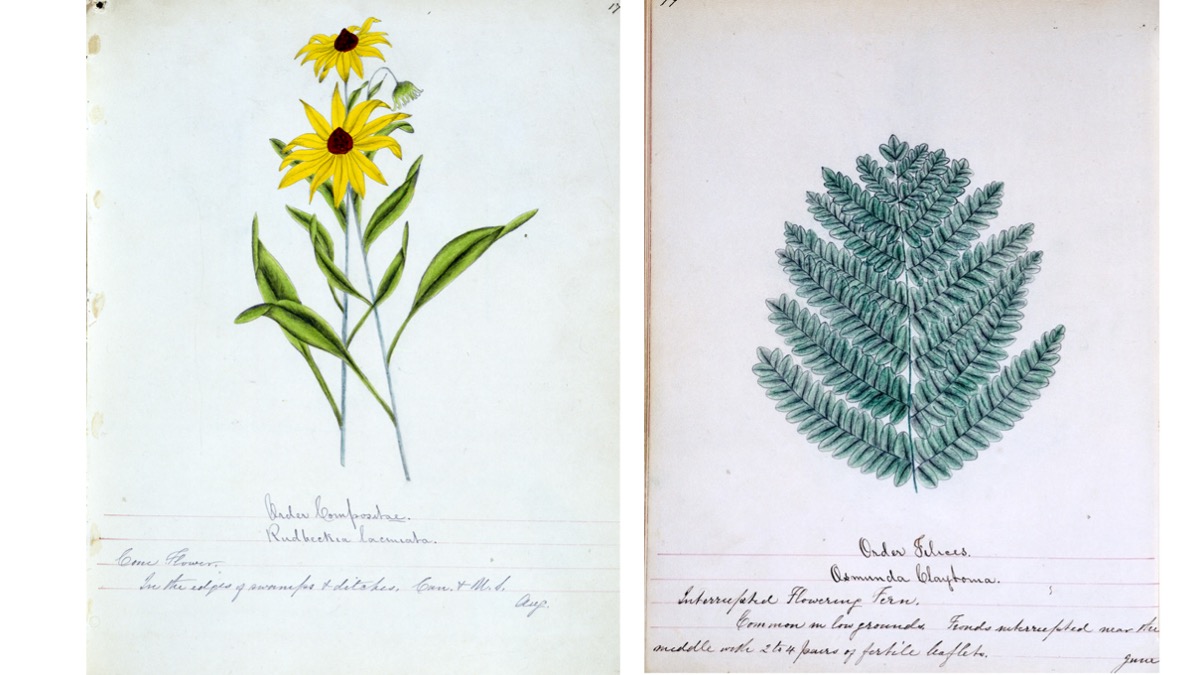
The Canterbury Shaker Village was established in 1792 when followers of Mother Ann Lee formed their seventh community in Canterbury, NH. Some 90 years later, in 1882, a young, frail woman named Cora Helena Sarle joined the Canterbury Shaker Village at the age of 14. Due to her fragile health, her Elders encouraged her to spend time outdoors and keep a plant journal, drawing all the wild botanical specimens growing in the surrounding fields—from common flowers to ferns and wild herbs. In the late 1880s, Sister Helena, as she was known among the Shakers, completed two notebooks of pencil and watercolor drawings that were subsequently used—alongside Elder Henry Clay Blinn’s identifying botanical annotations—to teach other members of the Canterbury community about useful endemic plants and, perhaps, the beauty of God’s creations.

Sister Helena’s drawings today serve as a catalog of the plants common in New England at the end of the nineteenth century. As such, they provide us with an invaluable inventory for determining the changes in flora biodiversity in the last 150 years. Yet, they should be treated neither as a mere botanical record nor as a plain nineteenth-century pedagogical device, nor should they be seen as a Shaker-specific example of the kind of accessible natural history to which the labor of many women was relegated in the second half of the nineteenth century. Instead, the drawings participate in the same fascination for the botanical world displayed by the spiritual trees of life painted by other Shaker visionary women artists during the Era of Manifestations. Sister Helena’s delicate and yet strikingly accurate images function, in fact, as implicit representations of the Shakers’ understanding of their relationship with both the environment and the divine; their unassuming and yet undeniable intensity as a wondrously simple map of the potential harmony between this world and the next.
Discussing the images drawn during the Era of Manifestations, Shaker historian Sally Promey claims that the most significant strategies of Shaker pictorial imagination are “proximity, presence, and self-representation.”[1] With “proximity,” Promey means that the pictures “asserted renewed contact with the divine by depicting the convergence of heavenly and earthly spheres.”[2] Although Sister Helena’s drawings do not immediately display the same mystical vibrancy of the trees of life depicted by previous Shaker artists, their general orderly simplicity and symmetry allude to a similar theological disposition according to which straightness was not merely aesthetically pleasing. As also apparent in their architecture and furniture design, straightness—understood as both a moral value and a representation quality—is instead an attribute of likeness to God and, therefore, necessary to communal life and personal salvation. From this perspective, drawings like the Gentiana andrewsii or the Eutrochium purpureum were likely meant to be handled quite literarily as contemplative devices capable of suggesting the closeness between earth and heaven while also functioning as thin windows between them. As a visible sign of an invisible presence, the plants and flowers depicted by Sister Helena were thus both a mirror of the Shakers’ contiguity with the surrounding environment, a score of ecological proximity, and, as Promey pointed out for Mother Ann’s representations, “a material locus of presence, a site for the experience of contact”[3] with the celestial sphere.
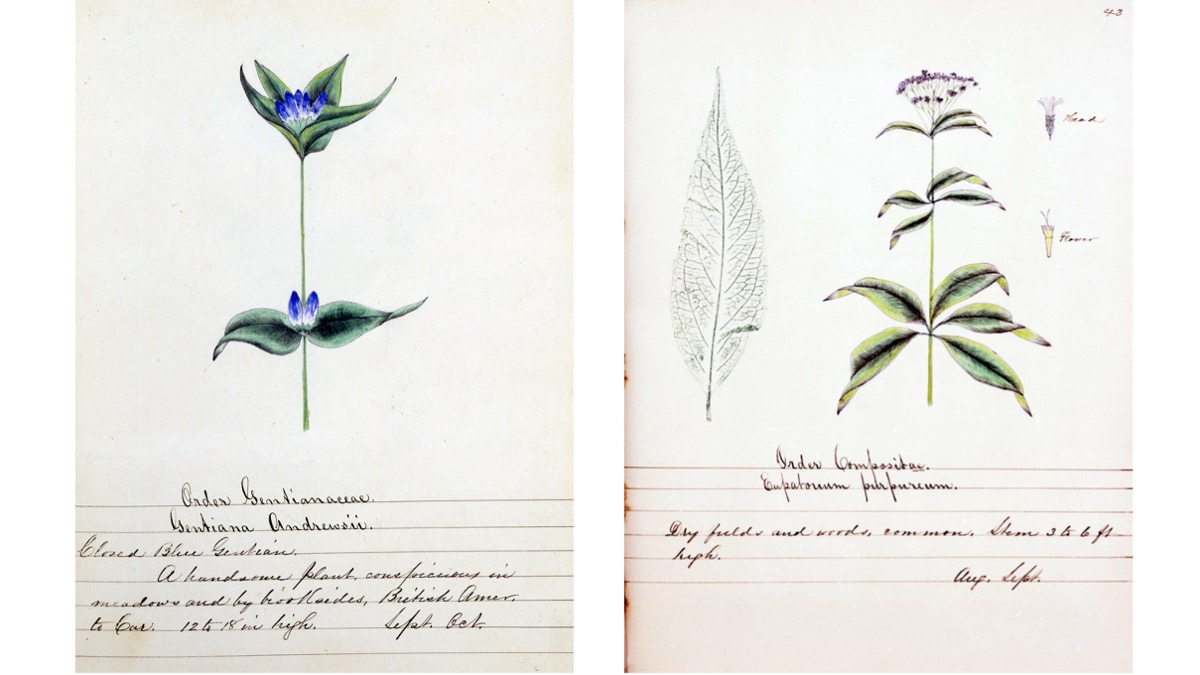
The concept of nature’s sublimity was a powerful and prevalent theme in nineteenth-century America, espoused by intellectuals such as Emerson, Thoreau, and Muir, as well as artists like Cooper and Cole. However, these thinkers and artists, as well as their followers, tended to locate divine manifestation within grandiose American landscapes: the American sublime and its implicit “manifest destiny” was better epitomized by Niagara Falls or the allegedly uninhabited high deserts of the West. Sister Helena’s images make clear that she recognized (and thus represented) the divine not in grandiose mountains or powerful waterfalls but rather in the smallest, humblest, almost insignificant presence of nearby plants and flowers, in the vegetal, material microcosmos of the fields surrounding her village. Her elegant plant drawings can thus be read as examples of the same kind of relational meanings that anthropologist Eduardo Kohn has described as “living thoughts,” i.e., modes of enchanted engagement in which “ends are not located somewhere outside the world, but constantly flourishing in it (…) intrinsic to the realm of life.”[4] There are, of course, many differences between the Indigenous communities explored in Kohn’s book and by the Canterbury Shakers, and it is arguable whether these drawings display any form of animism. Regardless, the fact that they were physically handled by different members of the Shaker community who could see their material equivalents growing just outside their windows presents an encounter with the divine that is relational and intimate, a spirituality that is based on the strength of our common material fragility with the nonhuman world. Asking us to pay attention to the minute forms of life surrounding us, to their ordinary and yet extraordinary beauty and presence, Sister Helena’s drawings are perhaps a manifestation of a spiritual hesitancy and aesthetic attention toward nonhuman life that could, and probably should, trigger alternative forms of ecological sensibility even today. In other words, we daily dwell with others: whether we are believers or not, Sister Helena’s plants remind us that we need only look beneath our feet to find the revelation of God’s glory.
The author thanks Shirley Wajda and Renee Fox, respectively Curator of Collections and Collections Manager at the Canterbury Shaker Village in Canterbury, NH, for introducing me to Sister Helena’s drawings when I was doing research in their archives and for supporting my work there.

Dr. Benvegnù joined the University of St Andrews in 2023. Prior to coming to St Andrews, he held academic positions at Dartmouth College and at the University of Virginia. His research and teaching interests are interdisciplinary and engage with comparative literature, critical theory, epistemology and philosophy of language, digital humanities, and the environmental humanities.
[1] Sally M. Promey, Spiritual Spectacles: Vision and Image in Mid-Nineteenth-Century Shakerism (Indiana University Press, 1993), 72.
[2] Ibid.
[3] Sally M. Promey, Spiritual Spectacles: Vision and Image in Mid-Nineteenth-Century Shakerism (Indiana University Press, 1993), 80.
[4] Eduardo Kohn, How Forests Think: Toward an Anthropology Beyond the Human (University of California Press, 2013), 90.