


Xochipilli: Psychedelic Plants, Song, and Ritual in Aztec Religion
This is the first published conference paper from the upcoming “Psychedelic Intersections: Cross-cultural Manifestations of the Sacred” 2024 conference anthology.
Introduction
Xochipilli, a deity linked to songs, flowers, the rising sun, joy, games, and fertility, holds profound significance in Aztec religion.1 His name’s etymology derives from a nominal composition of the nouns xochitl meaning “flower” and pilli meaning “noble, youth.” Fray Bernardino de Sahagún translates his name as “Noble Flower” or “Main One in Charge of Giving Flowers.”2 Historical sources explicitly characterize this deity as revered by nobles, elite principals, and guilds of artists, revered in both masculine and feminine forms.
Xochipilli is an understudied deity. This essay offers an overview of his features, including rituals consecrated in his honor. To state that he is a deity related to singing, playing, enjoyment, flowers, and fertility requires (a) considering the iconographic analysis of images found in pre-Columbian codices, (b) establishing his links between this deity and the vegetal world, and (c) examining rituals consecrated to Xochipilli during the “Flower Time” feast, or xochilhuitl.
Analyzing research into Xochipilli requires diverse methodologies, including historiography, iconography, and philology, all of which aid in understanding this deity in the Aztec worldview.3 My analysis provides fresh interpretations of rituals involving psychedelic plants associated with Xochipilli; these rituals, often overlooked, provide a rich understanding of the Aztec mental landscape in which psychedelic plants acquired meaning.
Perspectives on Xochipilli

The most important sculpture of Xochipilli, which currently resides at the National Museum of Anthropology in Mexico City, was found in Tlalmanalco, close to the Popocatepetl and Iztaccihuatl volcanoes. It is one of the most emblematic works of Aztec sculpture due to its technical execution and symbolic content. The expression of astonishment by the statue is palpable, intensified by the position of its face thrown back and the depth of its gaze. Viewing the statue, we are in the presence of someone who is not looking as we do everyday, who is absorbed in rapturous experience, the sacred trance of the temicxoch, what they call “The Flowery Dream.”
Scholars advance diverse hypotheses for the actual plants and fungi depicted in the sculpture.4 I summarize five prominent hypotheses below.
- Richard Evans Schultes and Albert Hoffman argue the glyphs carved on the body of Xochipilli represent various plants, such as the tobacco flower (Nicotiana tabacum), marigold flower or ololiuhqui (Turbina corymbosa), sinicuiche button (Heimia salicifolia), psilocybe or teonanacatl mushrooms (Psylocibe aztecorum), poyomatli flower or cacahuaxochitl (Quararibea funebris), and a stylized representation of the fungi Psilocybe aztecorum.5
- Robert Gordon Wasson follows Schultes and Hoffman. Wasson highlights the sound synesthesia, or sonorous hallucinations, associated with sinicuiche (Heimia salicifolia).6 Most history of art and psychedelic studies focus on the iconography of the Xochipilli’s sculpture, especially the different types of flowers and plants carved on the body; few explore the relationship between music and the plants associated with the deity. Xochipilli was the deity of singing (cuica), for plants associated with him caused auditory effects, such as sound synesthesia, that reveal the cognitive scope and creative uses of these psychedelics, especially in regard to music.
- Abraham Cáceres considers Wasson’s interpretation valid but incomplete. Cáceres emphasizes that the ololiuhqui plant, “Seed of the Virgin,” whose active principles ergine and hydroxyethylamide are indole alkaloids, contains psychodysleptic properties affecting auditory perception.7 Some plants depicted on the deity Xochipilli—sinicuichi, ololiuhqui, and teonanacatl—bear active chemicals that also have psychodysleptic effects related to singing. There is not a single plant in botany associated with sonorous hallucinations or sound synesthesia; therefore, the soundscapes of rituals consecrated to Xochipilli reveal how plants may become imbued with psychodysleptic properties, and thus why Xochipilli is the deity of singing.
- Aurora Montúfar proposes new identifications for the flowers, distinguishing various species. Richard Evans Schultes identified psychoactive plants such as the tobacco flower and the ololiuhqui plant (“Seed of the Virgin”), known in Nahuatl as coaxoxouhqui (green snake). Meanwhile, Aurora Montúfar identifies the representation of the xiloxóchitl, a flower frequently associated with the group of deities to which Xochipilli belongs; she also identifies specimens of the Asteraceae family, including dahlias and tagetes lunulata,8 tagetes lucida or yauhtli, and tagetes erecta or cempoalxóchitll.9 Xiloxochitl and the specimens of the Asteracea family, she argues, could be related with Xochipilli´s calendrical name, elaborated below. Montúfar’s hypothesis challenges the hegemonic paradigm to include different plants beyond psychedelics.
- Mercedes de la Garza argues that the calendrical name Macuilxochitl (Five Flower), meaning associated with the 20-day date cycle in Mesoamerican civilization, could also be linked to a species of flower, perhaps the Red-crescent marigold (Tagetes lunulasta or Tagetes lunulata). This hypothesis needs to be verified. Garza writes,
Another deity associated with the ololiuhqui (because of its identification with the cuetzpaltzin) seems to be Macuilxóchitl, “Five flower,” since in the Borgia Codex is represented with a cuetzpalin (lizard) as a phallus and a flower coming out of its mouth; this flower could be the one called the same as the god…: macuilxochitl or Tagetes lunulasta, of the same genus as the pericon or yauhtli, one of the main sacred Mesoamerican plants.10
Building upon these hypotheses, I contend—in contrast to the many specialized studies of Xochipilli’s iconography analyzing the “bouquet” of associated flowers rather than the single flower that gives a name to this deity—that the specific flower associated with the deity is key to interpreting Xochipilli, his symbolism, and his therapeutic properties. The Tagetes lunulata’s petals are yellow with red, resembling the sunrise and twilight, both times symbolically associated with Xochipilli in the “Song of Xochipilli.”
While the tagetes lunulata is integral to understanding Xochipilli, other associated plants are significant. For example, the association of the deity Xochipilli and the ololiuhqui plant (Turbina corymbosa) is a tapestry of Mesoamerican culture. This deity, who many believe is related to the origin of venereal diseases, was particularly revered by high social strata, notably those who led a sexual life divergent from the norm, such as the nobles and military chiefs.11 The “totemic animal” or nahualli associated with this plant was the lizard (cuetzpalin), symbolizing fertility. According to the testimony of Francisco Hernandez, the ololiuhqui—a sacred plant he describes to be intricately linked to Xochipilli—was used to alleviate ailments caused by syphilis. The ololiuhqui (Turbina corymbosa) was useful to treat syphilis, and the macuilxochitl (tagetes lunulata) was a contraceptive. The etiology of these illnesses and the domain of fertility are logically associated to Xochipilli.
Xochilhuitl: Cult and Ritual Depictions in Mesoamerican Codices
In the Florentine Codex, Fray Bernardino de Sahagún describes a great feast in honor of a divinity venerated by nobles and rulers; the divinity’s calendrical name was Macuilxochitl,12 “Five Flower.” To honor this god, Aztecs had a feast called xochilhuitl, “Flower Time.” Celebrants fasted and prepared spiritual and physically for four days leading up to the important fifth day of the central feast: fasting, sexual abstinence, food offerings, dance, penance, and self-sacrifice. Sahagún describes the preparation for the feast thus:
When people fasted, if one of us men lay with a woman, or a woman with a man, it was said: “They brought to naught their fasting through sin.” Thereupon [the god] gave them as merited punishment, haemorroids, venereal sickness, boils, and piles. Therefore they made vows to him, in order to quiet, move or abate the sickness. And when his feast, which was called the Feast of Flowers, was celebrated, first all fasted four days.13
Xochipilli is associated with fertility and pleasure. Venereal diseases were thought to arise after transgression of ritual norms associated with him. Historians of medicine and botany ought to establish which plants associated with Xochipilli had healing properties linked to venereal diseases or as contraceptives, especially the symbolical connections between Xochipilli and Turbina corymbosa and the Asteracea flowers (mainly Tagetes lunulata).
The fifth day of the festival, the day of the feast in celebration of Xochilhuitl, falls on the date macuil cuetzpalin, “Five Lizard.” Penitential rituals (tlamaceualiztli) were undertaken, including offerings of blood extracted through incisions made by maguey (Agave americana) thorns upon different body parts, especially the ears and tongue. These practices modified ordinary states of perception and conferred a peculiar type of sacred ecstasy, complemented with rituals, hierophany, songs, dances, psychoactive plants, and food offerings.

The center of the Codex Borgia Plate 47 depicts the 13 days in which the “Flower Time” was celebrated. At the left bottom is a yellow flower glyph, the marker of a time period called “One Flower.” Moving toward the top, red dots represent a day in the calendar. Only special days (one, five, and 13) are highlighted with a glyph. At the top, the line of spots turns to the right to complete the period of 13 days. The middle of the image depicts offerings of copal, an aromatic vegetal resin used as incense. Macuilxochitl holds in his right hand self-sacrifice instruments such as maguey thorns (Agave americana), obsidian blades, sharp bones, and three arrows with a shield. His left hand holds a bag of copal to fumigate ritual instruments. The first four days were devoted to fasting and self-sacrifice, and the feast was celebrated on day five, highlighted with a glyph above, a red and black cuetzpalin lizard.
The ritual was reinforced by continual collective performances of songs and public dances that were also considered offerings. In the dictionary compiled by Fray Alonso de Molina, the word penitencia (tlamaceualiztli) is linked to words that designate dance or dancing such as maceualiztli and netotiliztli.14 Dance was appreciated in Aztec society due to its capacity to stimulate the body, along with its ludic and ritual dimensions. The word maceualiztli that designates dance is synonymous with offering; both dance and self-sacrifice are offerings.
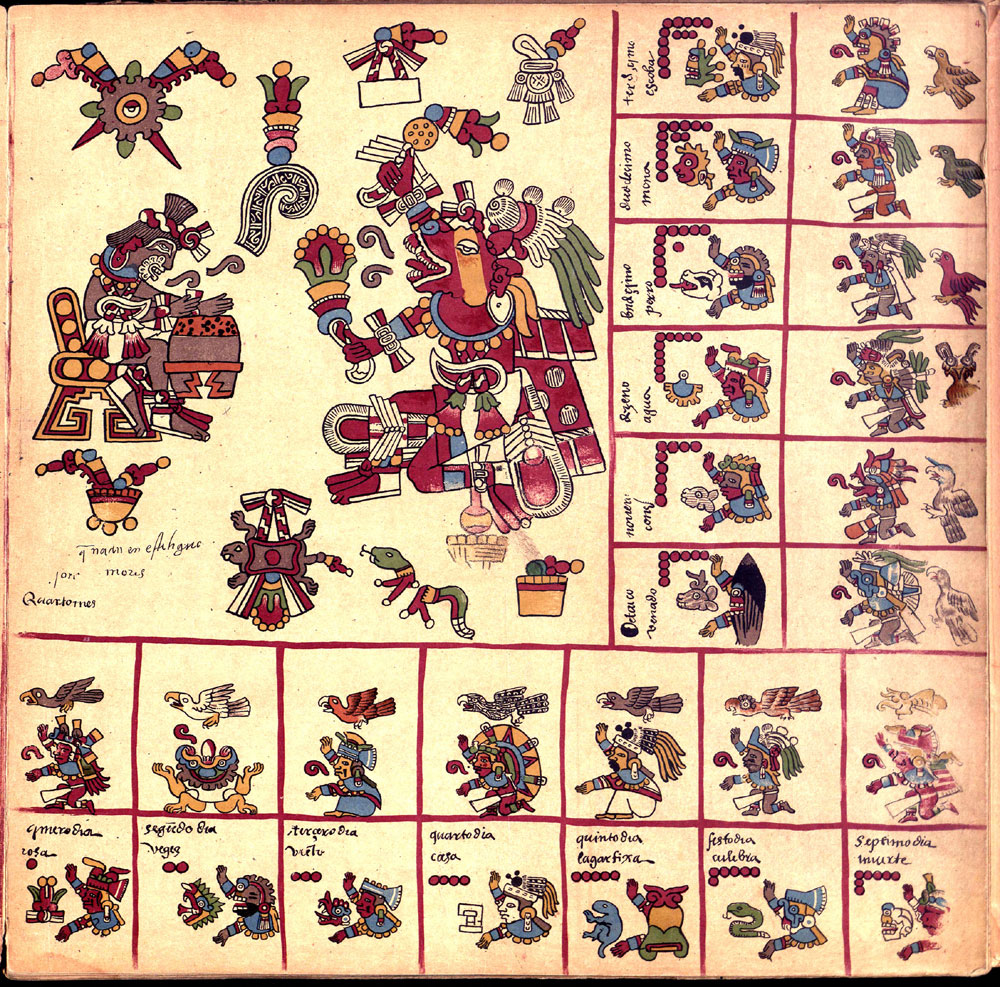
Plate 4 of the Codex Borbonicus complements written sources,15 indicating favorable designs accompanying sacred forces for each day. The central scene depicts two main characters: Huehuecoyotl (Old Coyote) and Macuilxochitl (Five Flower). Huehuecoyotl is the divinity of dance and feather art.16 A rattle known as ayacachtli is visible in his right hand, and two virgules, glyphic signs for words in Mesoamerican iconography, appear in front of his mouth. Macuilxochitl is seated on a mat, for he is the regent of that period of 13 days, or trecena. He plays a huehuetl, a percussion instrument, and his face is painted over with an open, white palm. Virgules surround him. One prominent virgule is accompanied by a flower, almost in the scene's center; its meaning could be “the flowery word” (xochitlahtol), which has been translated as poetry by scholars and contemporary Nahua poets.17
The scene is dynamic, suggesting the two figures are interacting. The codex contains glosses in Spanish for readers to identify names and the sequence of 13 days. Seven red squares from the bottom right depict symbols for seven days: 1-flower, 2- alligator, 3-wind, 4-house, 5-lizard, 6-snake, and 7-death. At the edge of the page the reading sequence changes, turning to the top, depicting six red dots: 8-deer, 9-rabbit, 10-water, 11-dog, 12-monkey, and 13-grass.
Each calendrical date is accompanied by another red square depicting the sacred forces, the regent for a 13-day period, and the regents’ bird or totemic animal associations. The main painted scene depicts offerings of sacrificed animals, specifically a snake and a rabbit, varied vessels, and copal. Flowers accompany the offerings in the vessels. A copal bag is depicted at the top right corner.
Conclusion: Beyond altered states
Scholars must not just study the iconography of deities like Xochipilli, but examine rituals and ceremonies associated with the deity. Ritual activities are essential to interpret this deity and his depictions. Within the Aztec worldview, the psychedelic/entheogenic experience was understood to be temicxoch, meaning “Flowery Dream.” This cultural feature deserves further attention, for an entheogenic experience is not only an “altered state of consciousness” isolated from poetic and spiritual uses. Modern scholars must become open to alternative frameworks to interpret the diversity in cultural uses of psychedelic plants and entheogens.
The therapeutic properties of psychedelic plants associated with Xochipilli, such as ololiuhqui, a classic psychedelic, have been overlooked. It is essential to highlight how these plants are related to symbolic, spiritual features, but they are also related to concrete, physical diseases, such as syphilis or gout. The flower Tagetes lunulata, associated with the calendrical name Macuilxochil, is considered a contraceptive, so it is aptly connected to a deity associated with fertility. These therapeutic properties, along with their symbolism and rituals, are associated with etiology of diseases.
Contemporary scientific research is mainly focused on therapeutic alternatives for mental illness, but Indigenous knowledge did not solely connect psychedelics to the mind. Cross-cultural analysis of ritual uses of plants, fungi, and animals with psychedelic properties could be a decisive step toward acknowledging Indigenous traditional medicine as a world cultural heritage, along with the imperative of set and setting in eliciting an altered state—whether for therapeutic, ritual, or celebratory purposes, or any combination therein.
References
- Justino Fernández, “Una aproximación a Xochipilli,”Estudios de Cultura Nahuatl 1 (1959): 31-41, https://nahuatl.historicas.unam.mx/index.php/ecn/article/view/78646. [Return to section]
- Sahagún, Bernardino de, and Bernardino de Sahagún. “Book 4, Chapter 7,” in Florentine Codex: General History of the Things of New Spain, ed. Arthur James Outram Anderson and Charles Elliot Dibble (The School of American Research, 1950), 23. Fray Bernardino de Sahagún was a Franciscan friar who arrived in Mesoamerica in the sixteenth century, and for several years performed ethnographic work with students, indigenous elders, and painters. His work is a key historical source for Aztec religion, especially The Florentine Codex, containing twelve books written in the Aztec language (Nahuatl) and Spanish. The Spanish version is known as Historia General de las cosas de la Nueva España. [Return to section]
- To avoid misunderstanding, the term Aztec is used in this chapter because it is best known for English readers. The self-denomination for this people was Mexica, a branch of the Nahua people, according to a sacred narrative founded in the Boturini Codex, not to be confused with the contemporary gentility of the country Mexico. [Return to section]
- This deity etymologically is related with flowers; his connection to flowers and his feast, “flower time” (Xochilhuitl) is implicit. His connection to flowers also connects him to varied plants and fungi. [Return to section]
- Richard Evans Schultes, Albert Hofmann, and Christian Rätsch, The plants of the gods: Their sacred, healing and hallucinogenic powers (New Healing Press, 2002), 62-63. [Return to section]
- R. Gordon Wasson. The Wondrous Mushroom: Mycolatry in Mesoamerica (McGraw-Hill, 1980), 57-78. [Return to section]
- Abraham Cáceres, “In xochitl, in cuicatl: Hallucinogens and music in Mesoamerican Amerindian thought” (Ph.D diss., Indiana University, 1984), 1-17, University Microfilms International. [Return to section]
- Some therapeutic properties of tagetes lunulata are related to contraception, vaginal discharge caused by chilling, and urinary diseases. [Return to section]
- Aurora Montufar López, “Las flores de Xochipilli un acercamiento taxonómico,” in Xochipilli: el Señor de las Flores ed. Museo Nacional de Antropología (Secretaría de Cultura-Museo Nacional de Antropología, 2018), 37-46. [Return to section]
- Mercedes de la Garza, Sueño y alucinación en el mundo náhuatl y maya, (UNAM, 1990) 73-75. [Return to section]
- Military chiefs were allowed to have different couplings because they could die at any time. Rulers and noblemen had several wives or concubines, and thereby had more opportunity for venereal disease. [Return to section]
- One core cultural feature among Mesoamerican civilizations was the development of calendrical systems. It was common to use two calendars: one solar calendar of 365.25 days and one divinatory calendar of 260 days. Aztec gods were associated with calendrical names, and “Five Flower” is a date in the divinatory calendar. [Return to section]
- Sahagún, “Book 1. Chapter 14”,” in Florentine Codex, 13. [Return to section]
- Alonso de Molina, Vocabulario en lengua castellana/mexicana y mexicana/castellana (Porrúa, 2004), 94r. [Return to section]
- El libro de Ciuacoatl: Homenaje por el año del Fuego Nuevo, Libro explicativo del llamado Códice Borbónico, trans. Ferdinand Anders, Jansen Maarten, and Reyes García Luis. (Fondo de Cultura Economica, 1991). [Return to section]
- Olivier Guilhem, “Huehuecóyotl, ‘Coyote Viejo’, el músico transgresor. ¿Dios de los otomíes o avatar Tecatlipoca?”. Estudios de Cultura Náhuatl 30 (1999). http://www.revistas.unam.mx/index.php/ecn/article/view/9202. [Return to section]
- See, for example, historical work by Miguel León-Portilla and Ángel María Garibay, as well as the contemporary Nahua poet Martin Tonalmeyotl. [Return to section]