


An Interdisciplinary Look at Psychedelics and Ethics
The newly founded Harvard Study of Psychedelics in Society and Culture is an interdisciplinary effort across the Faculty of Arts and Sciences, Harvard Divinity School and Harvard Law. It seeks to “transform the psychedelics research landscape by producing cutting-edge scholarship and convening faculty, students, and experts to engage in discussion around their far-reaching implications.”
This groundbreaking effort has forged new opportunities for the Center for the Study of World Religions to collaborate across the university, expanding its established interest in the study of psychedelics in the context of religion. Most recently, as part of its Transcendence and Transformation series, the CSWR has launched Psychedelics and Ethics, a series in collaboration with The Petrie-Flom Center for Healthcare Policy, Biotechnology, and Bioethics at Harvard Law School. Interest in psychedelics has grown in both academic and scientific communities in recent years, as research increasingly shows that psychedelics can safely treat disorders such as PTSD, depression, and addiction when used in therapeutic contexts. However, as interest continues to surge, the pace of developing legal and ethical frameworks struggles to keep up. In response to this, the CSWR’s new series aims to bring together interdisciplinary scholars and practitioners “to create a forum for constructive conversations about the role of psychedelics in culture, society, with an eye towards issues of justice, safety, and care,” according to Professor Charles Stang, Director of the CSWR.
The series’ inaugural event on April 16, called Psychedelics and Ethics: Bioethics, Legal Ethics, and Ethics of Care: An Introduction to Psychedelics and Ethics, included presentations by scholars Dr. Christine Hauskeller (Exeter University), Dr. Mason Marks (Florida State University), and Dr. Roman Palitsky (Emory University). Each shared insights on key philosophical, legal, and spiritual issues in the field of psychedelics and ethics, including the contribution of bioethics, decolonial ethics, the role of informed consent, as well as the value of spiritual care approaches to psychedelics.
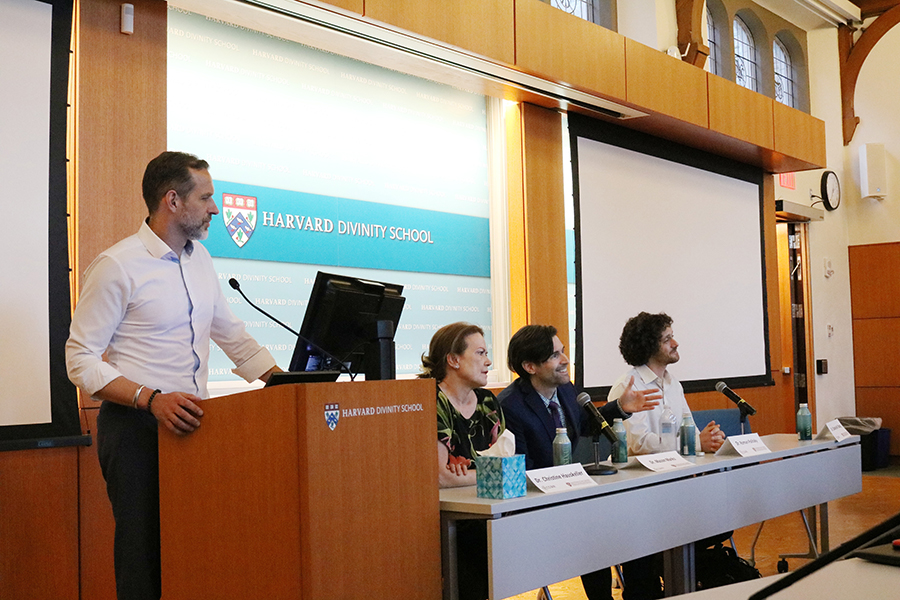
Dr. Hauskeller, who specializes in moral philosophy and philosophy of science, addressed the many semi-legal applications of psychedelics in current circulation — religious use, recreational use (to the degree that the business of psychedelics evades the law), as well as the entire psychedelic tourism sector. Dr. Hauskeller argued the Western medicalization of psychedelics has remobilized these spaces, and in turn, these spaces now inform the current discourse on the ethics. When it comes to ethics, for Dr. Hauskeller, the difference between psychedelics as a “substance” versus psychedelics as an “experience” is crucial. The tangibility of psychedelic substances makes them more easily defined, quantified, and seemingly easier to address ethically. On the other hand, psychedelic experiences are endlessly varied, subjective, and relational. When such experiences are reduced to mere quantifiable substances, it becomes ethically dubious when those experiences are then reframed in the context of mass production for maximum profit. Relatedly, Dr. Hauskeller addressed the issue of decolonial ethics in psychedelics, speaking to the industry’s colonization of psychoactive plants, indigenous knowledge, as well as rituals and practices of indigenous peoples. She noted the use of traditional colonial practices therein: extraction, oppression, appropriation, adaptation, synthetic reproduction, marketization, and control of profits. Dr. Hauskeller questioned what such decolonizing practice might look like — what it would mean to recognize indigenous contribution, respecting and crediting indigenous knowledge and technologies?
Shifting gears to the intersection of ethics and psychedelic law, Dr. Mason Marks offered key insights on clinical care in psychedelics from a legal and ethical perspective — largely unchartered territory. A visiting professor at HLS co-teaching a course on psychedelic law, Dr. Marks spoke on the central issue of informed consent, a topic only addressed in research due to limited clinical opportunities in psychedelics. Drawing from research gathered for a recent paper, “Essentials of Informed Consent to Psychedelic Medicine,” Dr. Marks reviewed unique clinical challenges in psychedelics when it comes to communicating risks to patients. For example, those who take psychedelics can experience acute and chronic perceptual changes, such as visual or auditory disturbances. There is also the possibility of personality changes or altered metaphysical beliefs, including shifts in core foundational views about how the world works. Furthermore, if such disturbances occur during an active session with a therapist, some have suggested the benefits of therapeutic touch, a controversial topic for obvious reasons. Relatedly, given the inherent vulnerability of being under the influence of psychedelics, there is also a risk of patient exploitation and abuse. During such states of incapacitation, patients are also more likely to share sensitive information about themselves or others, and if this information is recorded as part of standard data collection practices, there are also unique issues of privacy. Dr. Marks reiterated a provider’s duty to convey these uncommon risks as part of standard ethical practice,
Dr. Roman Palitsky, Assistant Professor of Psychiatry and Director of Research Projects in Spiritual Health at Emory University, explored how many of these same issues intersect with the spiritual and existential dimensions in psychedelic-assisted therapies. He also addressed ethical considerations that can arise when integrating spirituality and psychedelic care. Using the acronym “SERT” (spiritual, existential, religious, and theological), Palitsky argued that a SERT-based model for psychedelic therapy could offer a framework for addressing these issues systematically. The model could also help acknowledge the degree to which SERT experiences have implications in, for example, a patient’s worldview, their social and community domains, their primary relationships, as well as broader cultural domains. At the same time, Dr. Palitsky noted the importance of non-imposition and respect for autonomy in psychedelic care. Taking psychedelics can incur new beliefs, shifted values, and changes in metaphysical perspectives, but part of cultural competence in ethical care — especially given the role of suggestibility in a therapeutic context — is being able to address the importance of spiritual and religious values from the patient’s own perspective and in a way that does not impose on their belief systems.
Relatedly, Dr. Palitsky addressed the potential adverse effects of psychedelics, explaining his work on developing a framework for assessing various domains of these effects. These include heightened existential distress; loss of coherence, meaning, or purpose; increased death anxiety; and religious or spiritual struggles. Further underlining the need for cultural competency, an audience member pointed out that what some view as adverse side effects can also be a sign of spiritual progress, such as in Buddhist frameworks.
The inaugural event drew over 400 attendees (both online and in person), not only from across the university but from the local Cambridge community as well. Amber Houghstow, a prospective student interested in climate change advocacy and mental health, said she was applying to Harvard specifically because of this kind of programming: “I’m understanding that it’s possible to study the intersection of decolonization, psychedelics, spirituality, and social change. The fact that that is happening [at HDS] and it’s something that people care about here was mind-blowing for me.” Additionally, the event was attended by community members from the non-profit sector, journalists, and medical professionals, underscoring the broad spectrum of professionals that regard this subject as being of paramount importance.