# A Post-Cringe Theory of Psychedelic Spirituality in the Rave Scene
## A Post-Cringe Theory of Psychedelic Spirituality in the Rave Scene
Michelle Lhooq, *Independent Journalist*
[ Download PDF arrow\_circle\_right ](https://cswr.hds.harvard.edu/sites/g/files/omnuum4346/files/2025-02/Lhooq%2C%20Post-Cringe.pdf)

## A Post-Cringe Theory of Psychedelic Spirituality in the Rave Scene
On a golden afternoon in October, a few friends and I transformed a loft in downtown Los Angeles into a swampy fairy grotto, complete with a giant inflatable mushroom towering over a moss-covered dance floor. The occasion was R&R, or Rave and Ritual, a psilocybin mushroom-fueled party merging plant medicine ceremonies with the collective catharsis of raving.[1](#references)
The event began with a cannabis ceremony. Seated on the ground, attendees took hits of joints gifted by one of the brands sponsoring the party. A facilitator led a breathwork session, guiding us to focus on the sensation of getting stoned. As each exhale of cannabis further activated the mushroom chocolate I’d just eaten, I suddenly found myself weeping. Between each sob, I became painfully aware that I was treading dangerously close to a cliche I’ve always recoiled from: the New Age spiritualist meditating over a bong hit and crying. Was I, God forbid, cringe?
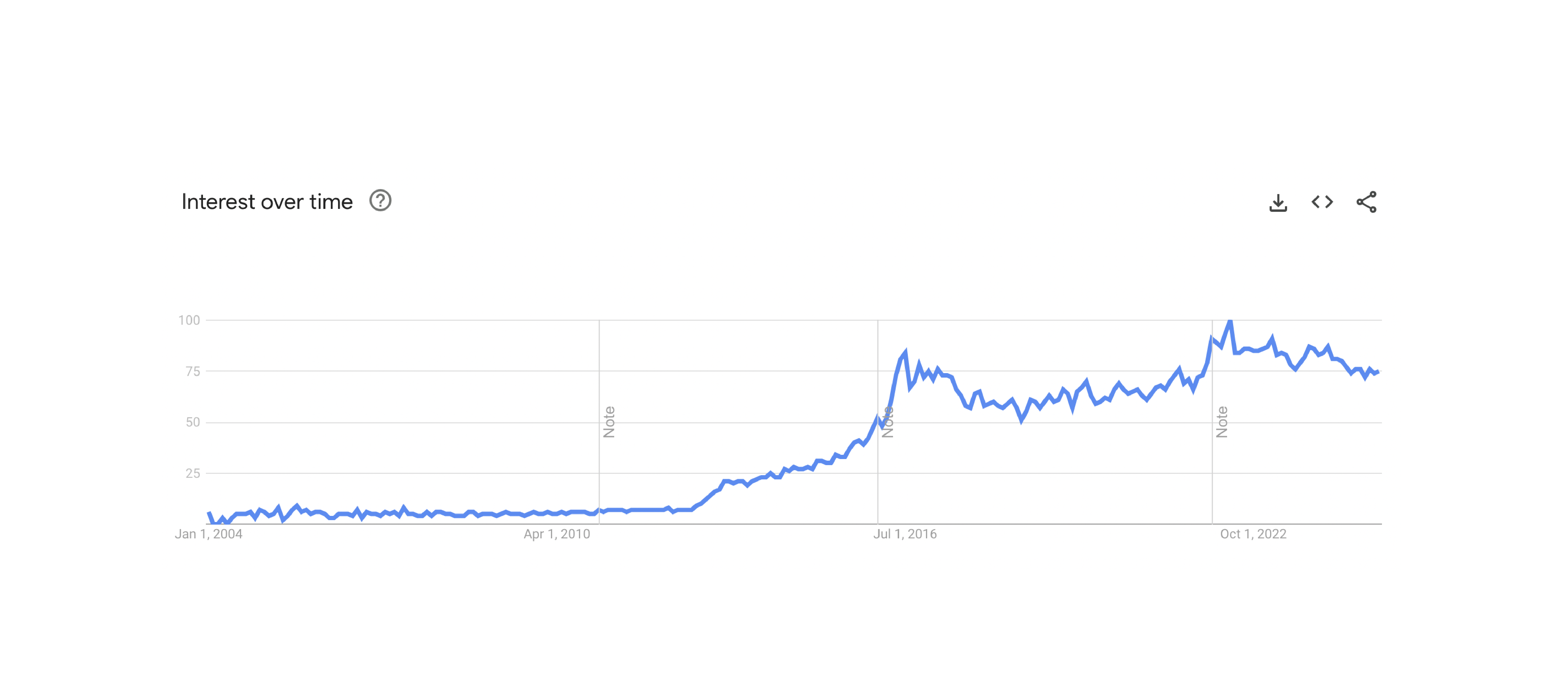
Cringe is a vibe and a state of mind: an expression of distaste marked by an aversive recoiling. Cringe was popularized on the internet and has grown along with internet culture (see Fig. 1). It has become a common slang term for describing the feeling elicited by an encounter with the uncomfortable, the disingenuous, or the banal. The rave community, of which I am both a participant and observer, has many cringe-worthy practices and belief systems, as I will discuss below. For this reason, I have found the term incredibly useful to my work as a psychedelic and nightlife journalist.
This essay uses the concept of cringe as a tool to assess where the rave scene has gone stale and to argue for ways it may reclaim a transcendent spirit. While we may never be able to fully escape the cringe, the powerful emotions it signals can serve as a shock collar, alerting us to behaviors and beliefs that were perhaps once radical but have since become outdated and cliche. In this way, I argue for the instrumentalization of cringe as a way of advancing the psychedelic music scene beyond its cringe and capitalist present. There cannot be change without cringe.
### The evolution of cringe
Merriam-Webster defines “to cringe” as “to wince or draw back in fear, pain, or disgust.”[2](#references) On the internet, the term has evolved into an insult and a value judgment—a term used to name and police a certain aesthetic sensibility.
In her explainer on cringe, popular YouTuber Natalie Wynn provides the example of an American Idol auditioner who thinks they’re performing well but actually has no talent.[3](#references) In this instance, the audience experiences the feeling of cringe due to the painful obliviousness of the singer to the reality of their performance. Cringe here is an interesting mix of empathetic shame, frustration, and disregard. Wynn goes on to show how cringe can be more pernicious. She provides the example of “cringe compilations” designed to ridicule people who are overweight, gay, or otherwise violate some normative standard. In this case, cringe is deployed as a form of control and social policing.
Cringe isn’t always punitive. Sometimes, it functions as a reflection of one’s own insecurities. We cringe when we encounter a discomfiting quality or action in others that we fear we, too, possess. For example, I cringe at the possibility of being perceived as a New Age cornball because my party dabbles in activities like meditation and breathwork. Here, cringe is a sort of reluctant empathy, or as artist K-Allado McDowell wrote, “we cringe because we love.”[4](#references)
Further, cringe reveals what has become outdated or stale. “Cringiness is not a static property,” said writer Sarah Perry. “Things that once had gravitas can become cringe-inducing with the passage of time. Cringe indicates a misfit between form and context; it is a property of the whole system.”[5](#references)
Revealing this misfit is, I argue, cringe’s most promising potential. In the psychedelic rave scene, cringe allows us to understand how describing raving using the language of spirituality and mysticism—a frame that was once central to the community’s survival and legitimacy—has become a misfit with the present context. Through this understanding, cringe provides psychedelic users and ravers an opportunity to develop more relevant, vibrant, and authentic ways of relating to these substances and practices.
### The spirituality of raving
The spiritual dimensions of the dancefloor are among rave culture’s most compelling offerings, and a diversity of party scenes over the decades have appropriated—and perverted—a variety of religious traditions in the pursuit of collective ecstatic experiences. The spiritually informed rave scene includes disparate threads from David Mancuso serving LSD as a sacrament in 1970s proto-disco Loft parties[6](#references) to Singapore’s contemporary neo-pagan raves[7](#references), which weave traditional ritual instruments into tracks with driving techno kickdrums.
Across these settings, raving is frequently portrayed by those in the scene using a number of spiritual tropes. Raving is framed as a form of spiritual redemption and “eroto-mystic delirium.”[8](#references) Party-goers may hear songs like “Baby Wants to Ride” by Jamie Principle, whose lyrics take inspiration from the Book of Revelations, or “We Magnify his Name” by Floorplan (aka Robert Hood), who claims a directive to put the gospel’s message into his music came directly from God.[9](#references)
Another common metaphor is referring to the club as a church. In this framing, clubgoers also reveal a desire for respect and legitimacy. This is not *just* a party; it is a religion.
This desire for legitimacy was particularly relevant to early club culture, which was largely comprised of marginalized and dispossessed communities. DJ Frankie Knuckles is often cited as describing The Warehouse—a pioneering Chicago house music club that catered primarily to gay, Black, and Latino men—as “church for people who have fallen from grace.”[10](#references)
Similarly, many of the spiritual frameworks for describing the scene emerged in response to negative stereotypes about rave culture. The 1994 Criminal Justice and Public Order Act in the UK curtailed partygoers’ civil liberties and allowed police to break up gatherings with “repetitive beats.”[11](#references) In response to this and similar acts, ravers began increasingly to define themselves with spiritual, mystical, and communal terms to counteract the image of raving as merely frivolous, druggie hedonism. When the free party collective Spiral Tribe and other grassroots organizations formed the “Advance Party” campaign in response to the 1994 Act, they framed raving as a ritual of collective awakening that enabled people to connect with each other in a deeper, spiritual way: “The coming together, and the dance, the ecstasy and the LSD was important. It enabled everybody to get that sense of community and equality simultaneously,” said founding member Mark Harrison. “Once that door’s been opened, that’s very real – it was a zeroing of our humanity back to an important true state.”[12](#references)
### Berghain, or Techno Disneyland
Today, Berghain, a nightclub in Berlin that is arguably the most famous in the world, continues to be described as a church by its devotees. Sunday mornings tend to be the most rapturous climaxes of its all-weekend benders, with rituals reminiscent of Christianity: attendees willing to go through the torturous trial of waiting in line for hours to become one of the “chosen few” to get in, dressing in their “Sunday best,” and experiencing shaking, babbling pleasure evoking Pentecostal ecstasy. When Berghain’s predecessor, a male fetish club called Snax, was founded in 1994, it represented the extreme possibilities of post-Wall anarchic freedom. In 2004, the club moved to a former power station that looks like a socialist fortress and has grown in popularity ever since. “Berghain has a type of aura created by the people that go there that makes it truly a spiritual experience every time I go and leaves me with this feeling as if you’re coming out of the spa, just for the soul,” said one social media manager interviewed in a New York Times spread on the club’s attendees.[13](#references)
Berghain wields immense institutional power. A single gig at the club can catapult a DJ’s career and land them spots at clubs and festivals around the world. Berghain has also become dance music’s biggest meme. Obsessive guides are strewn across Reddit and TikTok advising hopefuls on how to get in, including what to wear, how to act, and even what facial expressions to exhibit to the scowling bouncers. The infamous line outside the club is now a homogeneous mass of all-black uniforms and BDSM harnesses purchased on fast-fashion websites. Its virality has reduced a culture into the realms of cliche and caricature. In my experiences at the club, particularly since the pandemic, self-conscious performativity sets in once you’re on the dancefloor; the invisible hand of social media culture turns debauchery from a liberating act of debasement into a proscribed lifestyle of whatever clothing, body type, or effect is currently trending. Berghain has become “Berghain,” an affected simulation of itself.
The result is a fanatical club culture that can no longer describe itself as countercultural or avant-garde. What once stood as a vision of quasi-anarchic utopia has become a watered-down parody of itself. Attendees who still worship the club as a temple of radical subversion generally fail to acknowledge how club culture has been co-opted by the very same forces it claims to subvert. Wealth, power, commodification, and standardization have all come to dominate the rave scene at a place like Berghain. Pop stars and Silicon Valley tech CEOs make headlines when they name-drop the club as an aspirational destination, and the club’s silence on political issues such as the war in Gaza—partly due to its substantial funding from the German government—has resulted in many DJs boycotting their gigs at the venue. The club’s countercultural posture is thus revealed as little more than cosplay in the face of real political and financial stakes.
Describing Berghain as a church, a place of worship set apart from and subversive to the hyper-capitalization of everyday life, is now cringe. The club, like much of the commercial rave scene, feels more like a commodified leisure site, a Disneyland. While the experiences of transcendent pleasure on the dancefloor are often real, it is a place of worship to little more than social status and radical posturing and infected with dogmatic conformity to a culture that feels cultish and rigid while experiencing a crisis of faith. The assertion that the club is a sacred sanctuary for those outside the folds of mainstream society is overused, outdated, and overly attached to a moment long gone.
### New paradigms
Acknowledging the ways that commercial rave culture has become cringe is a step toward change. For example, the psychedelic parties I began to throw in the post-pandemic era were motivated by a frustration that the “Berghain model” of nightlife no longer felt like the future. The club’s infamous door policy—fronted by frowning bouncers that gloated over their ability to squash any aspiring attendee’s entrance—bred elitism and anxiety. While that may have fit with 90s cultural aesthetics, it was now a misfit for contemporary progressive politics that prioritize safety and inclusivity. I wanted to create parties where partygoers felt like they were entering a loving portal with a door policy that didn't take itself too seriously. For example, one rave, “Mushwomb,” had a door shaped like a vagina. There was no bouncer and no “right” way to get in; attendees just had to be willing to squeeze through the labia and be “birthed” onto the dance floor.
Similarly, Berghain’s no-holds-barred take on druggie hedonism encourages reckless drug use with few safety nets. Many of my friends have found themselves left alone on the streets after being thrown out of the club for accidentally overdoing it. Beyond a plaque in the bathroom encouraging clubbers to take care of each other, there is little harm reduction or safety education at the club. Those who find themselves in dangerous positions while under the influence have to rely on the uncertain kindness of strangers.
Raves, like those I throw, that are attempting to be post-cringe have an opposite drug-taking culture. There are free drug-testing kits at the bar that allow attendees to ensure their drugs aren’t adulterated with the deadly opioid fentanyl. Harm reduction organizations, like DanceSafe and Zendo Project, provide drug safety education or peer sitters who support those having a challenging trip. These post-cringe parties often address the spiritual inclinations of contemporary ravers by incorporating elements of mysticism and ritual: they are held in forests and other natural settings rather than warehouses, altars, and incense are placed by the DJ booths, and artistic performances reference folklore traditions while incorporating herbal hypnotics. At Ritual and Rave, for example, attendees were given doses of Syrian rue—an ancestral plant which some speculate is part of the Zoroastrian *haoma* brew[14](#references)—while watching a performance of Iranian whirling dervishes.
Of course, these measures are no guarantee that a party will not fall into the realm of cringe—in fact, they often do. I grapple with the question of whether the sponsorship of mushroom and cannabis brands at my parties is a capitalistic co-optation of the kind I seek to subvert. And, as a result, cringe. At the same time, it is complicated. These brands are the reason why we can afford not to serve alcohol at the bar (a move that seems to shift the vibe on the dance floor for the better) while remaining financially sustainable. Navigating money and materiality in a holy place is nothing new for the rave scene or religion. I don’t believe my mushroom raves or similar contemporary parties have truly figured out the way to preserve the sacred elements of raving without falling prey to cringe. But here again, that radical self-awareness of cringe may be our best hope for breaking through into something new.
### Author Biography
Michelle Lhooq is a Singapore-born, LA-based independent journalist covering the intersection of underground raves and psychedelics, with a particular interest in the shifting paradigms of counterculture in the era of drug legalization. Her work has appeared in The Guardian, GQ, New York Magazine, and the Los Angeles Times, and she is the author of Weed: Everything You Want to Know But Are Too Stoned To Ask (Penguin Random House). She chronicles her forays into the frontlines of today’s drug and party culture in her newsletter, Rave New World.

## References
1. Michelle Lhooq, “Inside Shroom Rave: An Experiment in Reimagining How We Gather and Process Grief,” *DoubleBlind Magazine,* November 15, 2023, . [\[Return to Section\]](#section1)
2. Merriam-Webster Online, s.v. “Cringe,” accessed December 19, 2024, . [\[Return to Section\]](#section2)
3. Natalie Wynn, “Cringe | ContraPoints,” *ContraPoints*, May 10, 2020, . [\[Return to Section\]](#section2)
4. K Allado-McDowell, “Notes on Cringe,” *Deluge Books Blog*, April 19, 2022, [\[Return to Section\]](#section2)
5. Sarah Perry, “Cringe and the Design of Sacred Experiences,” *Ribbonfarm*, 2018, [\[Return to Section\]](#section2)
6. Tim Lawrence, *Love Saves the Day: A History of American Dance Music Culture, 1970-1979* (Duke University Press, 2003). [\[Return to Section\]](#section3)
7. Michelle Lhooq, “SINGAPORE’S NEO-PAGAN RAVE RESISTANCE,” *Rave New World*, April 27, 2023, [\[Return to Section\]](#section3)
8. Simon Reynolds, *Generation Ecstasy: Into the World of Techno and Rave Culture* (Little Brown, 1998). [\[Return to Section\]](#section3)
9. Josn Baines, “How God Inspired Robert Hood’s Floorplan Classic ‘We Magnify His Name,’” *Vice*, October 2, 2015. [\[Return to Section\]](#section3)
10. Liam Maloney, “House Music & Spirituality Mix Pt.2,” *Foundations of House*, July 4, 2015, . [\[Return to Section\]](#section3)
11. United Kingdom, Public General Acts, *Criminal Justice and Public Order Act 1994*, Section 63, 1994, [\[Return to Section\]](#section3)
12. Milly Chowles, “Rave: The Beat Goes On,” *BBC Radio 4*, October 4, 2015, . [\[Return to Section\]](#section3)
13. Finn Cohen, Jelka von Langen, and Roman Goebel, “Audience Report: At Berghain, They've Been Waiting in Line for 20 Years,” *The New York Times*, December 13, 2024, [https://www.nytimes.com/card/2024/12/13/arts/music/berghain-audience-re…](https://www.nytimes.com/card/2024/12/13/arts/music/berghain-audience-report). [\[Return to Section\]](#section4)
14. See, for example, David S. Flattery, *Haoma and harmaline : the botanical identity of the Indo-Iranian sacred hallucinogen “soma” and its legacy in religion, language, and Middle-Eastern folklore* (University of California Press, 1989). [\[Return to Section\]](#section5)
#### Suggested Citation
Lhooq, Michelle. “A Post-Cringe Theory of Psychedelic Spirituality in the Rave Scene.” In *Psychedelic Intersections: 2024 Conference Anthology*, edited by Jeffrey Breau and Paul Gillis-Smith. Center for the Study of World Religions, Harvard Divinity School, 2025. © License: CC BY-NC.