# Corpsing: Two Flowers Perform the Smell of Death
## Corpsing: Two Flowers Perform the Smell of Death
Thinking with Plants and Fungi Conference 2025
Siôn Parkinson, *Visual artist, composer, performer, writer, and researcher, Royal Botanic Garden Edinburgh, Scotland*

### 1. Corpsing
This essay invites the reader to connect in mind two olfactory objects, each associated with the odor of a decomposing corpse.
The first is the “corpse flower” *Amorphophallus titanum*, a plant whose giant flowering structure and monumental stench continues to bring to botanic gardens worldwide huge crowds swarming to witness its rare and reeking blossoming event.
The second is the corpse of Saint Thérèse, more affectionately known by her nickname “Little Flower.” Little Flower was a French Carmelite nun whose body was said to smell of violets and roses in the days following her death in 1897. That same year, when her body lay in state—presented in a glass reliquary casket, visible to pilgrims—it attracted hundreds of visitors. The smell of flowers reportedly returned twice more, when her remains were exhumed in 1910 and again in 1923, when they were moved to the Carmelite chapel. In each instance, what many interpreted in her body’s sweet aroma as a miraculous absence of decay drew yet more crowds. Like the giant corpse flower she is paired with here, Little Flower became the focus of a powerful and unexpected scent event.
Some plants, and human bodies, emit smells so intense or incongruous that they momentarily undo our expectations of what such objects should express. These fleeting emissions resist full description in visual art and language. What they produce is not just a representational failure, but a shared disturbance—immediate and infectious, like an odor that overtakes a room before anyone can name it; like a laugh that slips out uninvited.
The title of this essay, “*Corpsing,”* has layered associations—performative, olfactory, and bodily. In British theater slang, to “corpse” is to break character, usually by laughing during a serious scene (Figure 1). It describes the moment an actor playing dead suddenly twitches or snorts, revealing the artifice of the performance and throwing off both cast and audience. Paradoxically, a corpse corpses when it stops behaving like a corpse. The illusion of death is broken; the spell collapses. Laughter spreads from the stage to the auditorium, overtaking bodies on both sides of the divide.
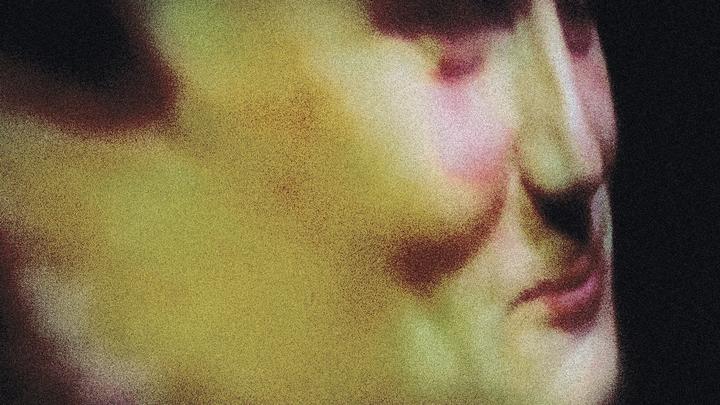
Figure 1. Michael Palin “mid-corpse” during *The Parrot Sketch*, *Monty Python Live at the Hollywood Bowl* (1982) in a still from the digital video *Corpsing* by Siôn Parkinson (2025). All the images in this essay are video stills from *Corpsing*.
Beyond metaphor, corpsing also conjures literal sensory cues, the kinds we associate with real corpses: the stench of purge fluid (a dark, blood-tinged liquid that leaks from the mouth and nose as the gut breaks down); the warmth and bloating of bacterial decay; wet gurgles as gas and liquid shift; sudden sighs, hisses and pops as air escapes distended orifices, sometimes triggering post-mortem vocalisation as it passes the vocal folds; and, finally, the insistent buzz of flies. Then there are the human responses: wails, gasps, nervous laughter. Taken together, these emissions⎯chemical, acoustic, affective⎯compose a multisensory event. The dead body becomes not a static object but a site of performance, of breakdown, overflow, and transformation (Figure 2). It unsettles by violating expectations of how a (dead) body should behave.
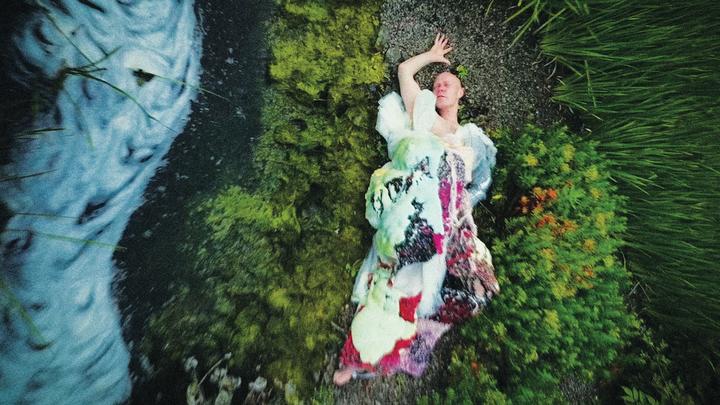
Figure 2. The author wearing a stink-inspired dress designed for him by Matty Bovan (2020), as featured in a performance-lecture at Harvard University, 15 May 2025.
I am interested in *corpsing* not just as a theatrical glitch, but as a conceptual tool for thinking about human encounters with plants that exceed their visual form as a result of their stinking. Corpsing lets us think through representational failure as something that unsettles expectations, or resists its assigned role.
Crucially, corpsing requires an audience. You cannot corpse alone. The sights, sounds, and smells that emanate from a corpsing object are signs of life⎯multispecies life, fragile and contingent, shaped by the organisms and environments in which the act of corpsing occurs. Wherever something corpses, whether in a rainforest, glasshouse, or glass coffin, ecology takes shape.
### 2. Pilgrims for the Putrid
Since it was first documented by Western science nearly 150 years ago in the rainforests of Western Sumatra, *Amorphophallus titanum*⎯better known as the corpse flower⎯has become a botanical celebrity. Its towering bloom, the largest unbranched inflorescence in the world, is a rare(ish) sight. Thanks to a surge in press coverage, the corpse flower is fast becoming more familiar to the public. But it is the corpse flower’s stench⎯an unmistakable reek of rotting animal flesh⎯that makes it truly infamous. Its smell has been compared to rotten fruit, decaying meat, fermented foods, sweaty socks, and even cancerous wounds—odors that typically attract flies, beetles, and other insects, which the plant has evolved to lure as pollinators.[1](#references)
As of March 2025, the corpse flower has been cultivated in more than 90 botanic gardens across 18 countries worldwide.[2](#references) Since the turn of the millennium, 550 corpse flower blooms have been recorded in more than two-thirds of U.S. states alone, a figure that will likely be outdated by the time you read this. Given affectionate nicknames like Putricia, Lil Stinker, Darth Vapor, and The Amazing Stinko, photographed by millions, and even live-streamed year-round, the corpse flower has become a lucrative and crowd-pulling attraction for hosting institutions, with flowering events drawing enormous crowds eager to see and sniff “nature” at its most noxious (Figure 3).
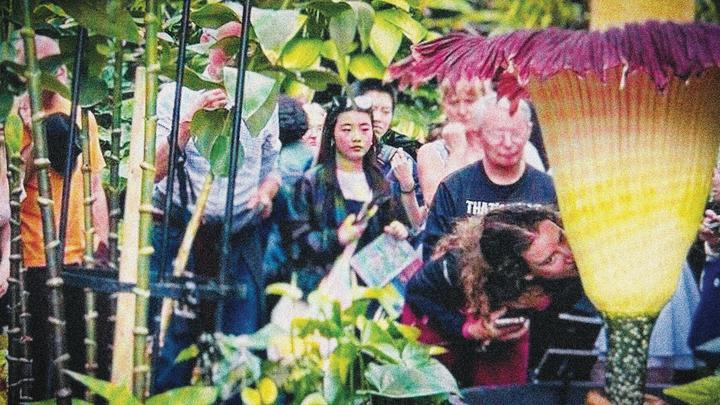
Figure 3. Visitors queuing to smell a blooming *Amorphophallus titanum* at Kew Gardens, London. Still filmed from BBC News webpage, June 19, 2024.
What does it mean to sensationalize a plant for our amusement? How does the corpse flower’s transformation from an elusive rainforest giant to a must-see botanical event reshape our relationship with plant life and the terms by which it becomes legible to the public? On one hand, these spectacles democratize botanical knowledge, drawing in audiences with little exposure to rare or ecologically distant flora. The corpse flower is charismatic: Its size, strangeness, and stench make it unusually effective at capturing human attention. On the other hand, this very charisma risks turning a fleeting biological process into a reproducible floor show. The demand to experience the bloom fuels what might be called a ***biocultural heritage economy***—a circulation of living specimens, attention, and symbolic capital, often far removed from the plant’s ecological origins. These events are not just celebrations of nature’s weirdness. They are **choreographed encounters**, calibrated for visibility, virality, and footfall. What is at stake is not only the welfare of wild populations (which now face threats from habitat loss and overcollection, according to the IUCN Red List[3](#references)) but also a cultural displacement: the translocation of an organism from forest to hothouse, from multispecies ecology to curated display.
In the process, the corpse flower’s strangeness is not lost but staged. Its rot is repackaged as performance, its rarity converted into content. It becomes manageable, consumable—rendered in memes, livestreams, and hashtags. The intense human desire to witness this plant in full, fetid bloom has contributed to its wider cultivation. The same institutions staging these events are also working to preserve the species. What we are left with is a paradox: To desire this plant is to remove it from its context, but perhaps also to ensure its survival.
Yet perhaps the most unexpected consequence of this global phenomenon is ecological. In our obsession with experiencing the corpse flower up close, we have unwittingly inserted ourselves into its ecology. No longer passive spectators, humans are becoming active participants, symbolically standing in for the insects that would otherwise pollinate the corpse flower in the wild. While casual spectators snaking through the hothouses do not pollinate the plant themselves, their fascination sustains the institutions that do. In botanic gardens around the world, horticulturalists now routinely hand-pollinate specimens to ensure successful reproduction, stepping in where carrion beetles and flesh flies would perform this role in the wild. Human hands now help propagate the species. We are no longer passive spectators. The corpse flower uses us—curators, crowds, cameras—as it once used its pollinators. We become beetle (Figure 4).
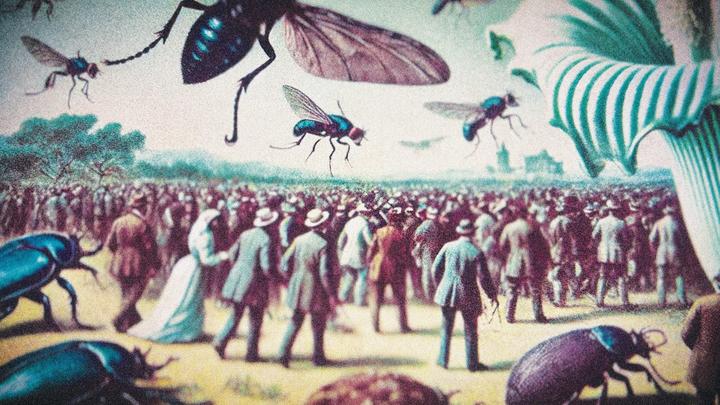
Figure 4. AI-generated image of flies, beetles, and people swarming a colossal bloom, while crowds of people turn their backs and move away. Created using ChatGPT (DALL·E) and digitally altered by the author.
More broadly, the global corpse flower phenomenon shows how we are increasingly drawn to rare olfactory experiences, especially and counterintuitively those that provoke revulsion. What we seek is smell—more precisely, stench. To us, this stench is ersatz; that is, a replacement for what we know or imagine a rotting animal or human body to smell like. Yet it is no less authentic to the corpse flower itself and the olfactory strategy it has evolved to propagate the species. In our voracious pursuit of extreme sensory experience, might we too be becoming, like insects that creep toward carrion, saprophiles, pilgrims for the putrid?
### 3. Olfactory Fiction
Odoardo Beccari, the nineteenth-century Italian naturalist, is said to have discovered the corpse flower. In truth, he “discovered” it only in the sense that he made it famous and fashionable in the West. And by “the West,” I mean Western Europe and North America, but also Australia and New Zealand—regions with enduring ties to European colonialism and extractive capitalism. The same forces that once relocated the plant for imperial display now contribute to its decline.
In September 1878, while traveling in the rainforests of Western Sumatra, Beccari encountered what he described as an extraordinary flowering specimen. He would later send seeds and letters to his colleague, the Marquis Bardo Corsi Salviati, a plant collector based in Florence. In his correspondence, Beccari emphasized not the smell, but its size—particularly the spadix, which he claimed reached “the height of a rather tall man.”[4](#footnotes) He originally named the plant *Conophallus titanum*⎯giant cone-shaped phallus⎯in reference to its towering six-foot-long shaft.
Beccari’s letters, translated and published that same year in *The Gardeners’ Chronicle*, offer no mention of the two Indigenous men who helped him collect the plant, an omission typical of the time (Figure 5).[5](#footnotes) More curiously, he also omits any reference to its smell. This is strange, given the overwhelming stench described by nearly everyone else since. Perhaps he missed it. The plant only emits the odor in bloom⎯which is to say, infrequently. And when it does, the smell is most pungent at night when, via a process called thermogenesis, the spadix heats up to more than 90°F (32°C), equivalent to the internal temperature of a decomposing pig cadaver.[6](#references)
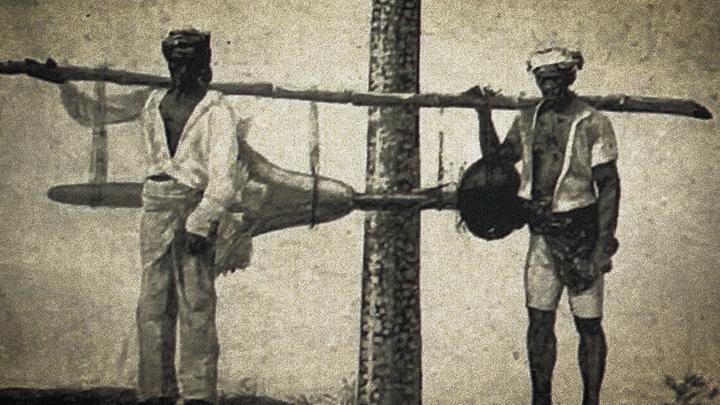
Figure 5. *Amorphophallus titanum* inflorescence with tuber, carried by two Indigenous collectors. Detail from a painting by E. Xiemens (c. 1889), executed under the direction of Odoardo Beccari. Reproduced in *Amorphophallus titanum Beccari* (Royal Tropical Institute, 1934).
Or perhaps, like many of his contemporaries, Beccari was too dazzled by scale to notice much else. Historical accounts of the corpse flower (and other phallic, stink-mimicking species such as the stinkhorn fungus[7](#references)) tend to fetishize the *fascinus*, the divine phallus of ancient Rome, thought to confer protection and ward off evil. From this same root comes the word *fascinate*—to be enthralled, even entranced, by what repels or threatens. The botanical gaze, seduced by sheer scale and form, often privileges this iconography of virility while sidelining olfactory detail.
In 1879, a year after Beccari’s letters were published, fellow Italian botanist Giovanni Arcangeli reclassified the plant as *Amorphophallus titanum*, the name it carries today.[8](#footnotes) In Arcangeli’s account, we finally catch a whiff, so to speak, of the corpse flower’s odor:
> Above the sexual organs, the spadix extends into an elongated, conical appendage, smooth and regular, ending in a blunt tip; it is dirty yellow at the base and livid in its upper region. Once the inflorescence has opened, this part emits a fetid odor, akin to that of rotting flesh, and exhibits a temperature considerably higher than the surrounding air, similar to what has been observed in other aroids.[9](#footnotes)
Even here, the scent is treated almost in passing, an afterthought to its visual grandeur. *Amorphophallus titanum*⎯giant misshapen phallus. The epithet *titanum* summons the Titans of classical mythology, those vast, unruly beings overthrown by Olympian order. Despite its ostentatiousness, the name is largely odorless for such a pungent plant.
In Western Sumatra, the plant is called ***bunga bangkai***—literally, *carcass flower*. A name not cast in mythological or morphological terms, but in visceral ones derived from the plant’s smell and the deathly affect it provokes. Where the Latin binomial anatomizes a body, the vernacular name evokes an encounter.
Underlying botanical naming conventions and taxonomic choices is a deeper epistemic bias: Sight is valorized as objective and stable, while smell is framed as subjective, volatile, and resistant to classification. The nose, after all, cannot be peer-reviewed.
The language of smell is metonymic. Adjectives for odors stand in for olfactory objects sited elsewhere, sometimes beyond our lived experience, as if hallucinated. The corpse flower does not smell of *itself*; it smells *like* a corpse. The often-repeated description of its bloom’s “fetid odor … of rotting flesh” acts as a proxy for an erstwhile smell encounter with a decomposing body⎯an intuitive memory of decay, perhaps, honed by evolutionary aversion to putrescence and the pathogens it may carry.
But what kind of body is imagined here? The colloquial “corpse flower” remains a failure of representation, for the word *corpse* gestures away from the plant itself and toward a specifically human body—a secondary object that remains out of sight and out of smell. The stench the flower mimics is not generic, but specific. It is calibrated to deceive the sensory apparatus of necrophagous insects, which have evolved to locate fresh carcasses. In the lowland forests of Western Sumatra, such insects might detect the bodies of wild pigs, macaques, or small deer. The corpse flower reproduces the volatile compounds associated with this kind of mammalian decay. The smell is not for us. It is an olfactory fiction evolved to seduce insects. That we humans are drawn to it too suggests a strange alignment of appetites, a proximity of instincts we might rather disavow.
The bloom of *Amorphophallus titanum* is famously fleeting: it takes years to gather the energy to flower, then opens within hours—usually at night—and collapses within a day. Its giant greenish-purple spathe (the petal-like outer sheath) unfurls just long enough to release its infamous scent. After that, it withers. In this sense, the plant is ephemeral in the original sense of the word: lasting only for a day.
Yet even this brief event leaves a lingering trace. While the inflorescence may be visually spectacular, its olfactory scale is greater still. The smell can travel up to half a mile, vastly exceeding the plant’s physical dimensions.[10](#references) It leaves an impression—on insects, on humans, and, increasingly, on institutions tasked with conservation efforts. In 2018, 140 years after Odoardo Beccari first described it, *Amorphophallus titanum* was added to the IUCN Red List of threatened species.[11](#references) Now classified as endangered, its native habitat is increasingly imperilled by logging and industrial agriculture. To focus solely on the corpse flower’s visual novelty is to undersmell the wider context of its ecological vulnerability and the deceptive olfactory cunning it performs.
### 4. What You Want, You Can’t Film
Beyond natural history, pilgrims have long sought strange scents. Take the French nun Saint Thérèse of Lisieux, or “Little Flower,” as she is affectionately known by Roman Catholics. After her death in 1897, devotees reported a mysterious floral fragrance as she lay in state (Figure 6).[12](#references) Her remains were exhumed twice, in 1910 and 1923, each time drawing hundreds eager to experience the miraculous scent of violets, roses, and incense.[13](#references)
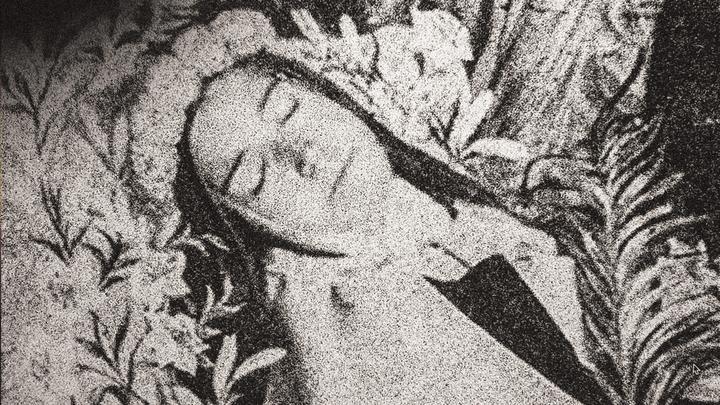
Figure 6. Detail from a historical photograph of Saint Thérèse of Lisieux (“The Little Flower”) lying in state, 1897. Her body is surrounded by flowers, with a palm frond laid across her chest.
The corpse flower and the body of Saint Thérèse each center on smell as transgression. One mimics the stench of a corpse; the other appears miraculously free of it. Yet both have shown a remarkable capacity to capture the public imagination with the promise of an exquisite, that is, a “choice” olfactory experience.
Between these two, it is the body of Saint Thérèse that most disrupts expectations. Her association with pleasant smells is not one of rot but of radiance. The olfactory phenomena surrounding her exhumation in 1910 defy naturalistic explanation. According to a later account archived by the Carmel of Lisieux, two men⎯father and son, one of whom had helped construct her wooden casket and stood nearby when it was opened⎯reported sensing “a sweet and strong scent of violets that no natural cause could explain.”[14](#references) This perfumed aura became part of Saint Thérèse’s sacred legend. But there may also be a chemical basis. Indole, a compound released during decomposition, is also found in small concentrations in jasmine, tuberose, and lily, and in lesser amounts in violet, where it contributes to their sweetness. At trace levels, it registers as floral; at higher concentrations, as fecal or putrid. In this light, the perceived miracle becomes chemically plausible: a faint trace of decay refracted through the register of sweetness. Sanctity by osmosis.
The Little Flower episode is more than just anomaly or marvel. It is a moment where the corpse does not behave *corpse-like*, breaking with expectation⎯“*corpsing”* in a literal and theatrical sense. Instead of disgust, it signals delight. Instead of decay, it performs sanctity. This rupture unsettles the boundaries between death and fragrance, relic and residue. And crucially, it spreads. The witnesses are affected; the story is retold. The scent becomes legend. In this, “Little Flower” offers a metonymic inversion: a body that smells like a bloom. The corpse flower, by contrast, stages the reverse: a bloom that smells like a corpse. Both unsettle through scent, refusing to stay in character. And both demand an audience. From the quiet hush of a convent to the humid press of a botanic glasshouse, what is on display is not simply flesh or flora, but a scene of olfactory transgression.
The poet Kimberly Johnson captures this strange mix of voyeurism, fascination, and revulsion in her 2010 poem “Corpse‑flower (*Amorphophallus titanum*).” Better than any botanical drawing, close-up photograph, or time-lapse video of seductively unfurling bracts and wilting shafts, Johnson’s words bring us nearer to the flower’s messy, fleshy, heat‑heavy scentscape and the invisible allure of its complex volatiles: “What you want / You can’t film: the meat-wet stench / Of my inflorescence, ruined sweet / Like a carcass heat-rotting in the compost heap . . .”[15](#footnotes)
Today, the corpse flower’s phone-camera frenzies have replaced the buzzing of beetles and flies. While horticulturalists hand-pollinate the plant to ensure seed production, the crowds queuing for hours form part of its strange new ecology in the way we circulate its image, carry its legend, spread its scent-story (Figure 7).
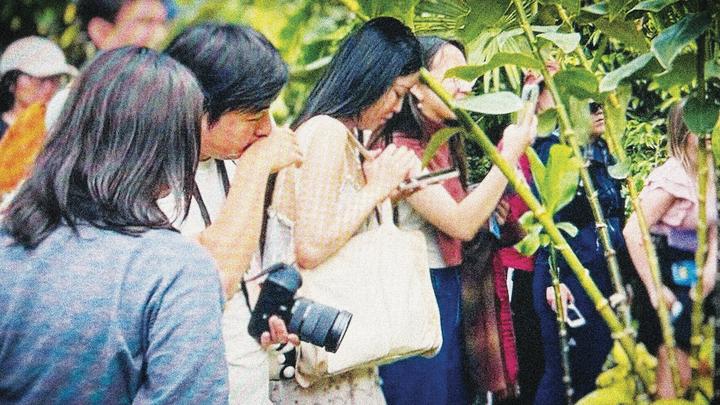
Figure 6. Detail from a historical photograph of Saint Thérèse of Lisieux (“The Little Flower”) lying in state, 1897. Her body is surrounded by flowers, with a palm frond laid across her chest.
As someone who works at the Royal Botanic Garden Edinburgh, where the corpse flower’s first Scottish bloom in 2015 drew around 19,000 visitors in four days, I have witnessed first-hand how this rare and reeking plant becomes a stage for our attraction to the abject.[16](#references)
“Of what should beauty smell / If not of death, whose flower it is?” the poem asks. Johnson’s final line leaves us with a truth deeper than any photo or Instagram reel: *What you want, you can’t film*. No matter the lens, the lighting, or the precision of the artist’s pen or paintbrush, the corpse flower eludes capture, just as scent resists taxonomy. Its power lies in presence, not in representation. As one visitor to the Garden put it, after encountering the bloom: “It didn’t smell bad enough.” As if the failure lay not in the flower but in our expectations.[17](#references)
The corpse flower is not just a botanical curiosity but a sensorium, a spectacle⎯and a problem. It unsettles what we think we know about beauty, decay, and desire. And if its scent escapes our language, it may be because language itself is still learning how to smell.
### Author Biography
Siôn Parkinson is a visual artist, composer, performer, and writer investigating our sensory relationship with the more-than-human world. His first book is forthcoming: *Stinkhorn: How Nature’s Most Foul-Smelling Mushroom Can Change The Way We Listen* (Sternberg Press, March 2025). Siôn is a research fellow at the Royal Botanic Garden Edinburgh, where he explores the olfactory heritage of fungi—mushroom smells that are meaningful to individuals or communities due to their association with significant places, objects, or traditions. Originally trained as a sculptor, Siôn received his PhD in sound studies from the University of Leeds, where he was an Amanda Burton scholar.
#### Footnotes
1 Mika Shirasu et al., “Chemical Identity of a Rotting Animal-Like Odor Emitted from the Inflorescence of the Titan Arum (*Amorphophallus titanum*),” *Bioscience, Biotechnology, and Biochemistry* 74.12 (2010): 2550–54. [\[Return to Section\]](#section1)
2 “*Amorphophallus titanum* (Titan Arum),” Juniper Level Botanic Garden, [\[Return to Section\]](#section1)
3 Yuzammi and J. T. Hadiah, “*Amorphophallus titanum* (Becc.) Becc.,” *The IUCN Red List of Threatened Species* (2018): e.T118042834A118043213. [\[Return to Section\]](#section2)
4 “Untitled,” *The Gardeners’ Chronicle* 10 (1878): 788. [\[Return to Section\]](#section3)
5 “Another Gigantic Aroid,” *The Gardeners’ Chronicle* 10 (1878): 596. Article title supplied by the journal; includes a translated extract from a letter by Odoardo Beccari. [\[Return to Section\]](#section3)
6 Philip S. Barton et al., “Temperature Dynamics in Different Body Regions of Decomposing Vertebrate Remains,” *Forensic Science International* 325 (2021): 110900. [\[Return to Section\]](#section3)
7 Siôn Parkinson, *Stinkhorn: How Nature’s Most Foul-Smelling Mushroom Can Change the Way We Listen* (MIT Press, 2025). [\[Return to Section\]](#section4)
8 Giovanni Arcangeli, “Sull’Amorphophallus titanum Beccari,” *Bullettino della R. Società Toscana di Orticultura* 4.2 (1879): 46–51. [\[Return to Section\]](#section4)
9 Arcangeli, “Sull’Amorphophallus titanum Beccari,” 49 (author’s translation). [\[Return to Section\]](#section4)
10 “The corpse flower: is this the world’s smelliest plant?” *The Guardian*, June 19, 2024, [\[Return to Section\]](#section4)
11 *Pluie de roses:* *Quelques-unes des grâces et guérisons attribuées à l'intercession de soeur Thérèse de l'Enfant-Jésus morte en odeur de sainteté au Carmel de Lisieux, 1873–1897* (Saint-Paul Bookstore, n.d.). Project Gutenberg eBook no. 36708, [\[Return to Section\]](#section4)
12 Yuzammi and J. T. Hadiah, “*Amorphophallus titanium,*” e.T118042834A118043213. [\[Return to Section\]](#section5)
13 Archives of the Carmel of Lisieux, *Eyewitness Accounts of the Exhumations of the Relics of St. Thérèse of Lisieux*, trans. Monique Pilon Fraschetti, ed. Maureen O’Riordan (Carmel Archives, 2010). [\[Return to Section\]](#section5)
14 Archives of the Carmel of Lisieux, *Eyewitness Accounts of the Exhumations of the Relics of St. Thérèse of Lisieux*, trans. Monique Pilon-Fraschetti, ed. Maureen O’Riordan (Carmel Archives, 2010). [\[Return to Section\]](#section6)
15 Kimberly Johnson, “Corpse-Flower (*Amorphophallus titanum*),” *Ploughshares* 36.4 (Winter 2010–11): 60. [\[Return to Section\]](#section6)
16 Royal Botanic Garden Edinburgh, “Blooming hat-trick for Scotland’s world-beating giant!” press release, June 17, 2019, [https://www.rbge.org.uk/news/media-centre/press-releases/current/blooming-hat-trick-for-scotland-s-world-beating-giant/](https://www.rbge.org.uk/news/media-centre/press-releases/current/blooming-hat-trick-for-scotland-s-world-beating-giant/?utm_source=chatgpt.com) [\[Return to Section\]](#section7)
17 Johnson, “Corpse-Flower,” 60. [\[Return to Section\]](#section7)
#### Suggested Citation
Parkinson, Sion. "Reimagining Smelly Plants and Fungi in Art and Sound" in Thinking with Plants and Fungi: Interdisciplinary Explorations of Ecology, Mind, and the More-than-Human World, edited by Rachael Petersen, Russell Powell, and Natalia Scott Schwein. Center for the Study of World Religions, Harvard Divinity School, 2026.