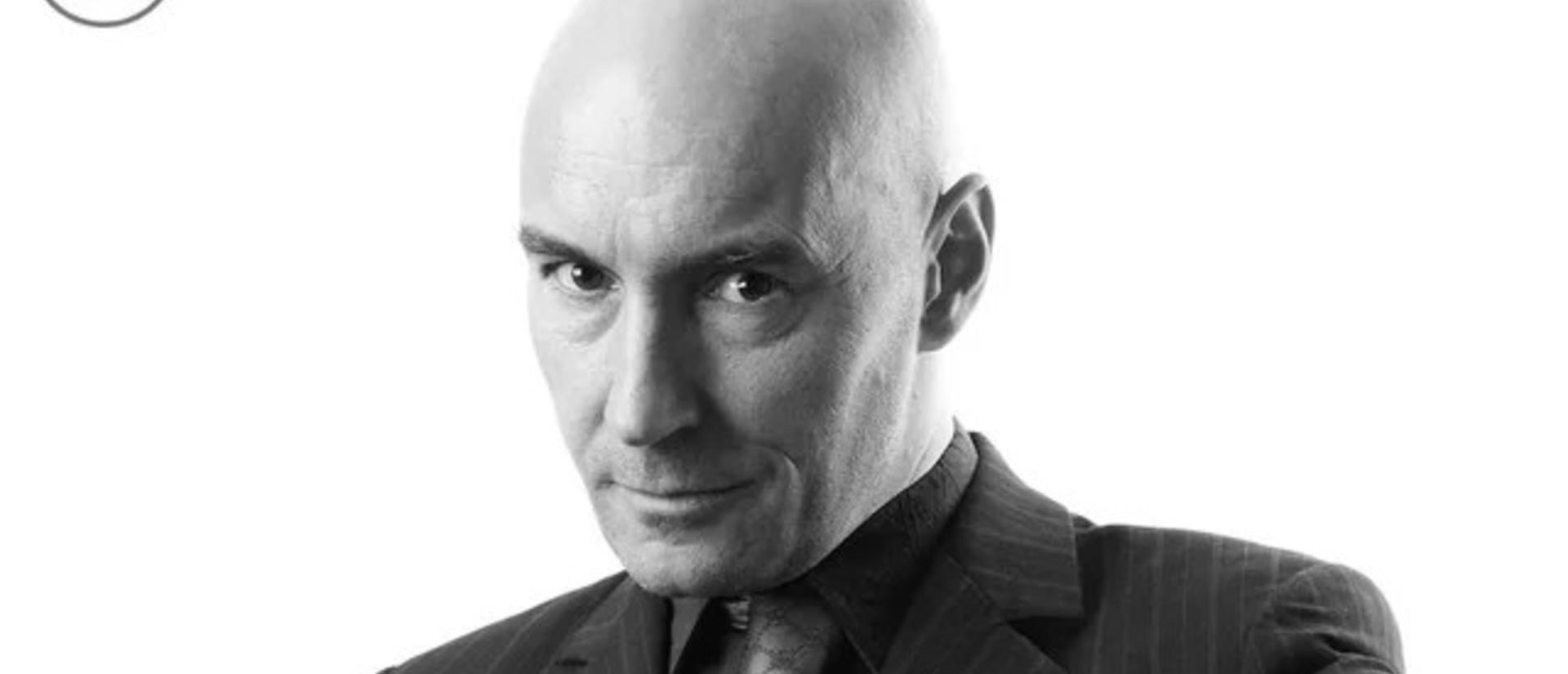
# Grant Morrison’s Kathmandu Abduction
January 20, 2026
Grant Morrison is a Scottish author of comic books. They have written primarily for Detective Comics (D.C.), writing long arcs for Batman, Superman, Green Lantern, the Justice League of America and Doom Patrol. At the time of the experience recounted below, Grant identified as he, but in 2019, they came out as non-binary. They have been a practicing ceremonial magician since the age of 18. After three decades of straight-edge living, Morrison started to experiment with alcohol, marijuana, and various psychedelics in 1993.
Morrison broke ground on their most personal and ambitious comic book, *The Invisibles,* in 1994*.* They aimed to collapse the distinction between themselves and the comic, reality, and fiction. Morrison shaved his head and dressed like the main character of the series, King Mob. Then they traveled the world. Morrison was traveling in Kathmandu, Nepal, in May of that year. They had just run up the 365 steps of a nearby Temple on a single lungful of air to “achieve enlightenment.” Later that day, Morrison smoked some hashish and sat on the roof of a motel overlooking the Swayambhu Temple while writing the letters column for issue #2 of *The Invisibles*. It is then that the experience recorded below occurred.
Morrison’s abduction experience transformed their person and their writing. Morrison claims that in the weeks after this event, they could experience the solidity of time by seeing the origin, life, and end of a given object. Morrison also began to note a string of paranormal events that blurred the distinction between their personal life and *The Invisibles.* The most striking instance of this is when the character King Mob was taken hostage and tortured by the villainous archons. In the comic, the archons infected King Mob with a bacterial agent and stabbed him in the lung. After writing this scene in the comic, Morrison themselves became severely ill. They were shuttled to the hospital to find that they had a severe staph infection in their lungs.
The abduction experience itself is encoded in both *The Invisibles* and *JLA: Rock of Ages*. Some of the ideas infusing their later work include the *gnosis* of the fifth dimension, universes as incubators for deities, consciousness as the spark of divinity within each of us, and the power of imagination to transform the world. Coming from one of the most widely read comic book authors at the turn of the twentieth century, these ideas have spread into other media, most notably in the sci-fi film franchise *The Matrix.*
## Source
Morrison has produced dozens of accounts of this event. The first mention comes in the letters column in issue #2 of *The Invisibles*. The earliest full account is found as a chapter in *Fortune Hotel: Twisted Travel Writing,* an edited volume by Sarah Champion. The account below is drawn from Morrison’s history of comics-cum-autobiography, *Supergods*.
Dillon, “Reimagining Gnostic Theo-Mythology Through Grant Morrison’s *JLA: Rock of Ages*.”
Later that night, as they sat on the rooftop of their hotel writing the second issue, they saw the adjacent Shwayambunath temple “rearrange itself like a Transformer into some kind of chrome lionlike configuration with exhaust pipes and tubular spirit conduits.” Understandably disoriented, Morrison made their way to their hotel bed before losing contact with the room completely. “Dribbling blobs of pure holographic meta-material angels or extraterrestrials” emerged from the walls. As they relay it, these angels took them briefly to Alpha Centauri before taking them to see “the secret of the universe.” Morrison found themselves in a space that was a “profound azure blue in all directions, laced with bright silver lines and grid traceries that came and went.” It felt like a homecoming. They were informed by these aliens that time and space were just lower dimensions for “creating gods.” Within these universes, what humans experience as “evil” was a necessary condition: strife and conflict were necessary for universes to become self-aware superdeities. They were being granted a vision of infant universes on their way to godhood. The aliens urged them to remember as much as they could, because “so many of \[the aliens/angels’\] concepts were quite simply beyond their comprehension and would not survive a return to human consciousness.” And when they returned to their body, they could not help but sense this was their “personal induction into... the army of light.
When they returned, Morrison found that they had their own superpower. They were able to see everything—people, objects, natural phenomena—as if the fourth dimension of time were visible. In their words: “I could see the shape of things and of people as the flat plane surfaces of far more complex and elaborate processes occurring in a higher dimensional location. Every human life became a trailing extension through time, not just four-limbed and two-eyed but multilimbed and billion-eyed as it wormed back from the present moment and forward in into the future.” Invoking the “flatland” concept, Morrison avers that their phenomenological experience rendered the fourth dimension as hard, not fluid. Like a comic book, where we can flip from beginning to end and back again (with characters in it none the wiser), the four-dimensional world appears to us to be in motion, but from a fifth-dimensional perspective, time is as solid as matter.
## Bibliography
**Works by Grant Morrison**
*Morrison, Grant. Supergods: What Masked Vigilantes, Miraculous Mutants, and a Sun God from Smallville Can Teach Us About Being Human. New York: Spiegel & Grau, 2011.*
*Morrison, Grant, Keith Aiken, and Brian Bolland. The Invisibles Omnibus. New York,*
*NY: DC Comics, 2012.*
*Morrison, Grant, Howard Porter, and John Dell. “Rock of Ages Prologue: Genesis*
*and Revelations.” LA, no. 10 (Sept 1997), . ———. “Rock of Ages Part Two: Hostile Takeover.” LA, no. 11 (Oct 1997), https://*
*[www.comics.org/issue/60888/](http://www.comics.org/issue/60888/).*
*———. “Rock of Ages Part Three: Wonderworld.” LA, no. 12 (Nov 1997), https://*
*[www.comics.org/issue/61014/](http://www.comics.org/issue/61014/).*
*———. “Rock of Ages Part Four: Wasteland.” LA, no. 13 (Dec 1997), [https://www ](https://www );*
*.comics.org/issue/61121/.*
*———. “Rock of Ages Part Five: Twilight of the Gods.” LA, no. 14 (Jan 1998),*
*.*
*———. “Rock of Ages Part Six: Stone of Destiny.” LA, no. 15 (Feb 1998), https://*
*[www.comics.org/issue/61447/](http://www.comics.org/issue/61447/).*
*Morrison, Grant, Ivan Reis, and Mark Pennington. “Black Science 2: Part 2:*
*Einstein’s Monsters.” The Invisibles vol 2., no. 18 (Sept 1998), [https://www.comics ](https://www.comics );*
*.org/issue/62161/.*
*Morrison, Grant, and Chris Weston. “Season of Ghouls.” The Invisibles, no. 10 (July*
*1995), *
**Works about Grant Morrison**
Dillon, Matthew. “Reimagining Gnostic Theo-Mythology Through Grant Morrison’s *JLA: Rock of Ages,*” in *Theology and the D.C. Universe,* edd. McKee, Gabriel, and Abraham, Roshan (New York: Lexington, 2022), 52-70.
Goodwin, Megan. “Conversion to Language: Magic as Religious Language in Grant Morrison’s *Invisibles*” in *Graven Images: Religion in Comic Books and Graphic Novels*, ed. Lewis, A. David and Hoffer Cramer, Kristine (New York: Continuum, 2010), 258–270
Meaney, Patrick. *Our Sentence is Up: Seeing Grant Morrison’s The Invisibles.* Revised first edition. Edwardsville, Ill.: Sequart Research & Literary Organization, 2011*J.*
Singer, Marc. *Grant Morrison: Combining the Worlds of Contemporary Comics*, Jackson: University Press of Mississippi, 2012.
Author Biography
### Matthew Dillon
Matthew J. Dillon served as Research Associate and Program Lead for the Archive of Mystical Experience project at the Center for the Study of World Religions from 2023 to 2026. He earned his PhD from Rice University with specializations in Christian Studies and the History of Religions. His research examines the afterlives of ancient apocryphal and Gnostic sources in American religion. To that end, he published articles on conspirituality, neo-Gnostic churches, Gnosticism in the works of Grant Morrison, Gnosticism and attachment theory, James Hillman's psychology, and theoretical approaches to the study of Gnosticism. His first book, *The Kingdom Is Within You: The Nag Hammadi Library and Post-Christianity in America*, is under contract with the University of Virginia Press's American Spirituality series.
During his appointment at the CSWR, Dillon led the development of the Archive of Mystical Experience database. He also created and hosted *Pop Apocalypse*, the CSWR's first podcast series, which explored gnostic, esoteric, mystical, and visionary currents in popular culture through conversations with artists, writers, scholars, and musicians. Episodes and recordings from the series remain available through the CSWR website and YouTube channel. [Pop Apocalypse (CSWR)](https://cswr.hds.harvard.edu/research-programming/transcendence-transformation/pop-apocalypse-podcast?utm_source=chatgpt.com) · [Pop Apocalypse YouTube Playlist](https://www.youtube.com/playlist?list=PLX_9feVneSp3MKVKN4mu_VdJ-hIdMtfPv&utm_source=chatgpt.com)

See also:- [ Archive of Mystical Experiences ](/topic-tags/archive-mystical-experiences)