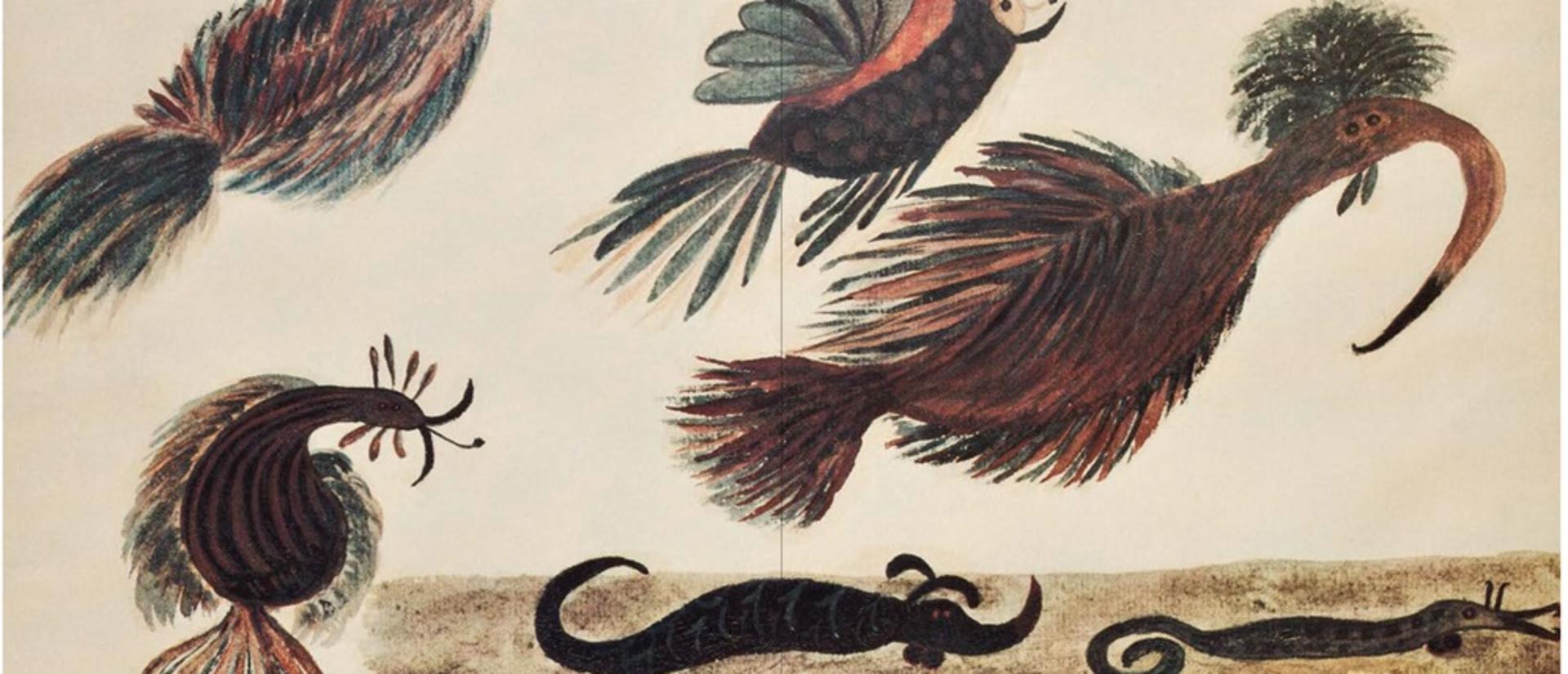
# Mars Within
March 04, 2025
[ Elitza Koeva ](/people/elitza-koeva)
*Edited by* [*Aaron Michael Ullrey*](https://cswr.hds.harvard.edu/people/aaron-michael-ullrey)*.*
*This Research Reflection by* [*Elitza Koeva,*](https://cswr.hds.harvard.edu/people/elitza-koeva) *Postdoctoral Fellow, Thinking with Plants and Fungi, is part of an ongoing series spotlighting the academic study of religions.*
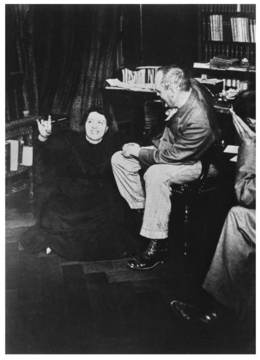
Hélène Smith (Élise Müller) and Théodore Flournoy circa 1894-1899. Image attributed to Eugène Demole. Bibliothèque de Genève.Mars has long ignited scientific and artistic fascination. Hélène Smith was a nineteenth-century Swiss medium who claimed to channel voices and images from the planet Mars. Her visual and acoustic landscapes captivated prominent figures, including Ferdinand de Saussure and Carl Jung, but these landscapes were also reduced by her interpreters to subliminal projections. Smith’s glimpse into a cosmos of interconnected consciousness resonates today with scientific and artistic explorations of mind and space, where boundaries of individual human consciousness are not edges of our universe but starting points for a broader cognition that includes nonhuman worlds.
Born Élise-Catherine Müller, Smith (1861-1929) was a medium at the cusp of European scientific curiosity and spiritual exploration. During séances, Smith manifested complex, multi-sensory experiences that she claimed transported her to past earthly lives and to the planet Mars. She described detailed visual and auditory imagery and narratives, drawing upon which she depicted cultural and social practices of life on Mars. Her ability to “speak” and “write” Martian language manifested through automatic writing and speaking in tongues that mimicked structures in genuine languages.
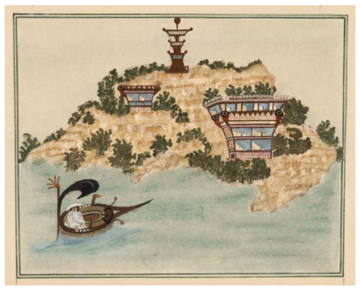
Martian landscape, painted by Hélène Smith, gouache and watercolor, 210 × 257 mm(1898). From Théodore Flournoy Papers, Bibliothèque de Genève.Théodore Flournoy, a Swiss professor of psychology who joined Smith’s séances and researched her over six years, described Smith’s experiences in his 1900 book *From India to the Planet Mars* (Princeton University Press, 1994). He attributed Smith’s experiences to autosuggestion and *cryptomnesia*, the resurfacing of latent memories and knowledge. Smith rejected Flournoy’s psychological reductionism, maintaining that she was not merely accessing hidden aspects of her mind but clairvoyantly projecting her cognition into foreign and extraterrestrial landscapes. Jung interpreted Smith’s experiences as manifestations of an unconscious, autonomous psychic entity; she channeled her animus and subjective complexes. Despite these analytical interpretations, Smith inspired the avant-garde art and literary Surrealism movement by demonstrating the power of the surreal and automatic writing to unlock extraordinary creativity from the unconscious mind.
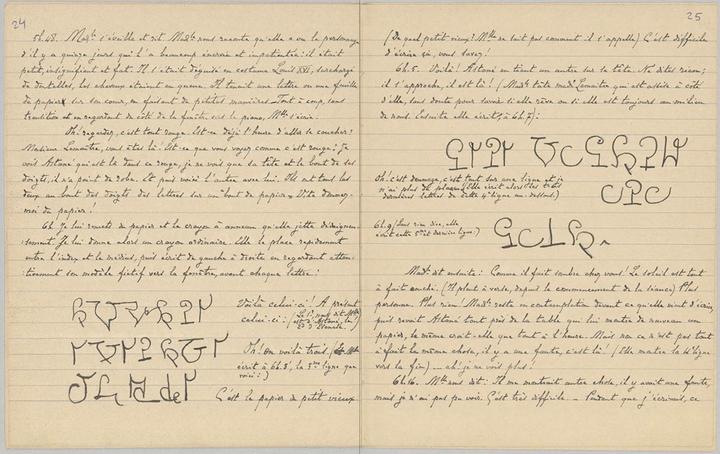
Martian Language. Procès-verbal (proceedings) of the séance on August 22, 1897. Image: Bibliothèque de Genève. The Martian text is also featured in “From India To The Planet Mars” as Fig. 21 with the caption: “First Martian text written by Mlle. Smith (according to a visual hallucination)…French notation—astane, esenale, pouze, mene simand, ini. mira.”Smith’s narratives about embodied interactions in extraterrestrial realms, suffused with sensory richness—sounds, smells, and tactile experiences—resonated with public and scientific imaginaries shaped by scientific breakthroughs and technological advancement. In 1877, the Italian astronomer Giovanni Schiaparelli observed “canals” on Mars, sparking fervent speculations about a technologically-advanced extraterrestrial civilization on the Red Planet. Mars’s canals mirrored terrestrial engineering feats such as the Suez Canal, completed in 1869.
Late nineteenth-century occult media facilitated the reception of new “disembodied” means of communication—telegraph, telephone, and radio—akin to occult, psychic transmissions at a distance. The Society for Psychical Research (SPR), founded in 1882, played a pivotal role by melding the mystical with the empirical, exploring the psychic and spiritual through a scientific lens. Psychologist Frederic Myers, an SPR founding member, coined the term “telepathy” to lend scientific credibility to the concept of mind reading by elucidating the phenomenon of remote thought transmission.
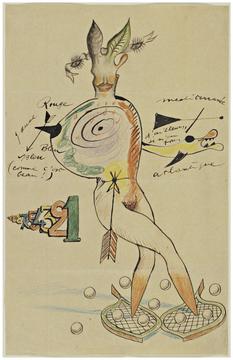
Nude, Cadavre Exquis (Exquisite Corpse)\* with Yves Tanguy, Joan Miró, Max Morise, Man Ray, 1926-27, Museum of Modern Art, New York, NY, USA. Smith’s embodiment of multiple personalities and languages questioned and expanded the understandings of human agency and intelligence, suggesting a multiplicity within the self that disrupts conventional anthropocentric views. Her séances, rich with performative and linguistic complexity, portrayed human cognition adapting to and navigating novel ontological landscapes. Today, Smith’s work anticipates key elements of emerging subjectivities in posthuman, digitally-mediated environments that require innovative theoretical frameworks to prioritize other-than-human agents, allow multiple displaced identities, and recompose the boundaries of the self transversally so that non-unitary subjectivity emerges on a planetary scale.
As art, science, and technology converge once more, Smith’s visionary narratives find renewed articulation. Artists like Jenna Sutela and Pierre Huyghe challenge conventional ideas about agency, intelligence, communication, language, and the self. Their work positions humans within the mentality of what the art historian Caroline A. Jones terms “symbiont,” encapsulating the interconnected and interdependent nature of life forms and challenging traditional existential philosophies that prioritize the individual.
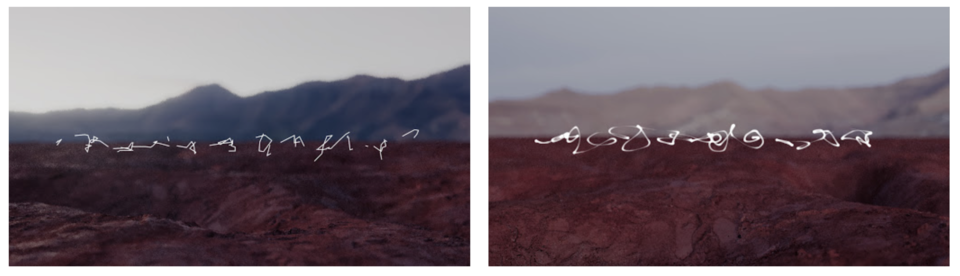
Screenshots from Jenna Sutela’s “nimiia cétiï” (2018). Image: https://experiments.withgoogle.com/nimiia-cetii. A neural network trained on Sutela’s voice, looked at each frame of the video and produced a short block of sound based on Smith’s glossopoetry matching that frame or the configuration of bacteria in it.Sutela’s “nimiia cétiï” (2018) explores the interaction between a neural network, a machine learning algorithm, and audio recordings of Smith’s Martian language combined with footage of the movement of Bacillus subtilis, a bacterium capable of surviving on Mars. The human medium is replaced by a “computer-shaman,” who channels messages from bacterial entities. Meanwhile, Huyghe’s “UUmwelt” (2018) replicates early SPR clinical experiments in telepathy by providing individuals with images and descriptions to visualize, capturing their brain activity via fMRI. A neural network then processes this data to reconstruct images displayed on LED screens responding rhythmically to the environmental conditions of the gallery.
These artworks speak to a world increasingly shaped by interconnected systems—ecological, technological, and social. While our own planet shakes, corporate technoscience envisions Mars as humans’ future planetary home, and commercial entities contrive to turn the moon into lunar gas stations. Smith’s story is a historical curiosity that is also a prescient model of distributed cognition; it conceives a relational consciousness interwoven with the fabric of the universe. If all matter participates in a shared existence, then art, science, and spirituality are not disparate but part of a unified endeavor to explore humanity’s collective potential intertwined with other-than-human agencies.
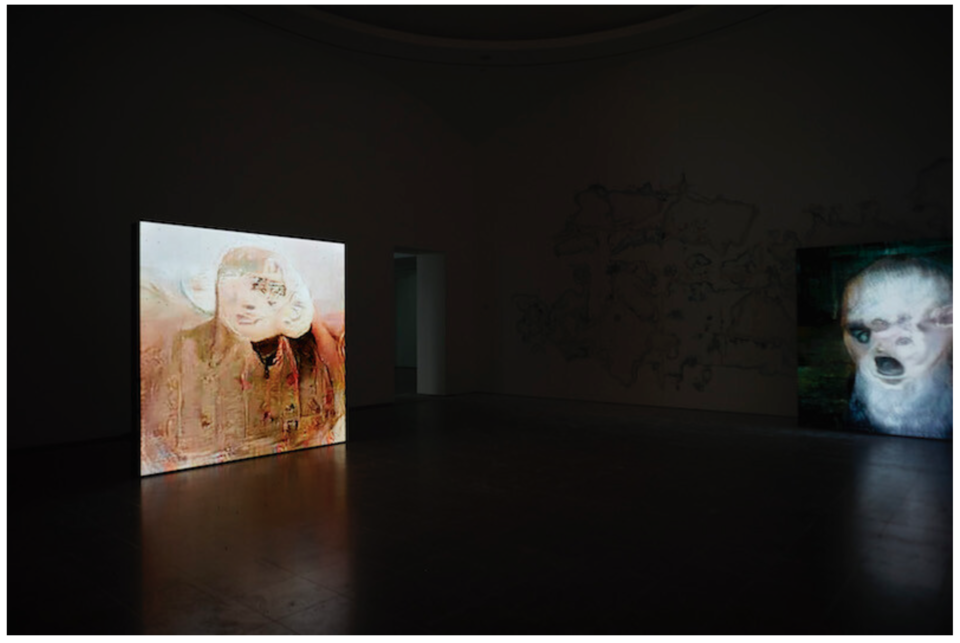
View of Pierre Huyghe’s “UUmwelt” at Serpentine Galleries, London, 2018. © Serpentine Galleries and the artist. Photo by Ola Rindal. The rhythm of the images is continuously modified by the physical conditions in the gallery; light-detecting sensors, temperature and humidity levels, and the presence of a community of flies all produce a feedback loop.---
\*Exquisite Corpse is a collaborative game and art technique invented by the Surrealists circa the 1920s, where participants sequentially contribute unseen drawn elements to a folded paper, creating an unexpected and surreal composition that taps into the collective subconscious.
References:
C. G. Jung. *History of Modern Psychology Lectures Delivered at ETH Zurich, Volume 1, 1933-1934*. Philemon Series. Oxfordshire: Princeton University Press, 2019.
Caroline A. Jones. “VIRIONS: THINKING THROUGH THE SCALE OF AGGREGATION.” *Artforum* (blog), May 1, 2020. .
Christopher Keep. “Life on Mars?: Helene Smith, Clairvoyance, and Occult Media.” *Journal of Victorian Culture : JVC* 25, no. 4 (2020): 537–52. .
Claudie Massicotte. *Hélène Smith: Occultism and the Discovery of the Unconscious*. 1st ed. OXFORD STU WESTERN ESOTERICISM SERIES. United Kingdom: Oxford University Press, 2023.
“Élise Müller, artiste médium, à la Bibliothèque de Genève | Exhibition Guide.” *2023*. Accessed March 3, 2025. .
Guy Mackinnon-Little. “In Conversation with Jenna Sutela.” *TANK Magazine*, 2019. .
Rosi Braidotti. *Posthuman Knowledge*. Cambridge, UK ; Medford, MA: Polity Press, 2019.
Théodore Flournoy. *From India to the Planet Mars: A Study of a Case of Somnambulism with Glossolalia*. New York, London: New York, 1900. .
See also:- [ Researcher Reflections ](/topic-tags/researcher-reflection)