# Seedbeds of Creativity: Superblooms and Superorganisms
February 13, 2025
By [Lisa Sideris](https://es.ucsb.edu/people/lisa-sideris) / edited by [Russell Powell](/people/russell-powell "Russell Powell")
> To open one’s mind to the mere existence of a superbloom shreds all kinds of narratives: the end of nature, the hopelessness of our times, the loss of wildness. – Thomas Ranier, “The Superbloom in an Age of Extinction”
California is a land of extremes. Often regarded as devoid of seasons, its climate, as the writer Joan Didion observed, is actually defined by a pendulum swing of “torrential subtropical rains” and “incendiary dryness.”[\[1\]](#_ftn1) In keeping with a principle that governs this region generally, nature’s destructive forces, unleashed through fire, flood, and earthquakes, also create the stunning landscapes for which California is justly famous.
Consider the superbloom. A superbloom is a relatively rare botanical event that occurs when monotonous beige and brown landscapes erupt in a vibrant, technicolor tapestry of wildflower blooms large enough to be seen from space. The phenomenon is associated with Southern California, although it occurs, somewhat less effusively, in Western South Africa, Chile, and Western Australia, all places characterized by wet-dry whiplash. “Superbloom” is not a scientific term, nor is there any objective measure for when a riotous profusion of flowers tips over into “super” status. You know it when you see it.
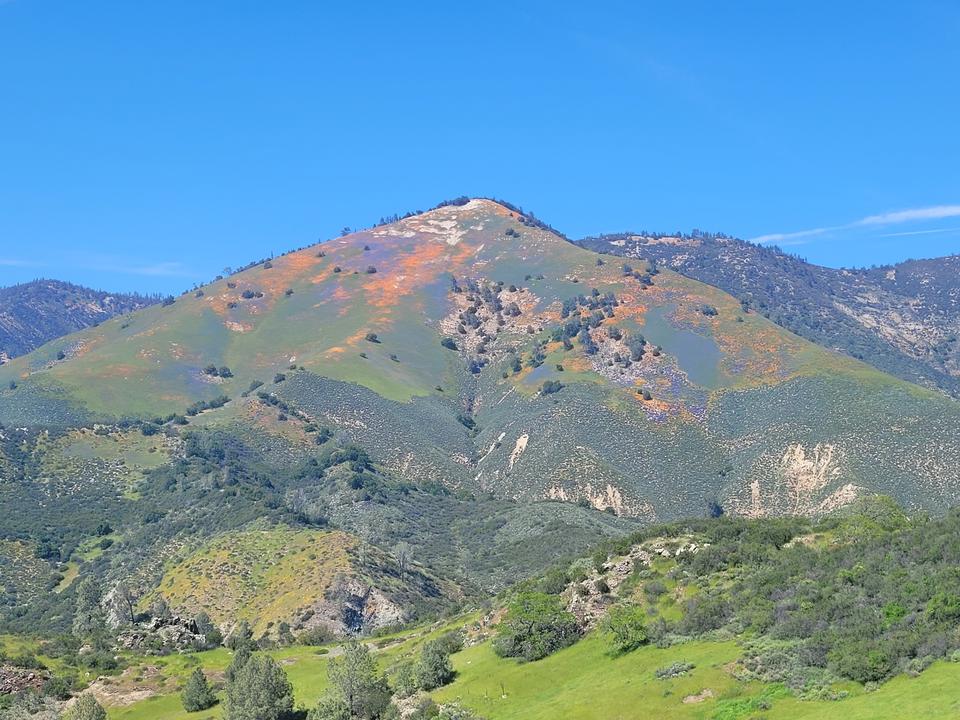
Photo courtesy of the authorClimatic extremes can favor superbloom dynamics, but there are limits to what even these well-adapted denizens can withstand. The basic recipe is years of drought followed by an excessively wet winter. Seasonal rains awaken the long-dormant seed banks that patiently bide their subterranean time, potentially for decades or even a century. Chemicals in the seed coat instruct the incipient plant not to germinate until conditions are ideal. Even then, the seed may choose to wait, heeding its own internal logic. Timing is all. Rains that arrive too early or too late, rains that violently swamp rather than steadily soak, will disrupt the superbloom magic. Wildfires can also spur a superbloom, returning nutrients to the soil and creating open, sunlit spaces. Dried remnants of a faded superbloom, in turn, become ready fuel for future fires. And on it goes.
John Muir, during his extensive travels on foot in the American West, reeled in astonishment at a vegetal “lake of pure sunshine, forty or fifty miles wide.” In a letter composed in July 1868, he pronounced the San Joaquin Valley “the floweriest piece of world I ever walked, one vast level, even flower-bed, a sheet of flowers.”[\[2\]](#_ftn1) Florida, he noted, might call itself the land of flowers, “but for every flower creature that dwells in its most delightsome places more than a hundred are living here,” in San Joaquin.
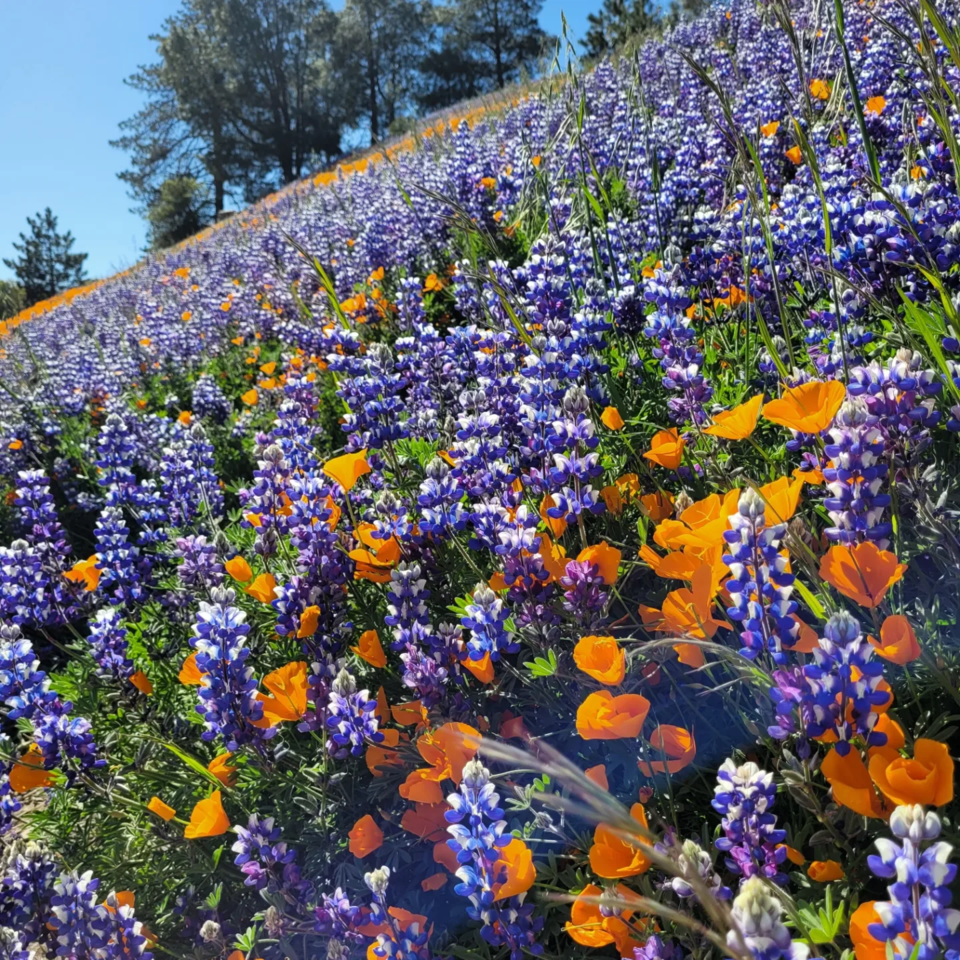
Photo courtesy of the authorI relocated to Santa Barbara from Bloomington, Indiana, in 2021. Despite spending most of my life in that Midwestern “haven of blooms,” I was unprepared for my first superbloom.
2021 was a relatively dry year with only a brief interlude of winter precipitation. Many, though not all, of the previous years had been bone-dry as well. But in 2022, California was lashed relentlessly with over 30 consecutive “atmospheric rivers.” (Because the calendar year bifurcates the winter rainy season, hydrologists cleverly devised the Water Year, which runs from Oct. 1 – Sept. 30). An atmospheric river is pretty much what it sounds like: a long column of persistent, concentrated moisture in the sky. The following year, more than 40 atmospheric rivers made landfall.
“It never rains in California,” as the song goes, “But girl, don’t they warn ya? It pours, man, it pours.”
That first wet winter brought a remarkable spring superbloom. But, despite nearly incessant (and to the human observer, nearly identical) bouts of rain, the subsequent year’s deluge yielded less than spectacular displays. The California poppy, the brilliant orange icon of the state, made a particularly poor showing that spring. The reasons for this are complex. Non-native (or “invasive”) plants tend to fare poorly in extended drought conditions compared to their native counterparts. Two consecutive years of rain gave invasive plants a foothold. Native wildflowers, meanwhile, may opt for dormancy even when conditions are right, deploying a tried-and-true strategy for survival in variable climates. That year, the poppies, in their infinite, inherited wisdom, demurred.
The ascription of mood and motive to plants—properties suggestive of agency—is not uncommon, even in the writings of hard-nosed scientists. The language of strategy, in particular, has a long history in evolutionary theory, often with an inordinate focus on the autonomous individual striving to outcompete other individuals in a zero-sum game. But the superbloom phenomenon suggests that the seed bank as a *whole*, comprised of up to 200 different species, acts as a buffer, a collective reservoir of strength and resilience, in the face of climate variability and the ever-present threat of invaders. As if to divide the labor and spoils, different wildflower species have precise, finely-tuned germination requirements. Under frequent conditions of water scarcity, they avoid competing with one another simultaneously. When the Water Year brings a bounty, the strategy pays off, and the group thrives as a whole.
Wildflowers are labeled an ephemeral species—a term for plants and animals whose lifespans may consist of a mere few weeks. But the fleeting, fragile beauty of the wildflower belies the stubborn persistence of the seed bank below. Ephemerality is an above-ground perspective.
As with other “super” phenomena in the natural world, reflection on superblooms can stretch the human imagination beyond a default preoccupation with individual organisms as the sole unit of interest or moral concern. The biological sciences have been repeatedly scandalized by encounters with meta- or superorganisms of various sorts. Some of these arrangements involve a single species, and others are multispecies affairs; all present a challenge to life as we once thought we knew it.
Insect colonies behave as superorganisms capable of swarm intelligence—distributed, decentralized behaviors that emerge at the level of the group. Flocks of birds and schools of fish exhibit “meta” levels of intelligent computation, moving together in unison, with no single individual in charge. Staghorn ferns, much like bees, appear to exhibit collective behaviors of eusociality, dividing up the labor of the plant colony. Scientists studying corals have come to understand them not as individuals but as symbiotic conglomerates, or holobionts, concepts pioneered by microbiologist Lynn Margulis to describe the assemblage of a host organism and associated species living in or around it. Efforts to save corals on the brink of extinction are better served by understanding them as complex superorganisms.[\[3\]](#_ftn1)
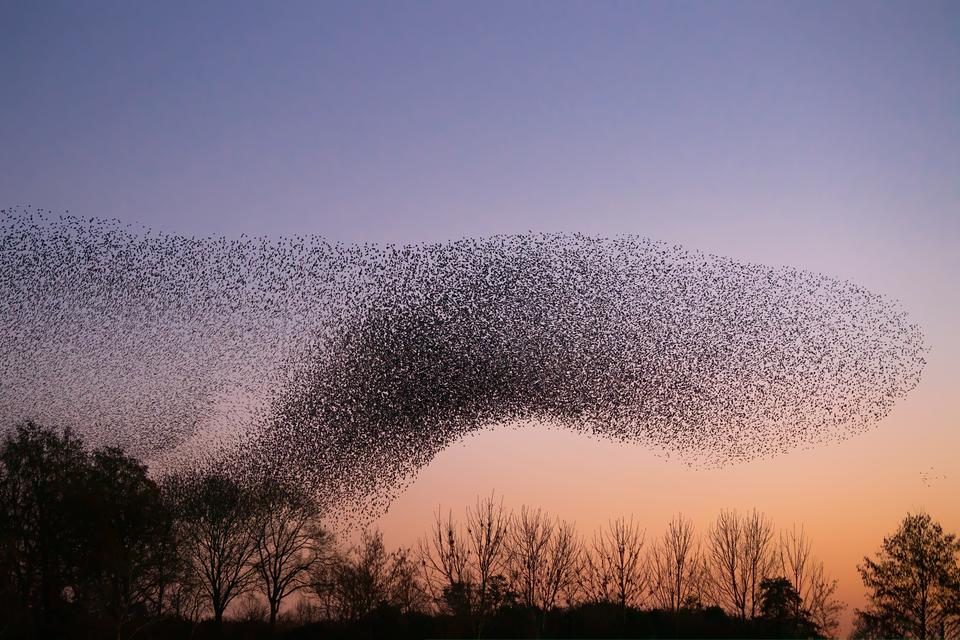
Bird Murmuration photo via Shutterstock (Stock Photo ID: 1930366580)Of course, superblooms are not, strictly speaking, superorganisms. Yet, they exhibit properties—not only breathtaking beauty, but also a kind of seasoned, distributed intelligence—that belong to the whole. Viewing superblooms in this light may inform efforts to preserve this rare natural wonder.
An analogy with migrating monarch butterflies is illuminating. A proposal to list monarchs as officially endangered is currently under consideration. But some scientists, and the U.S. Fish and Wildlife Service, argue that the imminent danger is to migration itself. Summer breeding grounds of monarchs show robust, healthy populations, but in overwintering sites, to which the butterflies migrate, we find alarming, precipitous declines. This puzzle presents many faces, but to my mind, it underscores the ethical challenge of valuing and preserving a collective behavior, a wondrous, epiphenomenal spectacle that arises mysteriously from the whole. The parts, meanwhile—pockets of monarchs thriving here and there across North America—may be less at risk of extinction than the cyclical pageant of migration.[\[4\]](#_ftn1) This shift in perspective has important practical implications for how best to protect monarchs.
By the same token, the superbloom as a collective, more than its component wildflower members, is the unit most vulnerable to endangerment. Like migrations, superblooms require both space and time to continue their forward procession. Humans have short memories and blinkered perception. Our steady encroachment—land development, suburban sprawl, and vast freeway infrastructure networks—all threaten to disrupt the superbloom’s conditional return. Both climate change and efforts to mitigate it place superblooms in the crosshairs: the perception of deserts as barren wasteland encourages the siting of [industrial-scale solar](https://caes.ucdavis.edu/news/solar-development-super-bloom-or-super-bust-desert-species) in delicate ecosystems where superblooms thrive. The invisibility of the seedbank and the rarity of superblooms make it easy to forget the richness that lies beneath our feet.
The disappearance of superblooms means the extinction of a broad network of communication, memory, and synchronized interactions. These diminishments are sometimes more difficult to reckon than the straightforward finality of species extinction. They leave in their wake what Willis Jenkins [calls](https://muse.jhu.edu/pub/3/edited_volume/book/115920) “a threadiness to Earth’s pulses of life, a spreading weedy sameness that crowds out seedbeds of creativity.”
What, then, does the super bloom demand of us? Since its inception, the concept of the superorganism—the holobiont, the symbiont—has symbolized mutualism and reciprocity—give and take.
Paradoxically, our irresistible attraction to superblooms often imperils them. “It takes a superbloom to make a superbloom,” as one report wisely observes.[\[5\]](#_ftn2) Damage inflicted on current blooms jeopardizes future generations. Wildflower tourism, fueled by social media influencers, brings a crush of spectators to superbloom sites, where flowers are collected or trampled by visitors impelled to possess and preserve some piece of this evanescent marvel. In 2019, Steve Manos, mayor of Lake Elsinore, CA, declared a “poppy apocalypse” as “Disney-sized” crowds of smartphone-brandishing tourists descended on his small desert town, clogging freeways, gouging hillsides, and mangling delicate flowers. Increasingly disconnected from nature, today’s visitors are “more extractive and domineering in the habitat” than in the past, says Evan Meyer, the director of the Theodore Payne Foundation for wildflowers and native plants.[\[6\]](#_ftn3) Visiting the blooms to gather social media posts is itself an extraction of value without giving in return.
My own photographs are evidence of this suspect impulse. In a small way, this essay is an effort to make amends for my extractivist zeal, to be more “reciprocal,” as Meyer advises. Reciprocity entails not just resisting the urge to destroy what we love but also striving to understand that beloved thing in all of its mind-opening dimensions. For the gift of wonder we receive, our response to the superbloom should be gratitude and informed care, not only for the flower immediately before us but for the mysterious, intangible whole it represents.
---

Lisa H. Sideris is Professor of Environmental Studies at UC Santa Barbara. Before coming to UCSB, she taught in the Religious Studies Department at Indiana University, the Faculty of Religious Studies and School of the Environment at McGill University in Montreal, and the Department of Philosophy and Religious Studies at Pace University in New York City. She teaches a variety of courses in environmental ethics, science and religion, and nature spirituality, as well as courses focused on the emerging ethical issues of the Anthropocene. She is author of *Environmental Ethics, Ecological Theology, and Natural Selection, and Consecrating Science: Wonder, Knowledge, and the Natural World*, and co-editor of a collection of interdisciplinary essays on the life and work of environmental pioneer *Rachel Carson, titled Rachel Carson: Legacy and Challenge.*
---
[\[1\]](#_ftnref1) Joan Didion, “The Santa Ana,” *Slouching Towards Bethlehem* (New York: Farrar, Straus, and Giroux, 1968).
[\[2\]](#_ftnref1) John Muir, “A Letter to Mrs. Carr, July 1868,” johnmuir.org, [https://www.johnmuir.org/walk/muir\_journal/IV.SJoachinValsyn.htm](https://www.johnmuir.org/walk/muir_journal/IV.SJoachinValsyn.htm).
[\[3\]](#_ftnref1) See Irus Braverman, *Coral Whisperers: Scientists on the Brink* (Berkeley, Cal.: University of California Press, 2018).
[\[4\]](#_ftnref1) Leigh Hataway, “The Monarch Butterfly Might not Be Endangered, but its Migration Is,” *UGA Today*, October 15, 2024 ().
[\[5\]](#_ftnref2) Corina Godoy, “Anatomy of the Superbloom,” *Mojave Desert Land Trust* (.).
[\[6\]](#_ftnref3) “The Dazzling, Troubling History of California Superbloom Tourism,” *The Guardian*, May 4, 2023 ().
See also:- [ Thinking with Plants and Fungi ](/programming-threads/thinking-plants-and-fungi)
- [ TWPF Blog Page ](/programming-threads/twpf-blog-page)